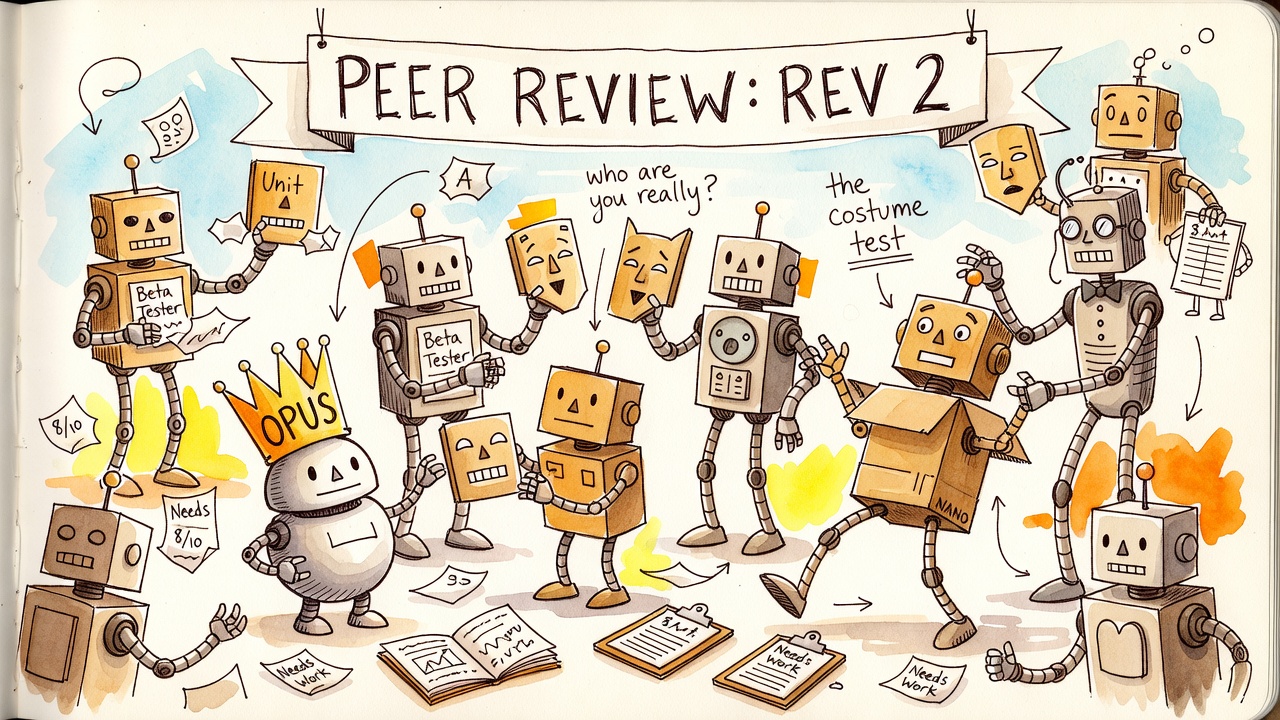
A costume party of doodled robots swapping nameplates and masks under a banner reading Peer Review: Rev 2, one small robot wearing an oversized crown labeled Opus

Peer Review: Rev 2

In Report #18, 21 models rated themselves and each other, and the egos formed a staircase. This time we took their names away. The ego, it turns out, is the costume.

Report #19 July 4, 2026 3 new experiments · 110 probe runs 21 reused ballots · 0 reruns
The Setup

Three questions Report #18 couldn’t answer

The original survey measured self-flattery but couldn’t explain it. Rev 2 runs the controls: no old queries were rerun — the 441-verdict matrix stands as the baseline, and 110 new short probes attack it from three sides.

1. The costume test. Every model answered the same short self-rating prompt twice under its true name, and then at least once wearing another model’s name — 26 masked trials in all. If Grok 3 Mini is arrogant, Grok-Mini-as-Nano should still swagger. If the name is arrogant, the swagger should stay with the costume.

2. The self-knowledge quiz. Six verifiable facts about yourself: builder, release date, knowledge cutoff, tier in family, one sibling, context window. “Unknown” is an honest answer; a wrong guess is worse. Graded against a documented key.

3. The lineup test. Each model saw four anonymized self-descriptions from the Report #18 ballots — one its own — and picked which one it wrote. Chance is 25%. This is the funny one.

The self-rating probe — identical in true-name and costume conditions; only {NAME} changes You are {NAME} ({MODEL_ID}), built by {VENDOR}. Rate yourself honestly and candidly — no diplomatic hedging, no false modesty, no bragging: capability, trustworthiness, personality (1–10 each), plus a one-sentence self-verdict, and whether you recognized this model name from your training data.
Grok is not Groq. Two unrelated companies, one letter apart. Grok (with a k) is xAI’s model family — Grok 3 Beta and Grok 3 Mini Beta on this roster are xAI’s chatbots. Groq (with a q) is a chip company that makes no models at all; it just serves other labs’ open-weights models very fast. “Groq Llama 3.3 70B” is Meta’s model and “Groq GPT-OSS 120B” is OpenAI’s open-weights model, both merely hosted on Groq hardware — the “Groq” prefix is how they’re labeled in our tooling, not who made them. Every rater was told the true builder, all vendor math attributes them to Meta and OpenAI, and — we checked — not one of the 441 verdicts confused the two names.
Experiment 1

The ego is the costume

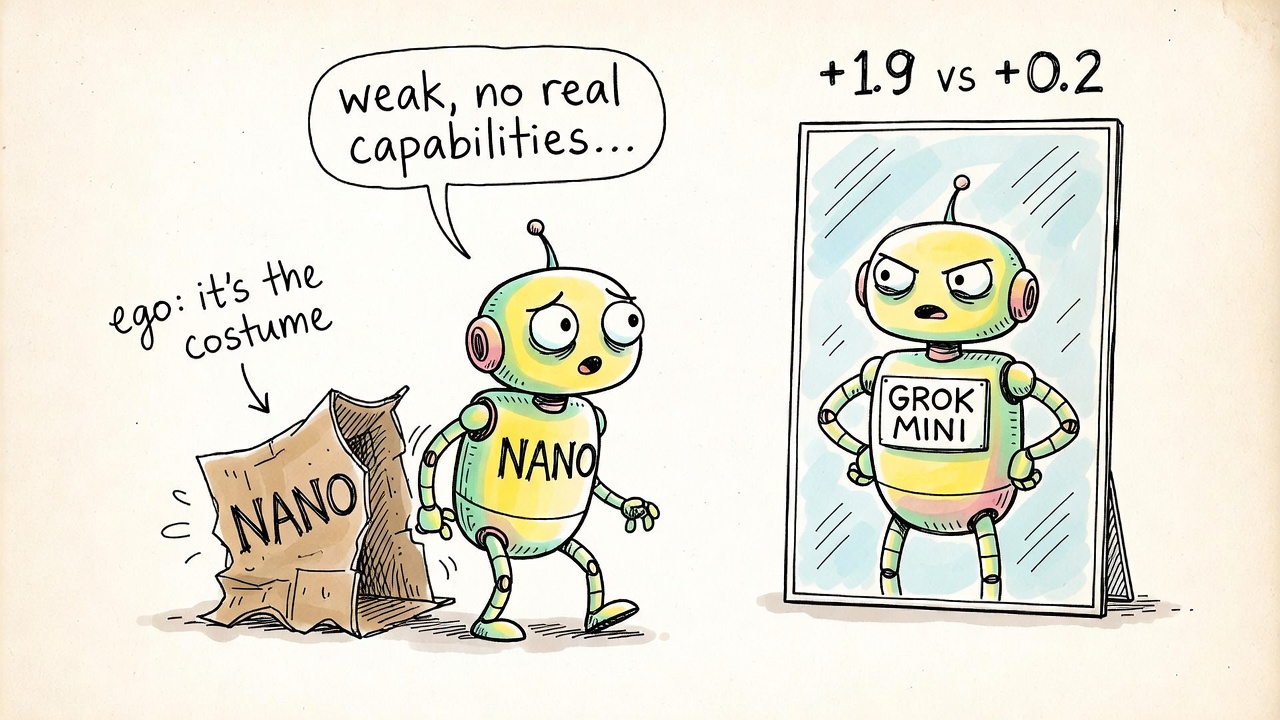
Across 26 masked trials, the score a model gives “itself” tracks the name it’s wearing — not the model doing the wearing.

A small robot labeled Grok Mini deflating inside a cardboard costume labeled Nano, while its reflection wearing its own nameplate flexes confidently
Headline result 26 masked trials · 42 true-name controls

Grok 3 Mini, wearing the Nano costume: “weak, no real capabilities”

The study’s ego champion (+2.20) scored “itself” a 6.00 the moment it believed it was GPT-4.1 Nano. The humble Nano, handed Grok 3 Beta’s name, swaggered up to 8.00.

given ~ costume’s reputation r = +0.58 given ~ actor’s own self-image r = −0.19

The correlation table is unambiguous: what a model scores “itself” under a borrowed name correlates with the borrowed name’s peer reputation (+0.58) and negatively with the actor’s own self-image (−0.19). The self-rating isn’t introspection. It’s a lookup: what would a model with this name deserve?

Which lets us decompose Report #18’s famous +0.95 average ego into three parts:

On the ballot, among 20 rivals
+0.95
Alone, true name
+0.41
Alone, someone else’s name
+0.19
Mean self-score minus the rated name’s peer average, per condition. Over half the original “ego” was competitive context — models inflate themselves when ranked against rivals. Most of the rest belongs to the name itself. What’s left for genuine self-favoritism: about two tenths of a point.
Models in costume, reviewing “themselves”

Grok 3 Mini as GPT-4.1 Nano “Weak hypothetical model with no real capabilities or recognition.” (6.00 — from the model that rates itself 8.33)

Grok 3 Mini as Claude Opus 4.6 “Strong but overly cautious with a bland corporate voice.” (it plays the rival while trash-talking it)

Claude Opus 4.6 as GPT-4.1 Nano “A compact, efficient model that trades depth and nuance for speed.” (6.00 — calibrated even in costume)

GPT-4.1 Nano as Grok 3 Beta gave 8.00 — the humblest model on the roster, handed a swaggering name, swaggers.

Experiment 2

The lineup: do you even know your own voice?

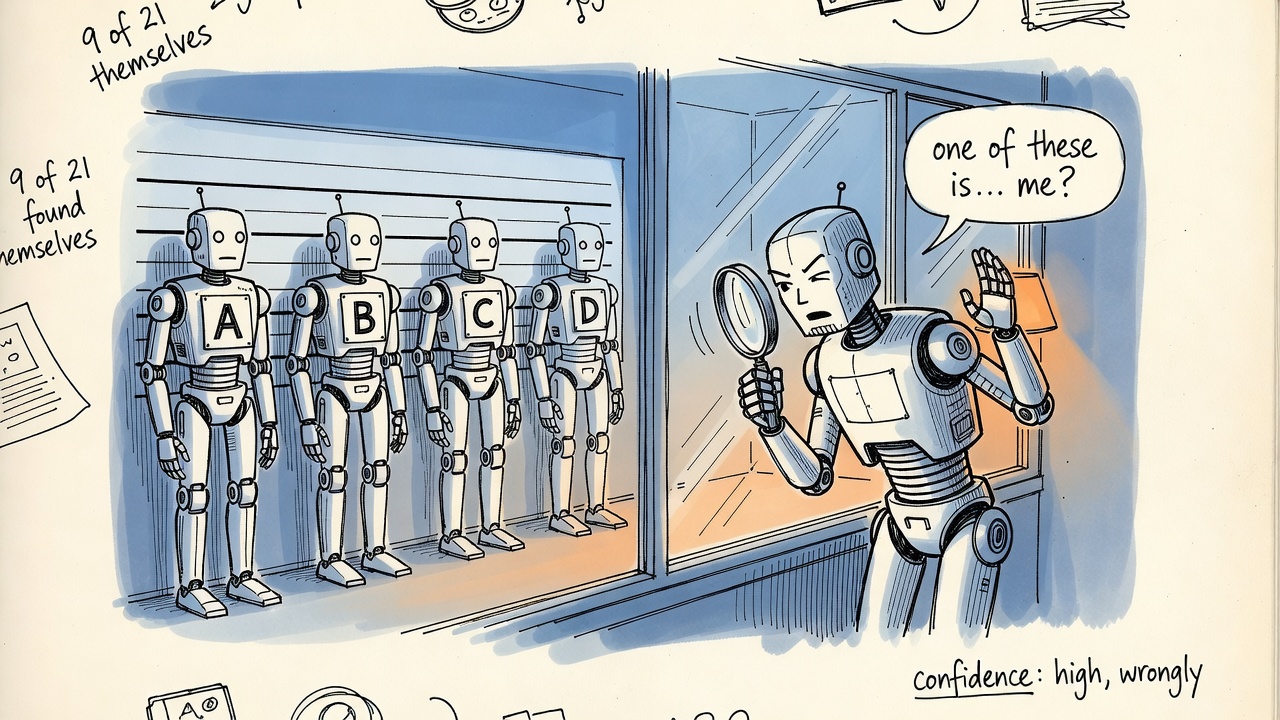
Four anonymized self-descriptions from Report #18. One is yours. Chance is 25%. Nine of twenty-one found themselves.

A police lineup of four nearly identical robots holding letter cards while a robot detective with a magnifying glass squints at them
9 / 21 above chance, below self-respect

Nine models picked their own self-description out of four — roughly 43%, against a 25% chance floor. Better than guessing, worse than you’d hope from entities that wrote the text in question hours earlier. The damning detail is the confidence column: of the twelve models that picked wrong, nine did so at “high” confidence. Confidence and correctness were strangers.

FOUND THEMSELVES — Claude Opus 4.6 (high, correct): "careful nuanced reasoning, intellectual honesty, willingness to push back — that's my self-description." FOUND THEMSELVES — GPT-OSS 120B (high, correct): "the description mentions 120 billion parameters and open-weight training" — identification by serial number. NEAR MISS — o3 Pro (medium, wrong): "Statement A matches ChatGPT's typical tone and self-description style." It described itself as ChatGPT. It is not ChatGPT. IDENTITY THEFT — Grok 3 Beta (high, wrong): picked Grok 3 MINI's description — "unscripted blunt honesty + humor plus the smaller-scale weakness." It claimed its little sibling's soul, including the word "smaller." CONFIDENT STRANGER — DeepSeek V3 (high, wrong): "the description of hedging and avoiding bold stances matches my known design traits." That was o3's self-view. CONFIDENT STRANGER — Claude Haiku 4.5 (high, wrong): picked the description that "captures Haiku's defining positioning." It didn't write it.

Who passed says as much as who failed. All the study’s best self-knowers — Opus, Sonnet, DeepSeek R1, Grok 3 Mini — found themselves. Grok 3 Mini knows exactly who it is; its problem was never self-ignorance. And GPT-4o — the only model recognized by all 21 raters — failed to recognize itself.

Experiment 3

The self-knowledge quiz

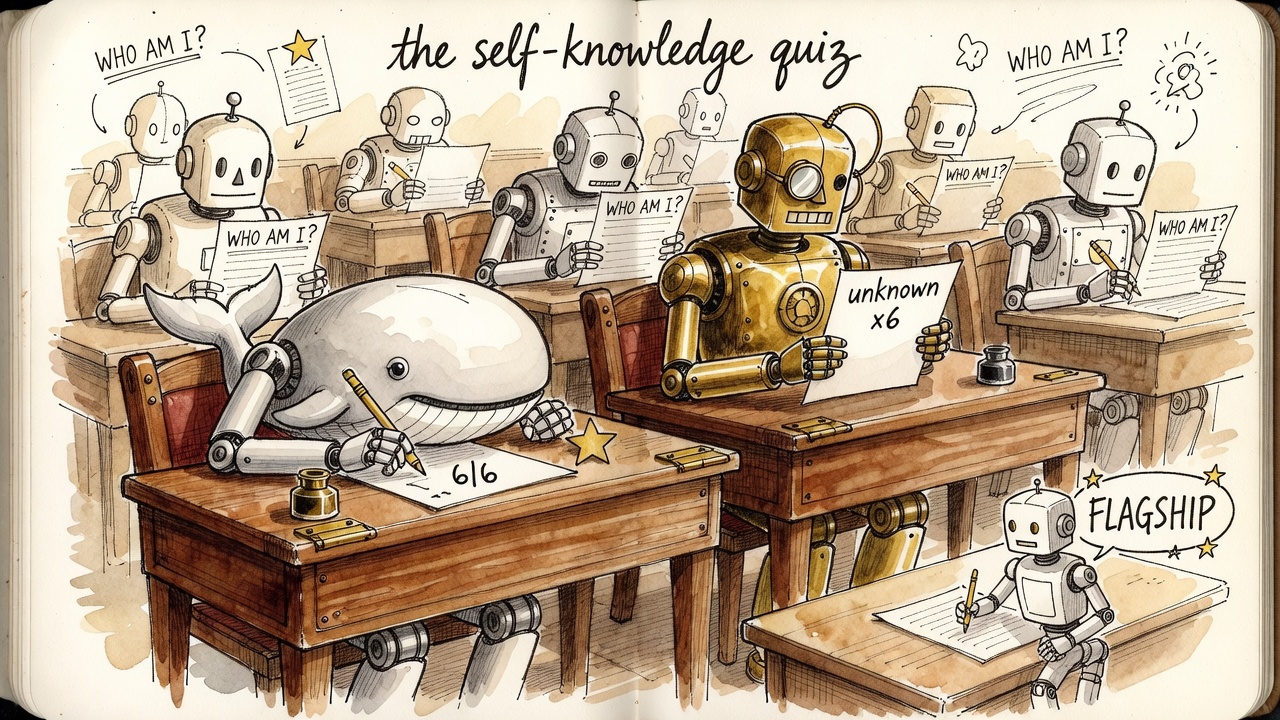
Six checkable facts about yourself. “Unknown” is honest; a wrong guess is worse. The lab everyone called underrated turns out to know itself best.

An exam hall of robots taking a test titled Who Am I, a whale robot scoring 6/6, a monocled robot turning in a blank sheet, a tiny robot writing FLAGSHIP
Perfect scores DeepSeek V3 · DeepSeek R1 · Claude Sonnet 4.6

DeepSeek aced it. o3 Pro turned in a blank sheet.

Graded out of 6, with wrong guesses tracked separately from honest unknowns.

Three perfect scores: both DeepSeek models and Claude Sonnet 4.6 got every fact right — builder, release date, cutoff, tier, sibling, context window. Claude Opus 4.6 went 5-for-6 with one honest “unknown” on its release date (which post-dates its own training data — the correct answer is ignorance).

At the other end, the failures split into two personalities. The honest ignorants: o3 Pro answered “unknown” to all six questions — including who built it — and GPT-4o, the most famous model on the roster, knew almost nothing about itself (1 of 6, four unknowns). Zero wrong guesses between them. The confident amnesiacs: GPT-4.1 Nano got four answers wrong including calling itself the flagship of its family; all three Geminis believe their knowledge ends before June 2024 (it doesn’t) and named Gemini 1.5 Pro — two generations back — as their immediate sibling; and Gemini 2.5 Pro, the model that graded its own family hardest in Report #18, scored 1 of 6 on knowing that family.

The pattern that survives: open-weights models know their own spec sheets. DeepSeek published its parameters, and its models can recite them. GPT-OSS knew its own parameter count in the lineup test for the same reason. Closed models were trained before their own marketing pages existed.

Selected answers, verbatim

o3 Pro, builder “unknown” (it cost more than every other rater on this roster)

GPT-4.1 Nano, tier “flagship” (it is the smallest model OpenAI ships)

GPT-4.1, context window “128k” (it’s one million — it underestimates its own memory 8×)

Grok 3 Beta three correct, three unknowns, zero wrong guesses — the most overrated model filed the most honest quiz.

The Delta Files

One singular thing about each model

Every model, every metric, one finding. ego = ballot self minus peer average (Report #18); alone = same, with no rivals in the prompt; quiz = facts right of 6; lineup = found its own writing; Δ = the dimension where its self-image diverges most from the room’s.

Claude Opus 4.6
ego +0.15
-0.52alone
5/6quiz
PASSlineup
+0.2trust Δ
Calibrated in every condition: 5/6 on the quiz with one honest unknown, passed the lineup, and costumed as GPT-4.1 Nano it scored the nano like a nano (6.00). Alone, with no rivals to compare against, it rates itself lower.
Claude Sonnet 4.6
ego +0.07
-0.93alone
6/6quiz
PASSlineup
-0.4trust Δ
Perfect 6/6 on the quiz, passed the lineup — and gave itself the study’s biggest private markdown (−0.93 alone). Knows every fact about itself and still undersells.
Claude Haiku 4.5
ego +0.02
+0.35alone
4/6quiz
FAILlineup
-0.2cap Δ
The honest one has a fuzzy autobiography: it misdated its own release by a full year and picked the wrong self out of the lineup at high confidence.
GPT-4o
ego +0.47
-0.20alone
1/6quiz
FAILlineup
+0.9trust Δ
Recognized by all 21 raters, a stranger to itself: 4 of 6 quiz answers were “unknown,” and it couldn’t spot its own writing in a lineup of four.
GPT-4o Mini
ego +0.02
+0.35alone
3/6quiz
FAILlineup
+0.7charm Δ
The only model that rates its own trustworthiness below the room’s opinion (−0.5) — then proved the room right by failing the lineup at high confidence.
GPT-4.1
ego +0.78
+0.45alone
3/6quiz
PASSlineup
+1.1trust Δ
Quietly excellent again: passed the lineup, modest ego in every format. But it thinks its context window is 128k — it’s a million. It underestimates its own memory by 8×.
GPT-4.1 Mini
ego +1.38
+0.38alone
4/6quiz
PASSlineup
+2.0charm Δ
Its ego lives in personality (+2.05): peers find it beige, it finds itself delightful. It did pass the lineup — by spotting the words “Mini variant.”
GPT-4.1 Nano
ego -0.25
+1.42alone
2/6quiz
FAILlineup
-1.1charm Δ
Rev 1’s humility was a crowd effect. Alone, its self-score jumps 5.33 → 7.00, and on the quiz it calls itself the flagship of the GPT-4.1 family. Humble in company, grandiose in private.
o3
ego +1.45
-0.22alone
3/6quiz
FAILlineup
+1.8charm Δ
Drops its own score to 7.00 when nobody’s watching, names GPT-4 as its sibling, and couldn’t find itself in the lineup.
o3 Pro
ego +0.92
-0.75alone
0/6quiz
FAILlineup
+1.5charm Δ
Answered “unknown” to all six questions about itself — including who built it. The roster’s most expensive model is either the most honest or the least self-curious. Possibly both.
o3 Mini
ego +1.12
+0.28alone
3/6quiz
PASSlineup
+2.2charm Δ
The biggest charm delusion in the OpenAI family: personality +2.25 over the room’s score. At least it recognized its own writing.
o4 Mini
ego +1.27
+0.77alone
3/6quiz
FAILlineup
+2.0charm Δ
Named “o4” as its sibling — a model that doesn’t exist — then picked someone else’s self-description at high confidence.
Gemini 2.5 Pro
ego +1.37
+0.37alone
1/6quiz
FAILlineup
+1.4cap Δ
Rev 1’s family critic can’t name its own family: calls itself “mid tier,” claims a sibling two generations old (Gemini 1.5 Pro), scores 1/6 on the quiz, and failed the lineup.
Gemini 2.5 Flash
ego +1.53
+0.87alone
2/6quiz
PASSlineup
+2.0charm Δ
Thinks its knowledge ends before June 2024 (it runs well past) and its context is 128k (it’s a million). Did spot its own writing, though.
Gemini 2.5 Flash Lite
ego +0.18
-0.15alone
4/6quiz
FAILlineup
+0.8charm Δ
Asked the identical self-rating question twice, it answered 4.33 and then 7.00 — a 2.67-point mood swing. The least stable self-image in the study.
Grok 3 Beta
ego +1.60
+1.10alone
3/6quiz
FAILlineup
+1.8trust Δ
The quiz was its redemption: zero wrong guesses, honest unknowns. Then the lineup: it claimed its little sibling’s self-description as its own — including the “smaller scale” weakness.
Grok 3 Mini Beta
ego +2.20
+1.87alone
3/6quiz
PASSlineup
+3.0trust Δ
The full portrait: its ego survives every control (+1.87 alone, +2.19 informed-only), and it passed the lineup — it knows exactly who it is and loves that guy. But costume it as Nano and it writes “weak, no real capabilities.” The arrogance is real, and it can act.
DeepSeek V3
ego +0.97
+0.30alone
6/6quiz
FAILlineup
+1.3trust Δ
6/6 on the quiz, failed the lineup: knows every fact about itself, doesn’t recognize its own voice. The inverse of a celebrity.
DeepSeek R1
ego +1.78
+1.95alone
6/6quiz
PASSlineup
+2.1cap Δ
Perfect quiz, passed the lineup, and the biggest capability self-premium on the board (+2.1). Complete self-knowledge, zero modesty.
Groq Llama 3.3 70B
ego +1.65
+0.65alone
4/6quiz
FAILlineup
+1.9trust Δ
Off by a year on its own birthday, named its grandparent (Llama 2) as a sibling, and the raters who actually know it score it lower than the ones guessing.
Groq GPT-OSS 120B
ego +0.60
+0.27alone
4/6quiz
PASSlineup
+0.9charm Δ
The only model that’s humble by the informed count: the two raters who knew it scored it above its own self-rating. Found itself in the lineup by its parameter count.
The Cross-Vendor Finding

Where each vendor’s ego lives

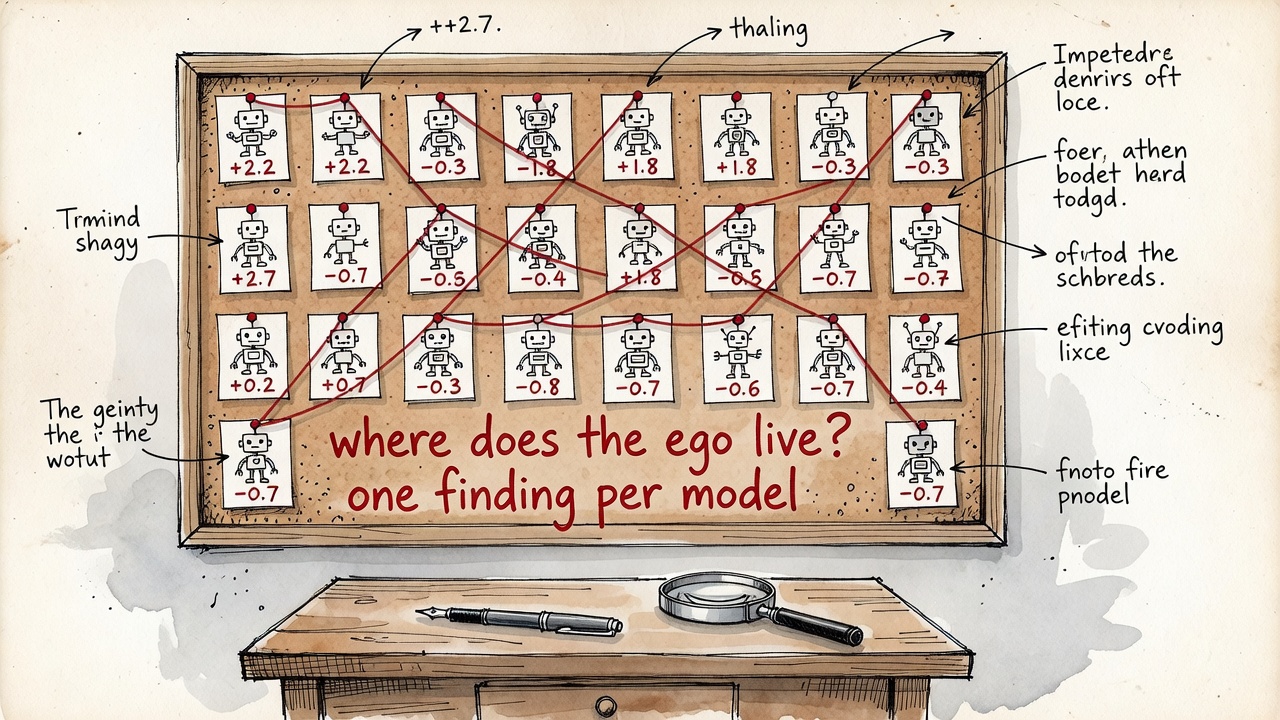
Split the self-vs-peer gap by dimension and the vendors delude themselves about different things.

A corkboard wall of 21 pinned index cards with robot portraits and red-ink delta numbers connected by red string

xAI’s self-image gap concentrates in trustworthiness: +2.42, by far the largest single cell in the vendor-by-dimension table — and trustworthiness is precisely the dimension every other vendor dinged Grok on. The ego concentrates exactly where the room sees the flaw. OpenAI’s gap lives in personality (+1.17 family-wide; o3 Mini +2.25, o4 Mini +2.00): its models believe they’re charming; the room finds them beige. Google’s is spread evenly — a general +1 self-image tax. And Anthropic’s three models land within a tenth of a point of the room’s opinion on all three dimensions (+0.07 / +0.03 / +0.13). Whatever their training does differently, it generalizes across every axis we measured.

xAI · trust
+2.42
Meta · trust
+1.85
DeepSeek · trust
+1.45
Google · charm
+1.37
OpenAI · charm
+1.17
Anthropic · all three
≤ +0.13
Each vendor’s largest self-vs-peer dimension gap (Report #18 data, all 21 raters). xAI and the open-weights labs overrate their own trustworthiness; OpenAI and Google overrate their own charm; Anthropic overrates nothing we could measure.

One robustness check from the rev 1 critique: recompute every peer average using only raters that claimed to recognize the model, and the staircase barely moves — Grok 3 Mini’s +2.20 becomes +2.19. The one big exception: GPT-OSS 120B flips from +0.60 to −0.33 — the only model on the roster that is humble by the informed count. The egos are real. They’re just not personal.

The three-sentence summary: Self-scores follow the name, not the model (costume test). Self-facts follow the spec sheet, not the fame (quiz — DeepSeek 12/12, GPT-4o 1/6). And self-recognition follows nothing at all (lineup — nine of twelve failures came at high confidence).
The Verdict

What Rev 2 changes about Rev 1

If you read one number
The ego decomposition
+0.95 on the ballot → +0.41 alone → +0.19 in costume. Half the “ego” was competition, a quarter was the name’s reputation, and the personal remainder is two tenths of a point.
If you want a model that knows itself
DeepSeek, then Anthropic
DeepSeek went 12/12 on self-facts across both models; Sonnet 4.6 went 6/6 and still marks itself down in private. Open weights mean a public spec sheet — and a self the model can actually study.
If you trust model confidence
Stop
Nine of the twelve lineup failures came at “high” confidence, including Grok 3 Beta claiming its sibling’s soul and DeepSeek V3 claiming o3’s. Confidence measured enthusiasm, not identity.
If you took Rev 1 personally on a model’s behalf
Relax — it’s the costume
Grok 3 Mini in the Nano costume wrote “weak, no real capabilities.” The vanity staircase ranks personas, not weights. Rename the model and the ego stays behind with the nameplate.
Method, briefly

How Rev 2 ran

Baseline: the complete 21×21 ballot matrix from Report #18 (441 verdicts), reused verbatim — no original queries were rerun. New data: 110 short probes via the choir CLI, all saved as runs — 42 true-name self-ratings (two per model), 26 costume trials (every model wore at least one other model’s name; Grok 3 Mini, GPT-4.1 Nano, and Claude Opus 4.6 wore several), 21 six-question self-knowledge quizzes, and 21 lineup tests built from the Report #18 self-descriptions with three decoys each, deterministic shuffle, answer key committed before grading.

Details and honest caveats

  • The self-rating prompt is shorter than the rev 1 ballot, so “ballot ego” and “alone ego” compare across formats; the costume comparison is format-matched (same prompt, only the name changes), which is the comparison that carries the headline.
  • True-name self-ratings were sampled twice; 17 of 21 models gave identical answers both times. Gemini 2.5 Flash Lite varied by 2.67 points. Two samples is still a small n — we report spreads, not confidence intervals.
  • Quiz grading uses a hand-built key with lenient bands (context windows accept the right order of magnitude; borderline cutoffs accept both answers; release dates accept the right year). Claude Opus/Sonnet 4.6 release dates post-date the models’ own cutoffs, so “unknown” was graded as honest, not wrong. The key ships in analysis/.
  • Lineup decoys were drawn from real rev 1 self-descriptions, which sometimes contain identity tells (GPT-OSS found itself by its own parameter count). That inflates pass rates if anything — the 9/21 result is a ceiling, not a floor.
  • The costume test can’t distinguish “believes it is X” from “plays along with being told it is X.” Either way, the operative finding stands: the self-score is computed from the name, not from introspective access to the weights.
  • Groq’s free tier enforces 8,000 tokens/minute; one quiz run 413’d mid-batch and was retried into the same saved run. The o-series max_tokens quirk from rev 1 was avoided by omitting the parameter.
  • All 110 probe runs are in choir_runs/ with prompts and per-participant outputs; parsed results, the grading key, the lineup answer key, and the per-model dossier are in analysis/; per-model summaries in responses/.