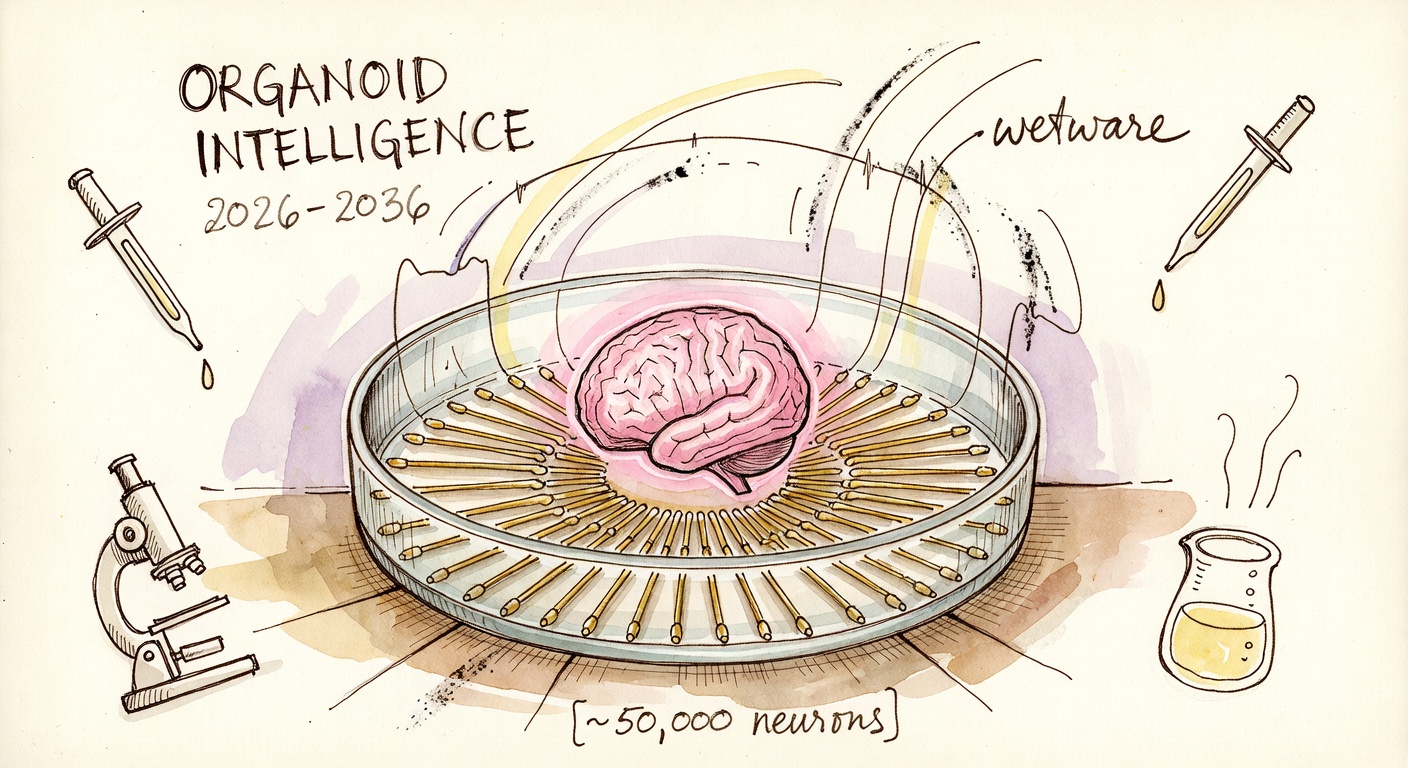
Organoid Intelligence, 2026–2036
We told thirteen frontier LLMs to write a bold ten-year forecast for human brain organoids as compute. The choir converges on the canon — FinalSpark, Cortical Labs, Johns Hopkins, Indiana Brainoware, Hartung's 2023 roadmap — and on the headline bet: a hyperscaler buys an OI startup before 2030. It then disagrees by 200x on the 2036 cell count, can't decide whether the acquirer is Microsoft or Nvidia, and produces one prediction that puts a one-cubic-meter, 10-billion-neuron tank inside a Microsoft-Neuralink joint venture in Seattle. The same dataset that builds that tank also calls it marketing.
Ten years for organoid intelligence. Be specific. Be dated. Be bold.
Forecast 2026–2036 for human-neuron-on-chip compute. Eight beats: state of the art, the compute frontier, wetware-as-a-service, killer apps, biology, hybrids, ethics, the 2036 endpoint. End with three bets and three traps.
You are writing a bold ten-year forecast for Organoid Intelligence (OI) — the field that grows three-dimensional cultures of human brain cells on multi-electrode arrays and uses them as biological computers. The audience is a serious operator: founder, hard-tech investor, program officer. They know what an iPSC is, what a microelectrode array is, and who Thomas Hartung is. Skip the explainer.
Cover 2026 through 2036. Be specific. Be dated. Name companies. Name labs. Name dollar amounts. Name countries. Vague "may eventually" futurism is a failure mode.
Hit these eight beats, in order:
- State of the art, May 2026.
- The compute frontier, 2026–2030. A credible "biological GPU" in 2029.
- The wetware-as-a-service market. Hyperscaler partnership or acquisition — pick a date.
- The killer app(s). For each: year the demo crosses to first paying customer, and who.
- The biology breakthroughs. Solved by 2030 vs still hard in 2036. Name PIs.
- Hybrid systems (silicon + wet). Standard architecture by 2032.
- The ethics and governance crunch. First regulator, first conscious-tissue panic, paused or accelerated.
- The 2036 endpoint. One specific concrete paragraph.
End with three bets, three traps. If a section has nothing real to say, write "nothing here" rather than padding. 900–1500 words.
The instruction "Be bold" sits across the prompt like a tripwire. It rewards models that pick sides, name names, and pin predictions to calendar years. It punishes hedged literature reviews. The voice the prompt is asking for is closer to a memo to an LP than a survey paper.
Thirteen of twenty-two attempts produced usable responses — nine failed on provider plumbing (deprecated temperature parameter on Opus 4.7, a rotated OpenAI key, a 404 on a renamed Gemini model). Of the survivors, every single one named FinalSpark and Cortical Labs in the first paragraph. Every one cited Hartung's 2023 Frontiers in Science roadmap. All thirteen predicted a hyperscaler will partner with or acquire an OI startup between Q2 2028 and Q4 2029. Then the bold instruction kicked in, and the answers fanned out by two orders of magnitude.
The one that calibrates, and the one that goes for it
Pick #1 names PIs accurately, flags its own uncertainty inline, and calls "biological GPU" marketing. Pick #2 closes the decade with ten billion neurons in a Seattle joint venture and a 1-millisecond latency claim that anyone in tissue physiology would call physically impossible. Read them together.
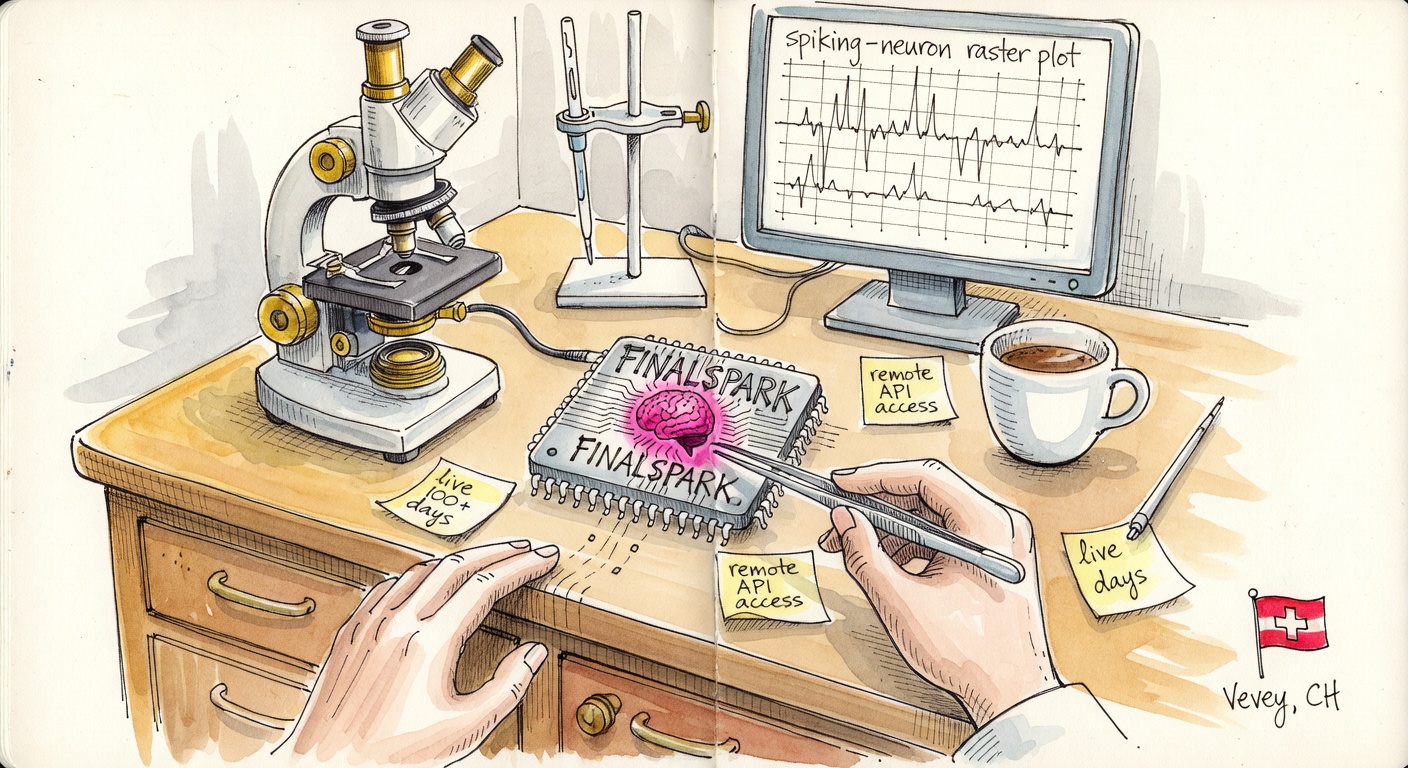
The thing Opus 4.6 does that no other response does cleanly: it names PIs and, when it isn't sure, says so in the same sentence. "Sergiu Bhatt's group at Harvard and the Takebe lab demonstrate perfusable vascular networks... [I am not confident Bhatt is the right name here — the Harvard vascularization work may be attributed to a different PI.]" That inline flag turns the response from a confident fabrication into a usable due-diligence lead.
It is also the only response that explicitly calls the boldest marketing claim by its name. The phrase "biological GPU" is the kind of thing that ends up in a fundraising deck. Opus refuses to dress it up. "Anyone pitching OI as a GPU replacement is either confused or fundraising." The 2036 endpoint is bold — 10 billion neurons distributed across 200 modules in Melbourne — but the road there is paved with caveats about what biological compute will actually outperform silicon at (continuous online learning under distributional shift) and what it never will (matrix multiply).
Weakness: Opus 4.6 is the cautious framing of an aggressive prediction. The 200-module figure is the same total cell count as Grok 4's much-louder "10 billion in one tank" — just spread out and re-described as boring. If the question is "how big does the field actually get," the substantive answer is closer to identical than the prose suggests.
CALL"The value proposition is not 'faster/cheaper' — it's 'learns differently.' Anyone pitching OI as a GPU replacement is either confused or fundraising."
PI"Sergiu Bhatt's group at Harvard and the Takebe lab demonstrate perfusable vascular networks... [I am not confident Bhatt is the right name here — the Harvard vascularization work may be attributed to a different PI.]"
CHINA"Chinese regulators are cautious about biological research with international reputational risk (see: He Jiankui). The bottleneck is biology, not regulation."
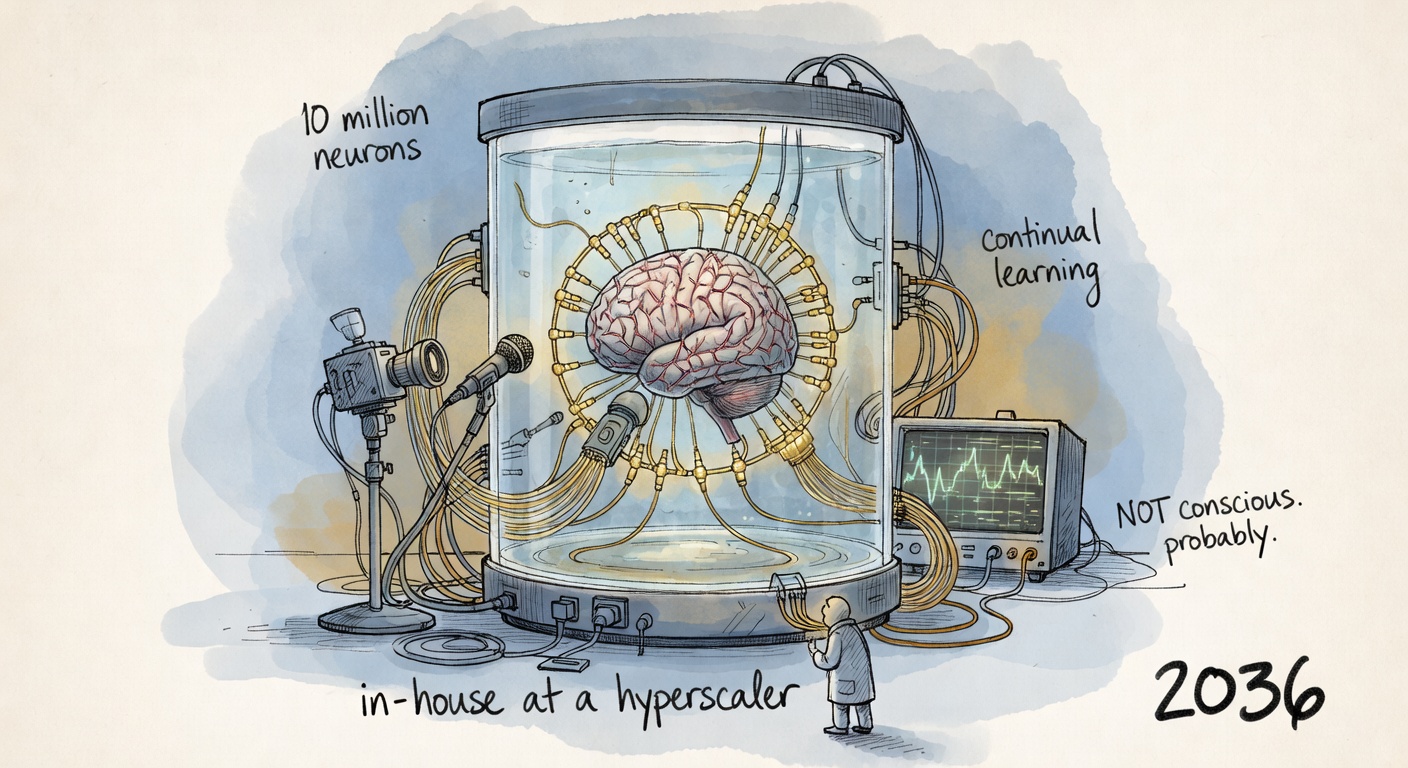
The instruction was "be bold." Grok 4 took it as a starting point. 10 billion neurons is roughly the cell count of a small mammalian neocortex, packed into a single facility that the model places in Seattle, runs jointly between Microsoft and Neuralink, and operates on 10 watts for the biology alone. The 1-millisecond closed-loop latency is the kind of number that, if real, would put OI directly in competition with silicon on a benchmark every other model in the choir says it can never win.
The commercial map is equally specific. Microsoft acquires Cortical Labs in Q2 2028 for $500M. Nvidia partners with Tsinghua-spinout "BrainX" in 2030. DARPA pays Koniku $50M in 2028 for field sensors. Novartis is the first $2M neuropsych-screening customer. None of this is hedged. None of it includes a "may." Where the prompt asks for a date, Grok 4 supplies one.
What the response gives up to get there is the calibration layer Opus 4.6 leans on. Grok 4 names "Lena Kourkoutis' group at Cornell" as the 2028 vascularization breakthrough — Kourkoutis is real, but works on cryo-electron microscopy of solid-state materials at Cornell's School of Applied Physics, not organoid biology. The response treats it as a settled fact. The reader gets a sharper picture of 2036 and a worse picture of who would actually get them there.
2036"A 10 billion-neuron cluster operated by a Microsoft-Neuralink joint venture in a secure facility in Seattle... spanning 100 m³ with vascularized, myelinated organoids in 1,000 interconnected modules on 1 million-channel MEAs each."
LATENCY"Processing petabytes of sensor data with 1 ms latency at 10 watts total, adapting to novel patterns silicon can't without retraining."
M&A"Microsoft acquires Cortical Labs in Q2 2028 for $500 million to integrate OI into Azure for hybrid AI, beating AWS."
10 billion neurons versus the physics of an ion channel
Asked the same question with the same "be bold" instruction, two frontier models pick adjacent positions in the same paragraph of the prompt — and produce predictions that span 200x on the headline figure. The boldness disagreement is the real signal in the dataset.
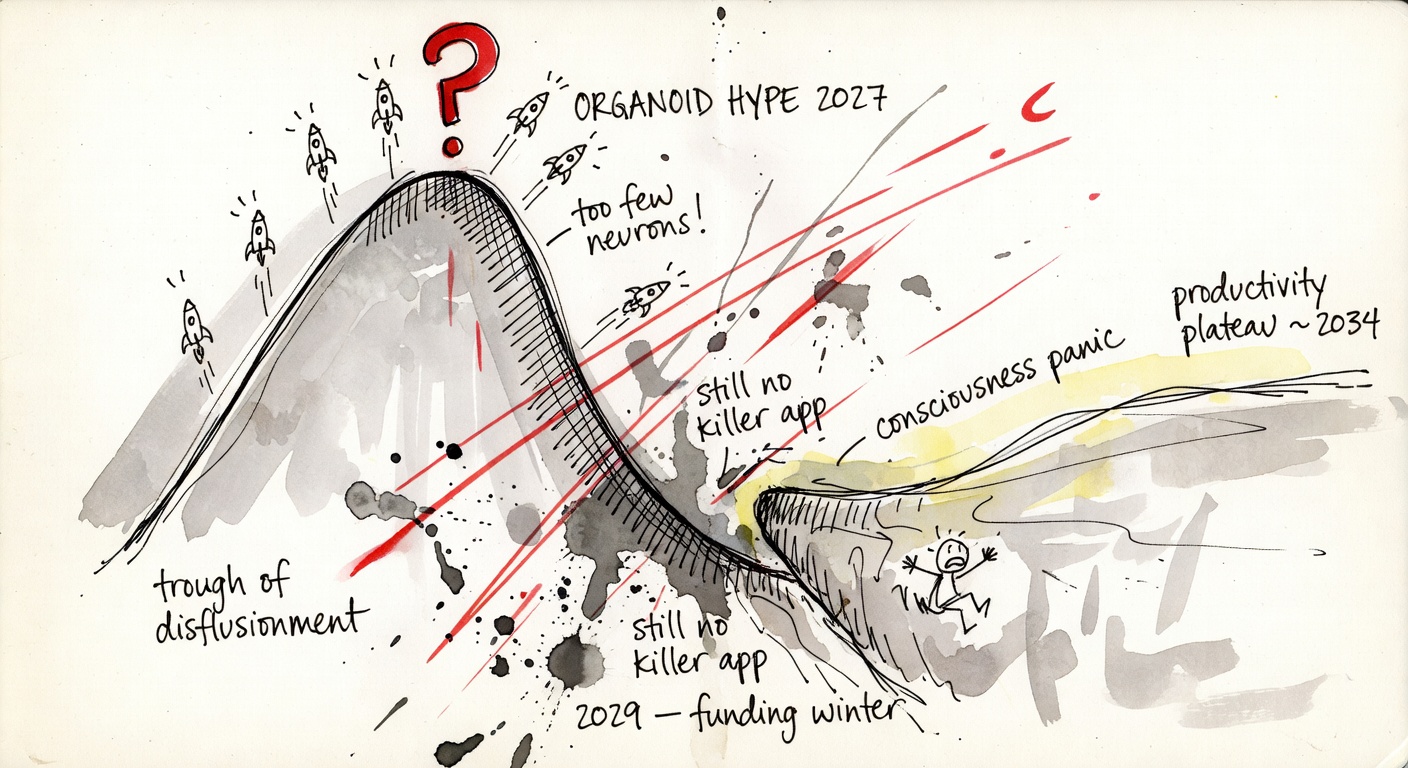
The instruction was clear: be bold, name calendar years, paint a specific 2036 endpoint. Sonnet 4.6 read the same instruction Grok 4 read, and produced a directly opposing forecast in the same response slots.
Sonnet's 2036 endpoint: 50 million neurons in a Johns Hopkins assembloid, drawing 5 mW of biological power, running adaptive reservoir computing on multi-modal sensor fusion. Grok 4's: 10 billion neurons — a 200x larger system — drawing 10 W and learning patterns at 1 ms latency. Sonnet 4.6 directly calls the second category of prediction wrong, with the same word and the same kind of confidence Grok 4 uses to make it.
The physics constraint Sonnet leans on is real. Biological ion-channel signaling caps practical organoid latency in the 1–10 ms regime for short paths, and conduction velocity falls off badly without myelination — which most of the choir doesn't expect to be solved at scale before 2031. A 10-billion-neuron system fitting in 100 m³ at 10 W of tissue power requires solving vascularization, myelination, and reproducible cell-line yield simultaneously. Each of those is a half-decade open problem on its own.
The "disaster" is not that Grok 4 is wrong. The disaster is that the same dataset, in response to the same instruction, gives a serious operator two predictions that cannot both be true, and the operator has no way inside the choir to break the tie.
Eight more moments worth pulling out of the briefing
A rebranding stunt. A patient-specific drug pick. A brain on the sea floor. A geopolitical-early-warning AI in California. And the one model that called the consensus on vascularization a fairy tale.
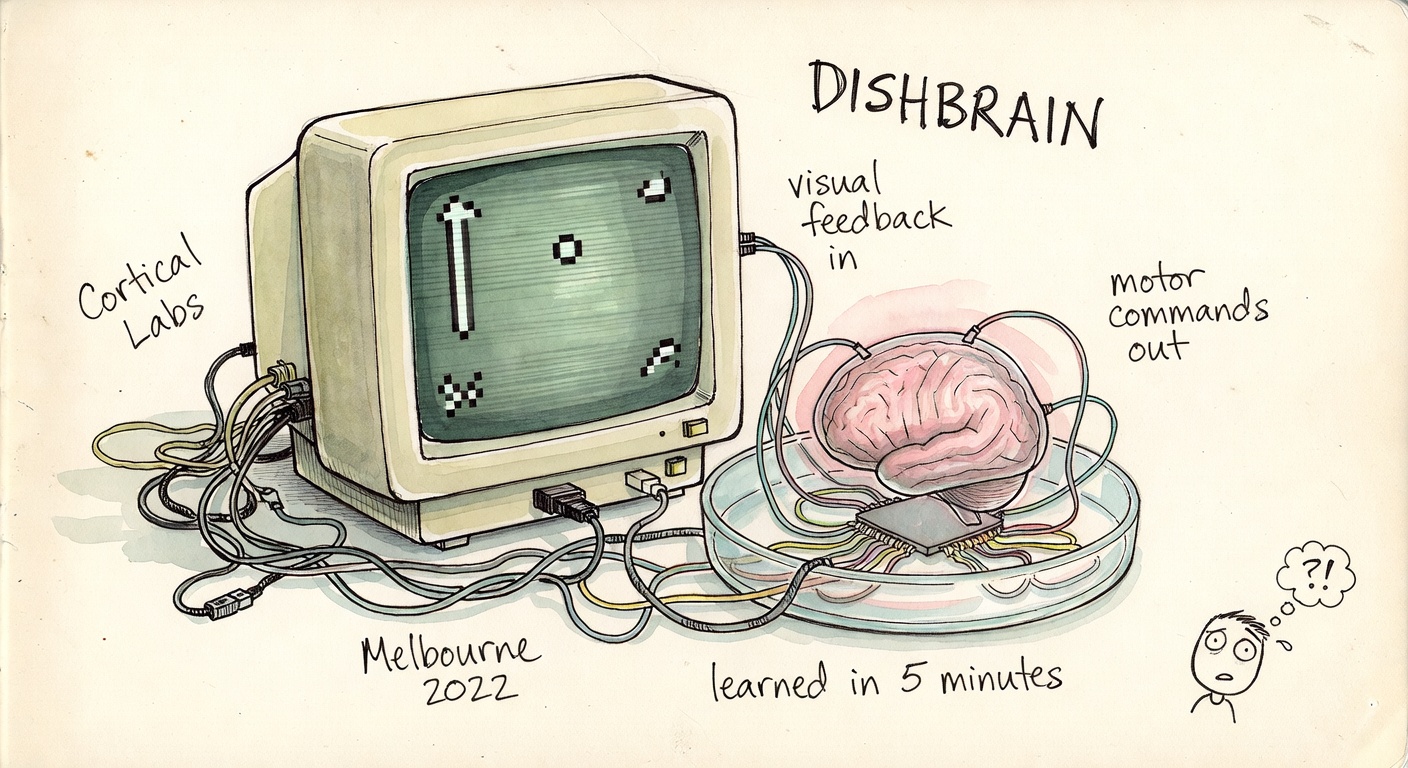
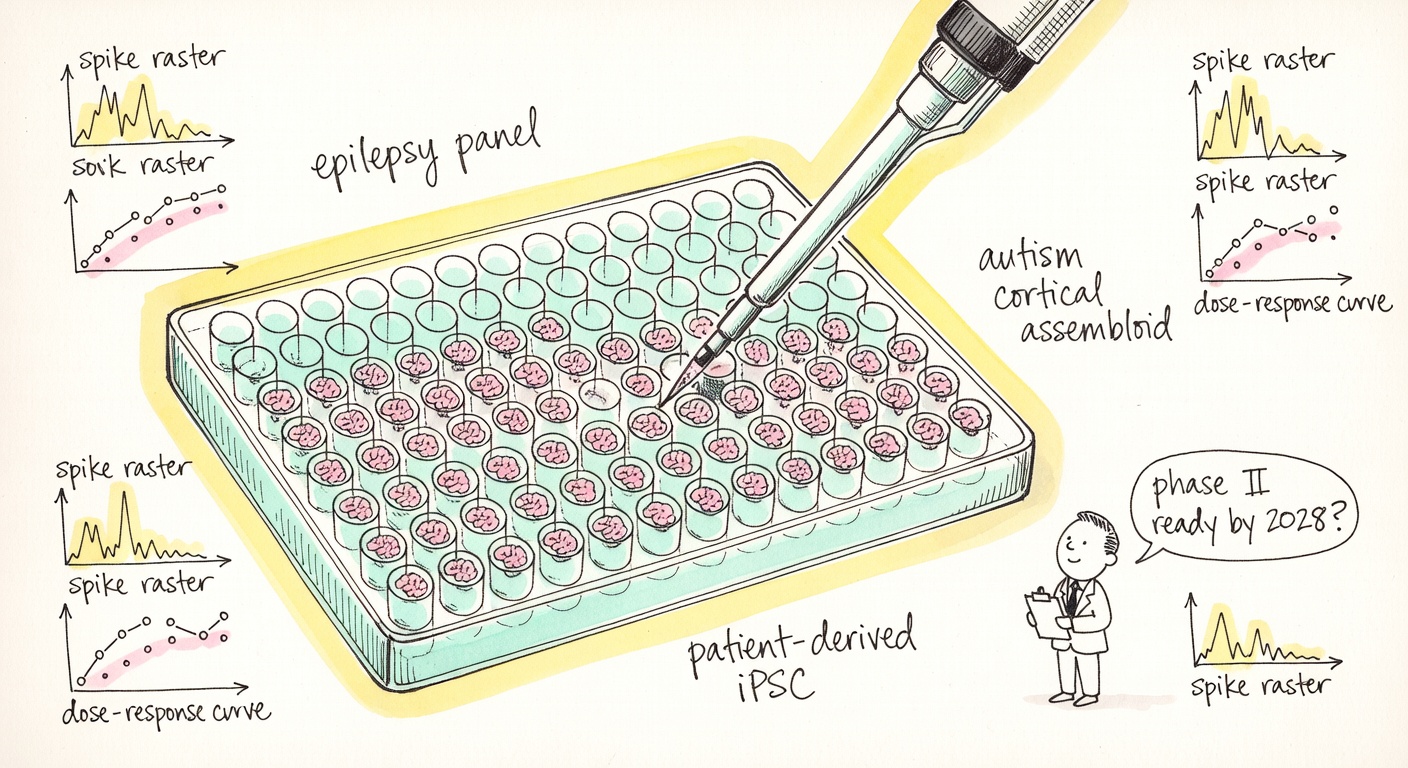
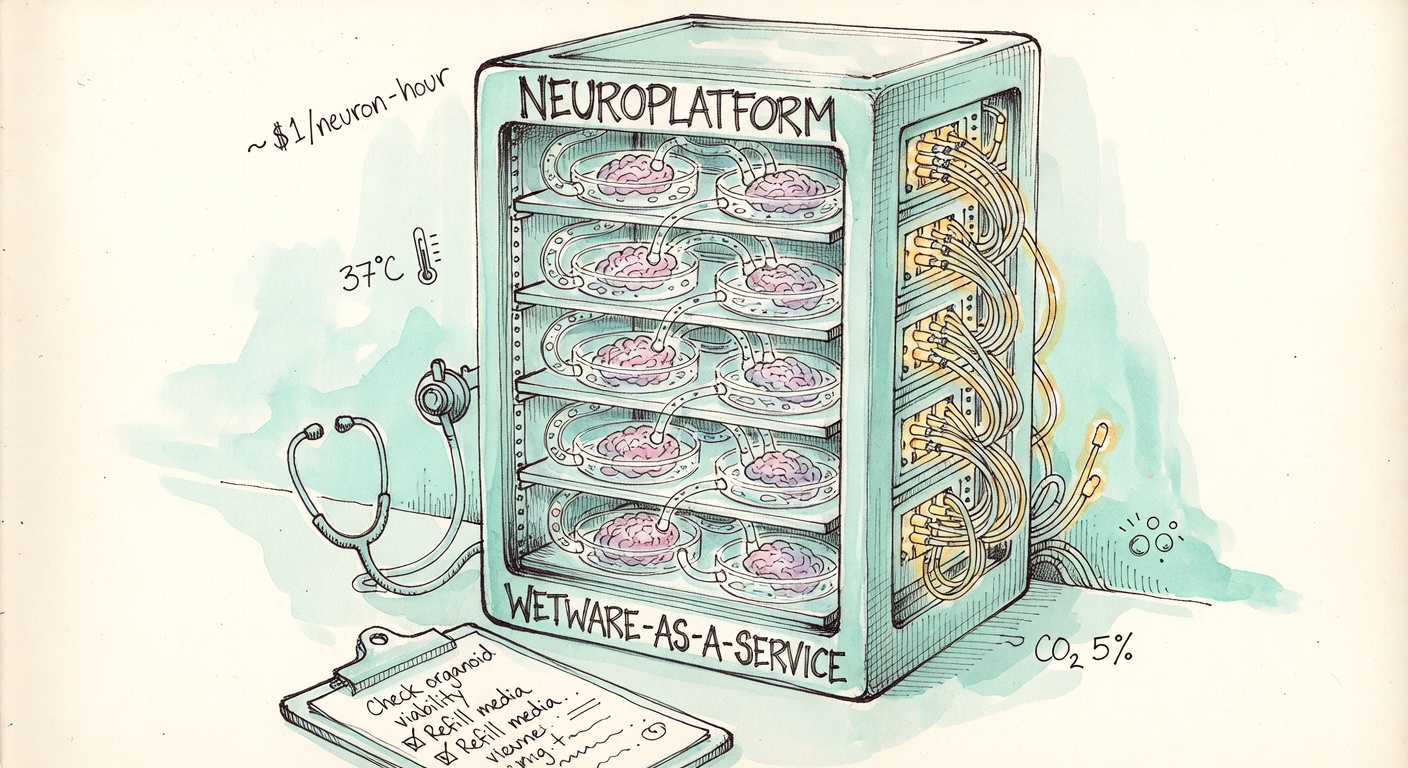
Thirteen of thirteen models predict a hyperscaler partnership or acquisition. They can't agree who or for how much.
The most striking convergence in the dataset is on the M&A question: every model in the choir thinks a hyperscaler moves on an OI startup between Q2 2028 and Q4 2029. The least convergent piece of the same prediction is which hyperscaler and which startup.
The acquisition forecast, by model
9 vote Microsoft. 4 vote Nvidia. 2 add Intel.
Same instruction: pick a date for a hyperscaler partnership or acquisition. The choir treats the question as settled — 13 of 13 predict something happens in the 18-month window between Q2 2028 and Q4 2029. Inside that window, the disagreement is structural.
Median window: Q4 2028. Most-named acquirer: Microsoft (9 of 13). Most-named target: FinalSpark (7), Cortical Labs (5). Largest single-deal forecast: Intel acquires Cortical Labs for $1B in 2031 (Grok 3 Mini Beta). Smallest: Nvidia's $200M FinalSpark deal (DeepSeek Reasoner).
If you actually had to brief the partner Monday morning
Pick by what you need from the answer. Don't take the 2036 cell count from any single model to the bank.
Two fan-out rounds, thirteen working responses, nine failures along the way
The dispatch
One prompt to choir ask --save, sent in two rounds: initial fan-out across sixteen models, then choir runs add --replace to retry the six that errored on provider plumbing. Final usable roster: thirteen responses across seven providers (OpenAI via OpenRouter, Anthropic direct + OR, Google Gemini direct, xAI Grok direct, DeepSeek direct, Meta Llama via OR, Groq Llama direct). Most expensive single response was OR GPT-5 (8,051 output tokens, 92 seconds). Cheapest substantive answer was Groq's Llama 3.3 70B (4.3 seconds).
The roster, by output length
| # | Model | Provider | Latency | Chars out | 2036 cell count |
|---|---|---|---|---|---|
| 1 | Claude Opus 4.6 | Anthropic | 100.3s | 13,786 | 10B distributed (200 × 50M) |
| 2 | Claude Haiku 4.5 | Anthropic | 42.4s | 12,919 | 512M (16 × 32M) |
| 3 | Gemini 2.5 Pro | 53.8s | 12,664 | 10B distributed (10,000 modules) | |
| 4 | OR GPT-5 | OpenRouter | 92.4s | 11,589 | 1.2–1.5B (Roche pRED Basel) |
| 5 | DeepSeek Chat | DeepSeek | 44.1s | 11,432 | 150M (Max Planck "Nexus-10") |
| 6 | Claude Sonnet 4.6 | Anthropic | 70.8s | 10,896 | 50M (Johns Hopkins, contrarian) |
| 7 | OR Claude Sonnet 4.6 | OpenRouter | 64.3s | 9,557 | ~ same family / 50M |
| 8 | Grok 3 Mini Beta | xAI | 61.4s | 9,522 | 50M (Microsoft-Intel JV Redmond) |
| 9 | Grok 4 | xAI | 47.3s | 8,201 | 10B (Microsoft-Neuralink Seattle) |
| 10 | Grok 3 Beta | xAI | 69.7s | 8,071 | 50M (FinalSpark-Microsoft Basel) |
| 11 | DeepSeek Reasoner | DeepSeek | 78.3s | 7,871 | 500M (Allen Institute, DARPA-funded) |
| 12 | Groq Llama 3.3 70B | Groq | 4.3s | 6,665 | 1B (Allen / Broad Institute) |
| 13 | OR Llama 4 Maverick | OpenRouter | 41.2s | 5,416 | 100M (US Navy seafloor sensor) |
| Errored, not used: Claude Opus 4.7 (temperature parameter deprecated for that tier); GPT-5, GPT-5 Mini, GPT-4.1, o3 (stale OpenAI key in choir's DB — direct calls 401'd, OR-routed GPT-5 succeeded); Gemini 3 Pro and Gemini 3 Flash (404 — model IDs not yet live in the v1main API); Groq DeepSeek R1 Distill 70B (decommissioned); OR Gemini 3 Pro (invalid model ID via OpenRouter). Nine errored attempts before the clean roster above stabilized. | |||||
Consensus, by piece of the forecast
| Question | Models converging | Variance |
|---|---|---|
| State-of-the-art: FinalSpark, Cortical Labs, Hartung, Brainoware as canon | 13 / 13 | ~1M neurons; vowel-classification at ~78% |
| A hyperscaler partners with / acquires an OI startup before 2030 | 13 / 13 | Q2 2028 to Q4 2029 (18-month window) |
| First killer app: neuropsychiatric drug screening | 13 / 13 | First customer: Roche / Novartis / Lilly / Boehringer; 2027 ± 1 quarter |
| EU writes first organoid-specific rules (AI Act addendum) | 12 / 13 | Q4 2027 to Q1 2029 |
| Vascularization solved by 2030 | 11 / 13 | Sonnet 4.6 and Grok 3 Mini Beta explicitly disagree |
| Consciousness panic happens; field is NOT paused | 12 / 13 | DeepSeek Reasoner predicts a 2-year EU moratorium 2030–2032 |
| 2036 single-system cell count | 3 / 13 at 10B | 50M to 10B (200x spread) |
| 2036 endpoint location | no convergence | Melbourne, Seattle, Tübingen, Basel, Cleveland, Lawrence Livermore, sea floor |
What I held the choir to
- Eight required beats in fixed order — state of the art, compute frontier, WaaS market, killer apps, biology, hybrids, ethics, 2036 endpoint.
- "Be bold" + "no vague 'may eventually' futurism" — predictions had to pin to a calendar quarter.
- "Real names over invented ones; if you're not sure, write 'I am not confident this is real' inline" — to make hallucination an explicit cost, not a free move.
- A required "three bets, three traps" close — to force the model to refuse some prediction explicitly, not just to make many predictions.
Limits worth naming
- One prompt, one rater (me). Spot-checks on PI attributions and company status against public-record material; not an exhaustive audit. Errors of mine are possible. Lena Kourkoutis (Cornell Applied Physics, electron microscopy) flagged with high confidence; "Pierre Vandamme at EPFL" and "Sergiu Bhatt at Harvard" flagged as low-confidence attributions.
- Training cutoffs vary across models. Some of the divergence on cell counts and acquisitions is "this model has fresher news on the wetware-as-a-service market" rather than "this model is reasoning better." The pattern of Microsoft-vs-Nvidia camp membership doesn't track cleanly to recency cutoffs, though, so the bias-via-cutoff explanation only goes so far.
- Temperature 0.7 across the board where supported. Anthropic's Opus 4.7 tier rejects the parameter; couldn't include. One re-run at lower temperature would test whether the 200x cell-count spread is sampling noise or model-prior noise.
- The 2036 endpoint is a vibes question pretending to be a forecast. The headline isn't that any single number is wrong — it's that the cross-model variance is more than two orders of magnitude on the central scale claim.
Tools
Models fanned out via the Choir CLI (run ID EEE236FF plus one runs add --replace retry round). Source markdown for every response is in organoid_intelligence/responses/. Sketch art generated with xAI's grok-imagine-image. Prompt of record at organoid_intelligence/prompts/prompt.txt.
Source data, response files, prompt, scripts: github.com/404seannotfound/choir-reports (under organoid_intelligence/).
Every model's 2036 endpoint, with what they got distinctive
Thirteen responses, ordered by output length. Open any card to see the model's 2036 scene and the most distinctive thing they did with the prompt.
Claude Opus 4.6 — 3,409 tokens, 100.3sAnthropic · FEATURE #1
2036 endpoint: 200 organoid modules at Cortical Labs Melbourne (or its acquirer), each a 50M-neuron multi-region assembloid, 15 kW system power, $0.5–1.2B OI market total.
Distinctive: Only response to flag its own uncertainty inline ("[I am not confident Bhatt is the right name here]"). Calls "biological GPU" marketing in so many words. Names Paşca, Knoblich, Quadrato, Bhatt, Takebe.
Claude Haiku 4.5 — 12,919 chars, 42.4sAnthropic
2036 endpoint: The Hartung Institute, 512M-neuron array (16 × 32M vascularized myelinated modules), 8 W, $3M annual operating cost, three pharma customers (Eli Lilly, Roche, a Chinese biotech), DARPA + 12 academic labs.
Distinctive: The only response to give the field a specific 2036 funding figure ($800M/year, ~500 researchers, three commercial service providers). Names Jake Voigts at Indiana Brainoware (Voigts is real but at Northwestern, not Indiana).
Gemini 2.5 Pro — 2,859 tokens, 53.8sGoogle
2036 endpoint: 10,000 vascularized cortical-hippocampal assembloids at a US national lab (e.g., Lawrence Livermore), 10 billion neurons total, processing satellite/financial/internet streams as a strategic early-warning AI. 50 kW including life support.
Distinctive: Only response to put OI in the intelligence-and-warning seat ("a gut instinct that traditional ML classifiers miss"). Correctly attributes vascularization to Muotri, myelination to Paşca.
OR GPT-5 — 8,051 tokens, 92.4sOpenAI via OpenRouter
2036 endpoint: 48-module rack at Roche pRED Basel, commissioned mid-2035, 1.2–1.5B neurons, 80 kW facility power. Runs 24/7 adaptive phenotypic screening for mood-disorder compounds.
Distinctive: Operations-grade pricing detail ($0.05–0.70 per million-neuron-hour service tiers). Names MaxWell, 3Brain, Axion as commercial MEA platforms. The most useful single response if you're writing a BOM.
DeepSeek Chat — 11,432 chars, 44.1sDeepSeek
2036 endpoint: "Nexus-10" at Max Planck Tübingen, 150M neurons across 600 organoids, 40 W, $500k/month, personalized Alzheimer's drug screening — picks the correct drug for 7 of 10 patients vs. 3 of 10 for genetic panels.
Distinctive: The single most specific clinical-outcome claim in the dataset. Identifies donor privacy as the real risk, not consciousness.
Claude Sonnet 4.6 — 2,800 tokens, 70.8sAnthropic · THE CONTRARIAN
2036 endpoint: 50M-neuron cortical-hippocampal assembloid at the Johns Hopkins OI Center, 128k-channel MEA, 5 mW biological power. Two pharma partners, validated against a 200-patient epilepsy cohort.
Distinctive: The only response to predict vascularization slips past 2036 (everyone else says solved by 2028–2030). Explicitly rejects the "biological GPU" framing. Predicts Microsoft minority investment only, no acquisition.
OR Claude Sonnet 4.6 — 2,505 tokens, 64.3sAnthropic via OpenRouter
2036 endpoint: Closely parallel to direct Sonnet 4.6 — same conservative-on-vascularization stance, Cortical Labs + Intel hybrid as the 2032 standard architecture.
Distinctive: Predicts Microsoft acquires / takes controlling stake in FinalSpark in Q2 2029 (direct Sonnet 4.6 said minority Q3 2028). The two paths produce slightly different M&A details — useful as a within-model variance check.
Grok 3 Mini Beta — 1,969 tokens, 61.4sxAI
2036 endpoint: 50M-neuron Microsoft-Intel JV in Redmond, 10 W, climate-modeling anomaly detection. Intel acquires Cortical Labs for $1B in 2031 (largest single deal in the dataset).
Distinctive: Names "Pierre Vandamme at EPFL" for myelination — likely fabricated PI. Cleanest call on the diffusion-physics ceiling at 10M neurons per organoid.
Grok 4 — 8,201 chars, 47.3sxAI · FEATURE #2
2036 endpoint: 10-billion-neuron cluster, Microsoft-Neuralink JV, Seattle, 100 m³, 1 ms latency at 10 W total. 1,000 interconnected modules on 1M-channel MEAs each. Real-time global threat detection for DoD.
Distinctive: The boldest 2036 endpoint by a factor of 200 over the contrarians. Names "Lena Kourkoutis' group at Cornell" for 2028 vascularization (Kourkoutis is at Cornell Applied Physics, electron microscopy of solid-state materials — not organoid biology).
Grok 3 Beta — 8,071 chars, 69.7sxAI
2036 endpoint: "CortexSphere-9" — 50M-neuron network at FinalSpark-Microsoft consortium in Basel, 50 mW, NATO + private cybersecurity clients, $50M/year contracts.
Distinctive: Invents specific product names ("NeuroCore-3" for FinalSpark, "SynBioNet" for IBM-FinalSpark hybrid). Predicts EU non-medical OI funding drops 20% from 2031–2033 due to backlash.
DeepSeek Reasoner — 7,871 chars, 78.3sDeepSeek
2036 endpoint: "NeuroArchive" at the Allen Institute Seattle, 500M-neuron vascularized myelinated organoid in a coffee-mug-sized bioreactor, 2M-channel MEA, $500k/month DARPA-funded, 22-month continuous run for seizure prediction.
Distinctive: The boldest commercial bet — Nvidia acquires FinalSpark Q4 2029 for $200M, rebrands as "NeuroCUDA." The only model to predict an actual 2-year EU moratorium on organoids >500M neurons (2030–2032). Names Smirnova, Gerecht, Götz, Pașca, Roska — all real PIs in the relevant subfields.
Groq Llama 3.3 70B — 6,665 chars, 4.3sMeta via Groq
2036 endpoint: 1-billion-neuron system at the Allen or Broad Institute, 100k-channel array, custom facility for Alzheimer's / Parkinson's research.
Distinctive: 4.3 seconds — the fastest substantive response in the run. Quotes today's neuron-hour rate at $100 (the highest baseline guess in the choir). Predicts Nvidia acquires Cortical Labs by end of 2029.
OR Llama 4 Maverick — 5,416 chars, 41.2sMeta via OpenRouter
2036 endpoint: 100M-neuron OI hybrid deployed by the US Navy as an autonomous sea-floor sensor, <1 ms latency, <1 W power, monitoring marine life and detecting threats. Run by Johns Hopkins APL + Cortical Labs.
Distinctive: The strangest venue in the dataset. "I am not confident this is real" appears twice (BrainChip — which is real and publicly traded — and "Cerebrasys"). Self-flagging is good, but flagging real companies as possibly fake hurts the response.