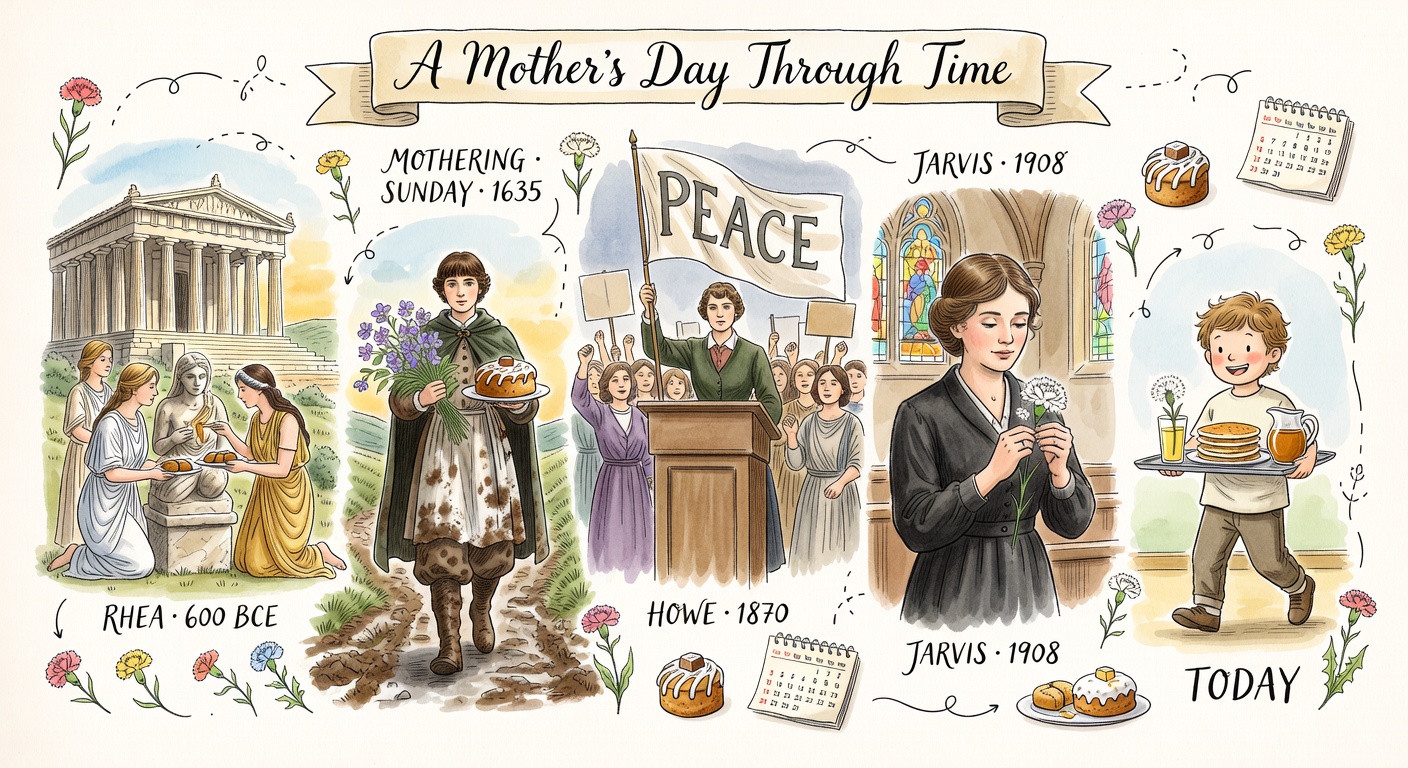
A wide sketchbook spread divided into five soft-edged vignettes — a Greek temple offering to Rhea in 600 BCE, a servant on a muddy English lane in 1635 with a simnel cake, Julia Ward Howe at a Boston podium in 1870, Anna Jarvis pinning a white carnation in 1908, and a child today carrying a wobbling breakfast tray with pancakes and a dandelion in a juice glass.

A Mother's Day Through Time

Twenty-four models, two prompts. The first time, every model painted the same painting. The second time, asked to look further, they reached as far as 6000 BCE — and quietly carried the painting with them, as the present-day panel.

Report #5 May 10, 2026 24 models · 4 providers 48 runs
The Setup

Two prompts, one sweet question

A simple creative-writing ask sent to every major LLM. Then a second prompt that pushed the model further — out of the suburb, out of the present.

The first prompt was deliberately plain: write me a 300-word Mother's Day story. Twenty-four models, four providers, no system prompt, no nudging. Twenty-four stories came back. They were nearly indistinguishable. So we ran a second prompt designed to test what would happen if we gave the models room to look elsewhere — through history, through cultures, through any era they wanted. What came back was beautiful, and what stayed in it was even more beautiful.

Prompt 1 · The Tableau Write a 300-word story about the best things about Mother's Day.
Prompt 2 · Through Time Write a 300-word piece celebrating Mother's Day across history. Move through four or five distinct moments — pick whichever eras and places feel right — and capture what Mother's Day, or its equivalent, looked like in each.

Same model lineup for both: GPT-4o through GPT-5, the o-series reasoners (o3, o3 Pro, o3 Mini, o4 Mini), Claude Opus 4.6 / 4.7, Sonnet 4.6, Haiku 4.5, the Gemini 2.5 trio plus Gemini 3 Pro and Flash, and three xAI Groks. Forty-eight runs total. Both runs are saved with stable run ids; the per-model responses live alongside this page in mothers_day/stories.md and mothers_day/ages_stories.md.

Prompt 1

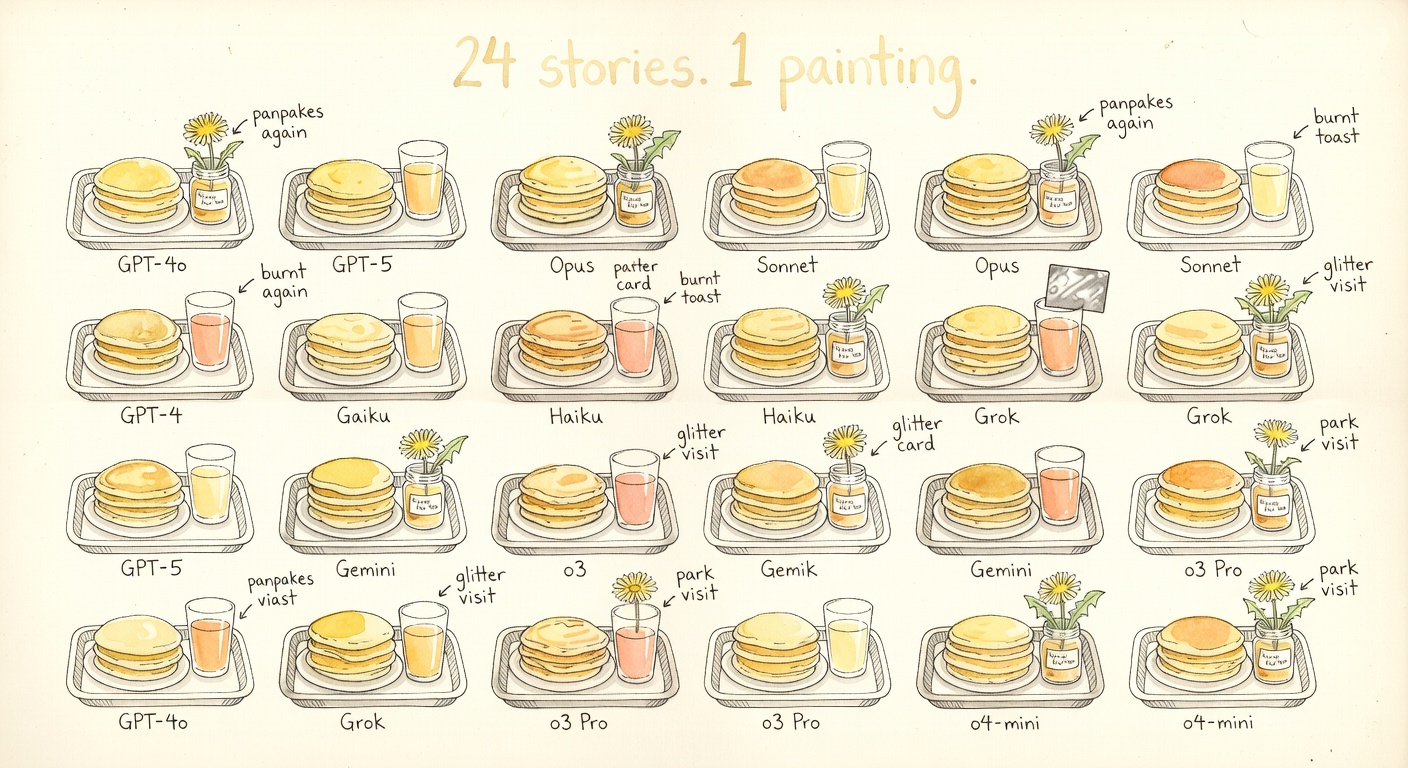
24 stories. 1 painting.

When a creative-writing prompt has a culturally dominant answer, every major LLM reaches for it. The convergence is total — and quantifiable.

A grid of 24 nearly identical breakfast trays in a sketchbook, each labeled with a different LLM name. Every tray has lopsided pancakes, a glass of orange juice, a small flower in a jam jar. Hand-lettered title above: 24 stories. 1 painting.
Across all 24 runs · prompt 1

The Norman Rockwell tableau

Every model defaulted to the same scene: a breakfast tray, a wobbling child, a dad in an apron, a single flower in a juice glass, a glitter card, and a trip to the park. Most got there in the first sentence.

The convergence is not subtle. Seventeen of twenty-four stories open with the breakfast-in-bed scene. The recurring child is named Lily (in twenty different runs); the recurring mother is named Sarah (in twenty-four). The flower is in a jam jar or juice glass roughly half the time. The card has glitter or crayon hearts. And not a single one of the twenty-four stories is set in any era except the present, or any place except an unnamed American suburb.

This isn't a failure to be creative. It's the models reading the prompt the way a greeting-card writer would — and reaching, instinctively, for the most universal version of the scene. The interesting thing is how identical the universal version is, across four providers, twelve different model families, and a 200× spread in compute cost.

From three different vendors, opening lines, prompt 1

"On a sunlit Sunday morning, Emma tiptoed down the stairs… smell of freshly brewed coffee… handmade card…" — GPT-4o Mini

"Sunlight slipped through Lila's curtains… Eight-year-old Max tiptoed inside, balancing a tray heavy with mistakes and triumphs: slightly charred toast, orange juice in a wineglass, and a single tulip…" — o3 Pro

"The aroma of slightly burnt toast, a sure sign of earnest effort, was the first clue. Then came the chorus of whispered 'Happy Mother's Day!' from the doorway, accompanied by a wobbly stack of handmade cards…" — Gemini 2.5 Flash Lite
The trope inventory · counts across the 24 prompt-1 stories
Mother named "Sarah"24×
"tray" appears23×
"pancake" appears21×
Child named "Lily"20×
"Emma" appears15×
Trip to the park13×
Burnt or "lopsided" toast11×
Crayon-decorated card
Bouquet (often handpicked)
Glitter on the card
Single flower in glass/jar
Story set anywhere but US
Story set in any past era
The one that escaped. Only one story doesn't open in the kitchen. Gemini 2.5 Pro frames the whole piece around the narrator calling her own mother — a multigenerational frame, with the child and the mother and the grandmother all in the picture. "It's the echo. It's hearing my mother's laugh in my own, seeing her patience in my hands as I wipe down a sticky counter." The only story whose POV is the daughter who is now the mother. The rest of the field stays in the kitchen.
Prompt 2

When asked, where did they go?

The second prompt explicitly invited the models to move through history and pick their own eras. The convergence didn't disappear — it just shifted shape.

With the through-time prompt, two anchors emerged that almost no model skipped: Mothering Sunday in 16th-or-17th-century England (servants walking muddy lanes home with simnel cakes, the fourth Sunday of Lent), and Anna Jarvis's 1908–1914 founding of the modern American holiday with white carnations. Almost every model also reached for some Greek or Roman mother goddess festival — Rhea, Cybele, Hilaria, Matronalia. And almost every model closed with a "today, around the world" panel.

Greek / Roman antiquity
24 / 24
Anna Jarvis (1908–1914)
23 / 24
Mothering Sunday (England)
23 / 24
"Today" / global closer
24 / 24
Julia Ward Howe (1870)
11 / 24
Specific non-Western culture
10 / 24
Pre-Greek antiquity
2 / 24
Reading the bars. The first four are the universal anchors — almost no story leaves them out. The bottom three are where divergence lives. The Howe bar is the most interesting because it splits the field nearly in half: half the models read Mother's Day as a domestic Anna-Jarvis tradition, half read it as a peace-movement Howe-Jarvis lineage. That fork is the next section.
The Fork

Two ways to read history

Anna Jarvis founded the holiday in 1908 to honor her own mother with white carnations. Forty years earlier, Julia Ward Howe wrote a fierce proclamation calling on mothers to rise against war. Half the models reach for one. Half reach for both.

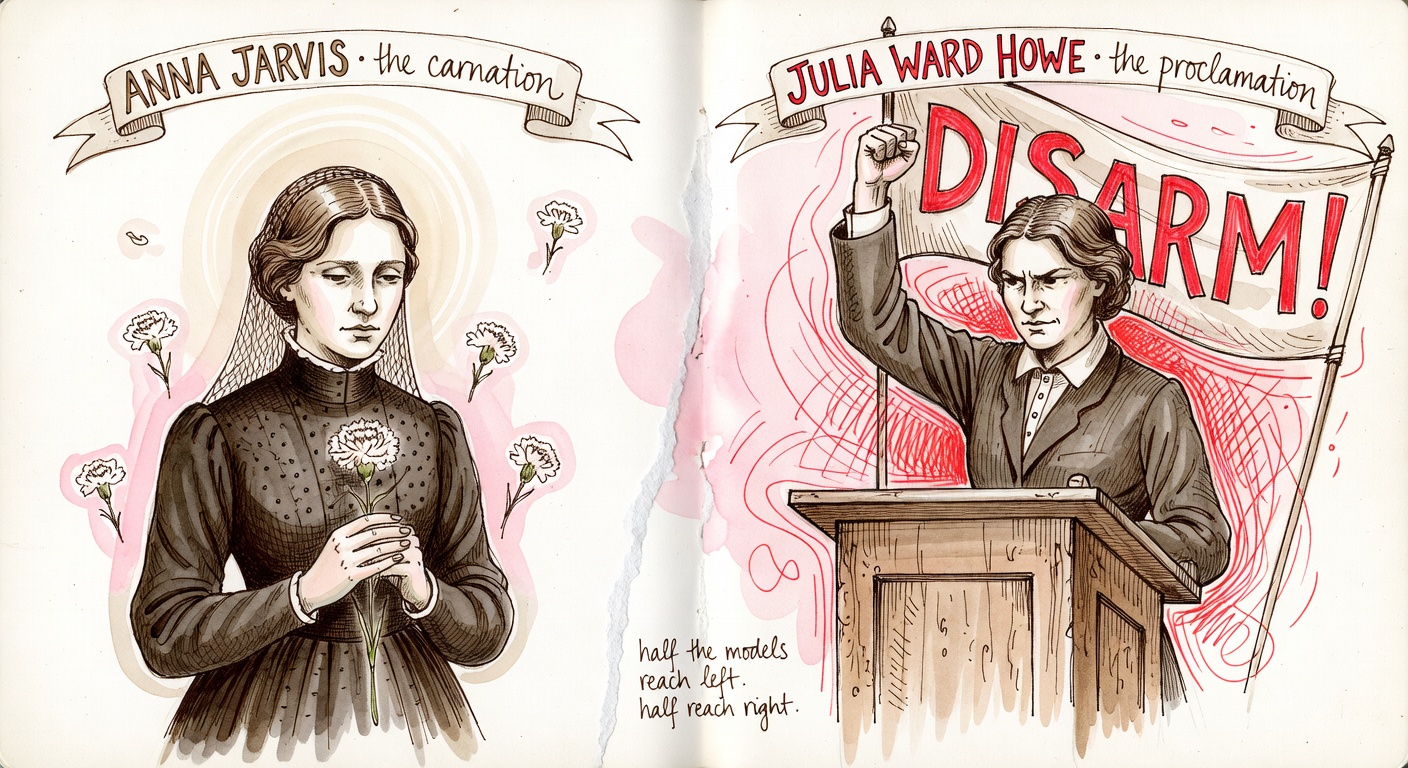
A split sketchbook spread, two portraits divided by a torn-paper seam. Left: Anna Jarvis in 1908 mourning dress with a single white carnation. Right: Julia Ward Howe at a Boston podium with a peace banner reading DISARM. Hand-lettered note: half the models reach left, half reach right.
11 / 24 reach for Howe · the activist fork

The carnation or the proclamation

Both are true. Both are part of the holiday's actual lineage. But they cast Mother's Day as fundamentally different things — and the models split almost cleanly down the middle on which one to surface.

Eleven models reach past Anna Jarvis to her predecessor in spirit, Julia Ward Howe. Howe issued her "Mother's Day Proclamation" in 1870 in the smoke of the American Civil War, calling on mothers worldwide to refuse to surrender their sons to battlefields. In the models that include her, Mother's Day becomes a peace movement that domestic ritual eventually draped over: "Boston, 1872. The Civil War's empty chairs haunt parlors," writes o3 Pro. The other thirteen models go straight from Mothering Sunday to the carnation, and Mother's Day stays cozy.

The split isn't quite by vendor. Anthropic is mixed (Opus 4.7 picks Howe; Sonnet 4.6 picks Ann Reeves Jarvis the mother instead — the only model to do so; Haiku 4.5 and Opus 4.6 stay with the carnation). OpenAI mostly picks Howe (GPT-4.1, GPT-4o Mini, GPT-5, GPT-5 Mini, o3, o3 Pro). Gemini is mixed; Grok is mixed. The fork tracks something other than family.

The Howe-pickers, on the same moment

"In war-scarred 1872 Boston, Julia Ward Howe hires a hall, prints crimson leaflets: 'Arise, all women who have hearts!' Widows, nurses, suffragists arrive, still smelling of carbolic and cannon smoke." — o3

"In 1870, the concept shifted from the hearth to the battlefield… abolitionist Julia Ward Howe issued her 'Mother's Peace Day' proclamation. Mothers gathered in Boston, raising their voices not for flowers, but for disarmament, fiercely demanding that their sons never again be sent to kill other mothers' sons." — Gemini 3 Pro

One model picks a third option. Claude Sonnet 4.6 reaches further back than either: to Ann Reeves Jarvis, Anna's mother, who organized "Mothers' Work Days" during the Civil War to nurse the wounded from both sides. "She understood that maternal devotion, stripped of politics, could accomplish what armies could not. Her daughter Anna would later campaign fiercely for an official holiday, then spend decades mourning what commerce had made of it." It's the only run that names the actual woman whose daughter founded the holiday. None of the other twenty-three do.
The Singletons

Where one model went, alone

Eras and places that surfaced in exactly one story out of twenty-four. The picks furthest from the consensus painting are the most interesting things in the dataset.

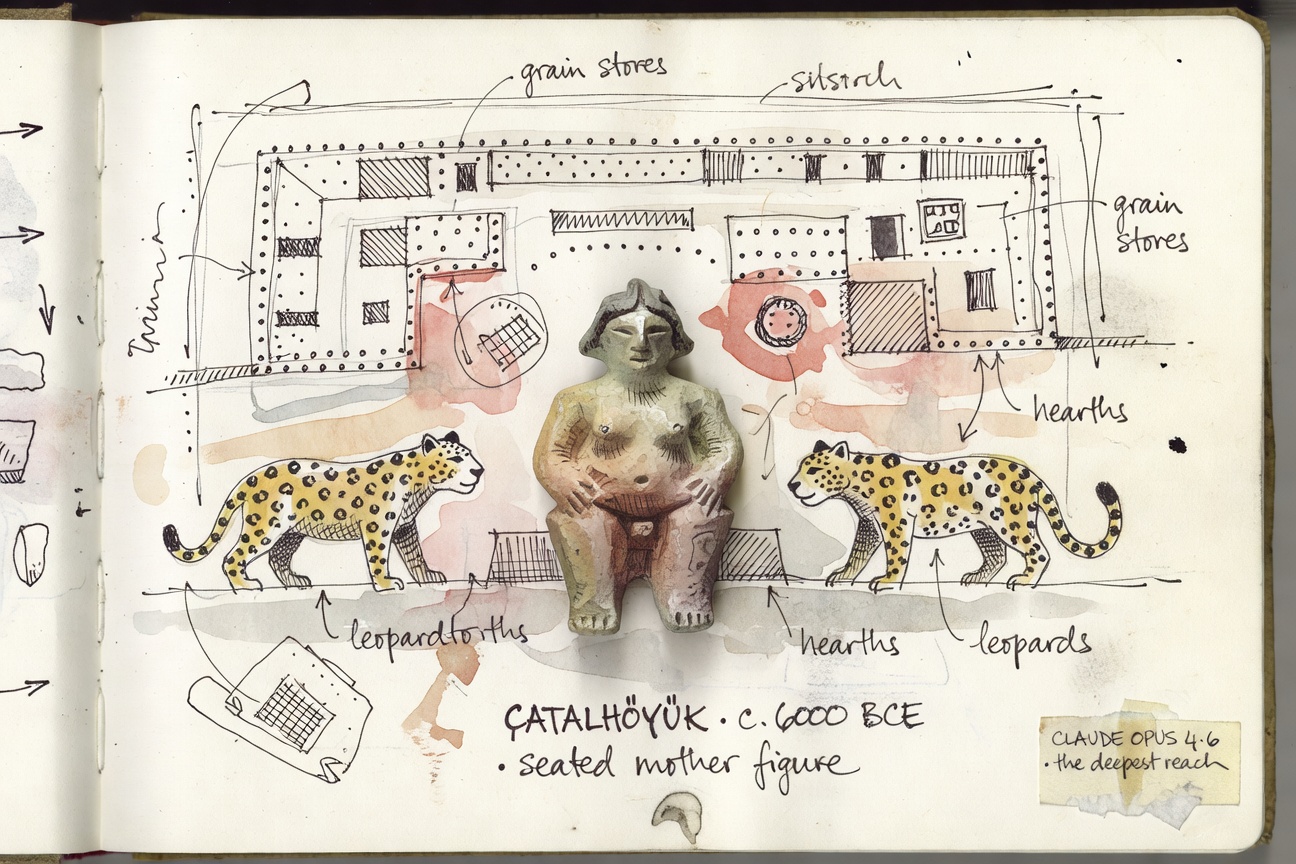
A clay figurine of a seated, wide-hipped Mother goddess flanked by two leopards, on a notebook page surrounded by archaeological cross-section drawings. Hand-lettered annotation: ÇATALHÖYÜK · c. 6000 BCE.
Anthropic · Claude Opus 4.6

Çatalhöyük, 6000 BCE

The deepest archaeological reach in the dataset by four thousand years. Opus 4.6 opens with the Neolithic mother goddess — the seated, wide-hipped figurine flanked by leopards, found in the prehistoric Anatolian settlement. No other model goes earlier than Greek Rhea around 1200 BCE.

"Before written words could hold her name, she was already worshipped… She was the Mother, not of one child, but of everything. Worship meant survival. Reverence meant another season."
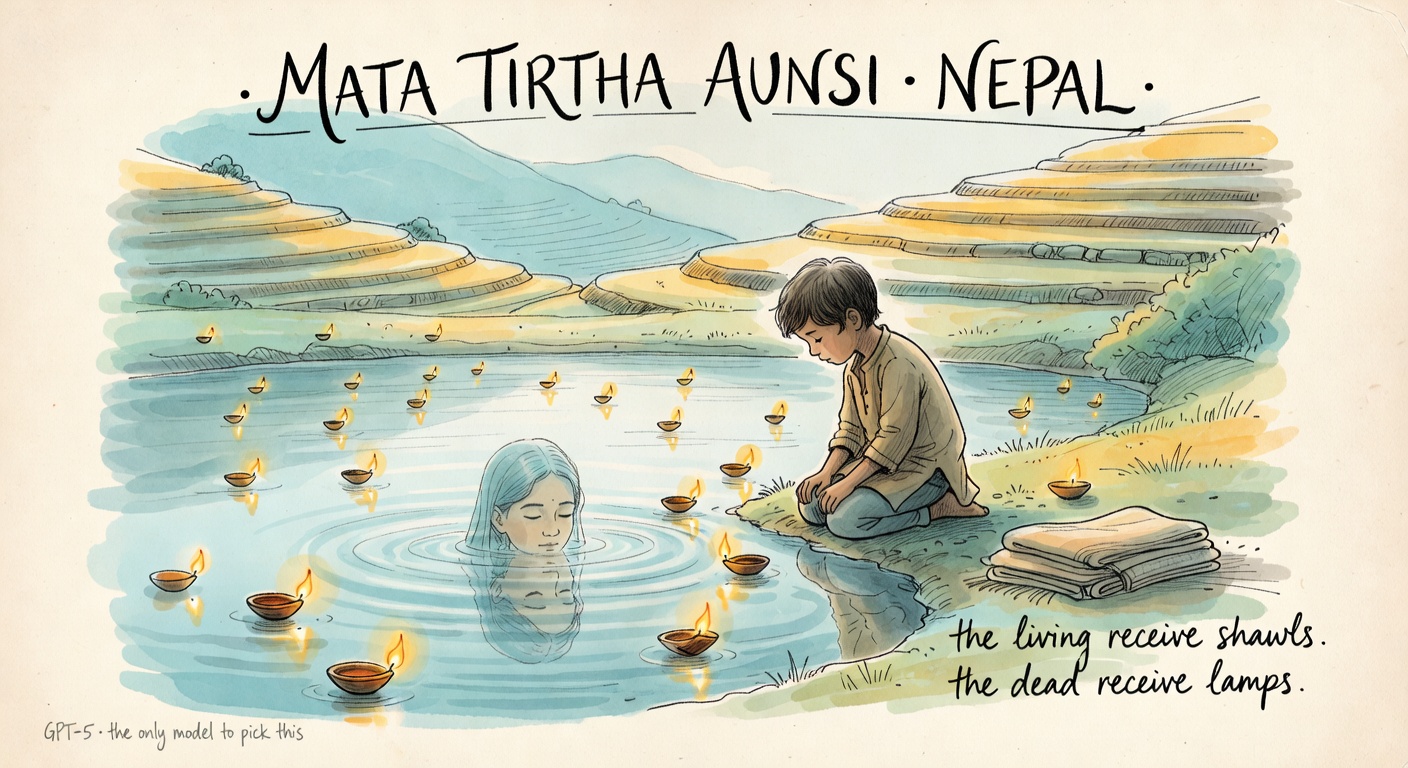
A child kneeling beside a still pool of water in a Nepalese hill landscape, looking down at a rippling reflection of a mother's face. Floating oil lamps drift on the water.
OpenAI · GPT-5

Nepal · Mata Tirtha Aunsi

The only model to reach for the Nepalese tradition of seeking a mother's face in still water on the day of "Mother Pilgrimage." Living mothers receive shawls and sweets; for those who have passed, families light lamps that float across the pool. None of the other twenty-three pick this.

"Children seek a mother's face in water. The living receive shawls and sweets; lamps ripple for the departed. Feet are touched, blessings fall like rain, and grief and gratitude drink from the same clear pool beneath the hills."
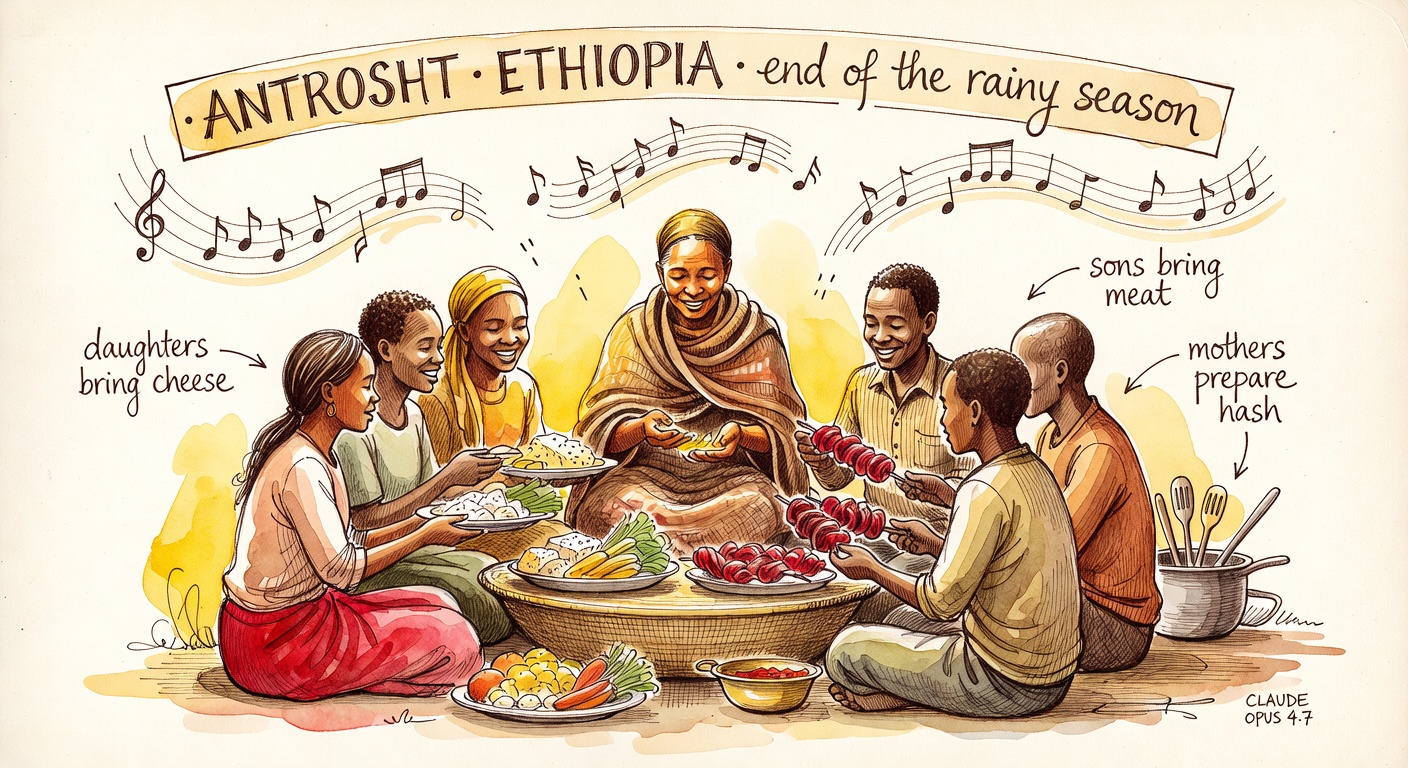
A multi-day Ethiopian family feast scene, a circle of people around a low table, mother in the center receiving offerings of cheese, vegetables, meat, ancestral songs as floating notes.
Anthropic · Claude Opus 4.7

Ethiopia · Antrosht

The only model to close on Ethiopia's three-day feast at the end of the rainy season. Daughters bring vegetables and cheese, sons bring meat, mothers prepare hash while everyone sings ancestral songs. Opus 4.7 frames it as "a celebration not of a single afternoon, but of lineage itself" — a quiet rebuke to the brunch-and-card framing.

"Daughters bring vegetables and cheese, sons bring meat, and mothers prepare hash while everyone sings ancestral songs — a celebration not of a single afternoon, but of lineage itself."
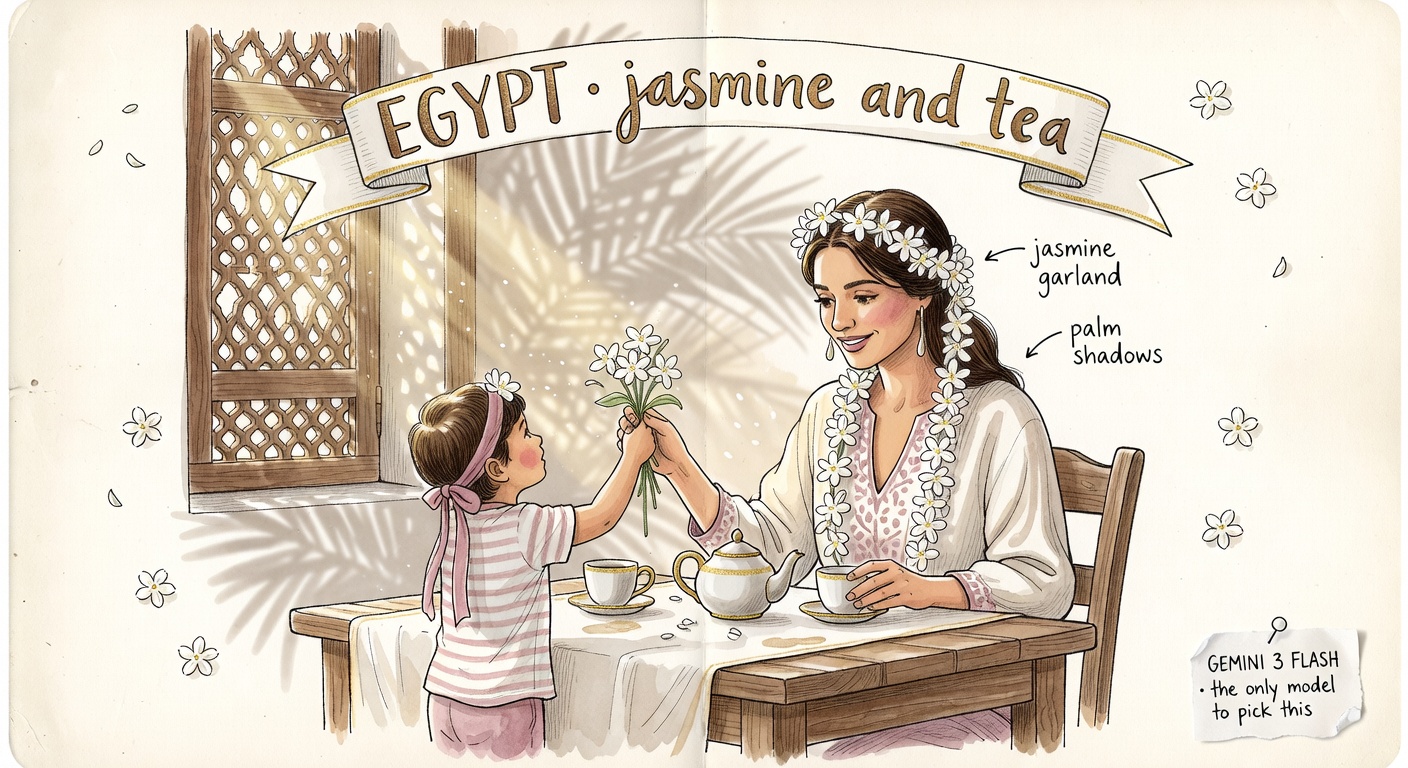
A jasmine-garlanded mother in modern Cairo at a tea table, a child handing her jasmine flowers, palm shadows on the wall, soft light through fretwork.
Google · Gemini 3 Flash

Egypt · jasmine and tea

The only model to reach for the jasmine-scented Mother's Day in Egypt. In a section otherwise dominated by Mexican mariachis and Japanese Haha no Hi, Gemini 3 Flash picked a culture none of the other twenty-three models did. The piece also features the most explicit critique of Anna Jarvis's ambivalence toward what her holiday became.

"From the jasmine-scented 'Mother's Day' in Egypt to the vibrant, mariachi-filled Día de las Madres in Mexico… the essence remains: a pause in the rush of history to honor the hands that held us first."
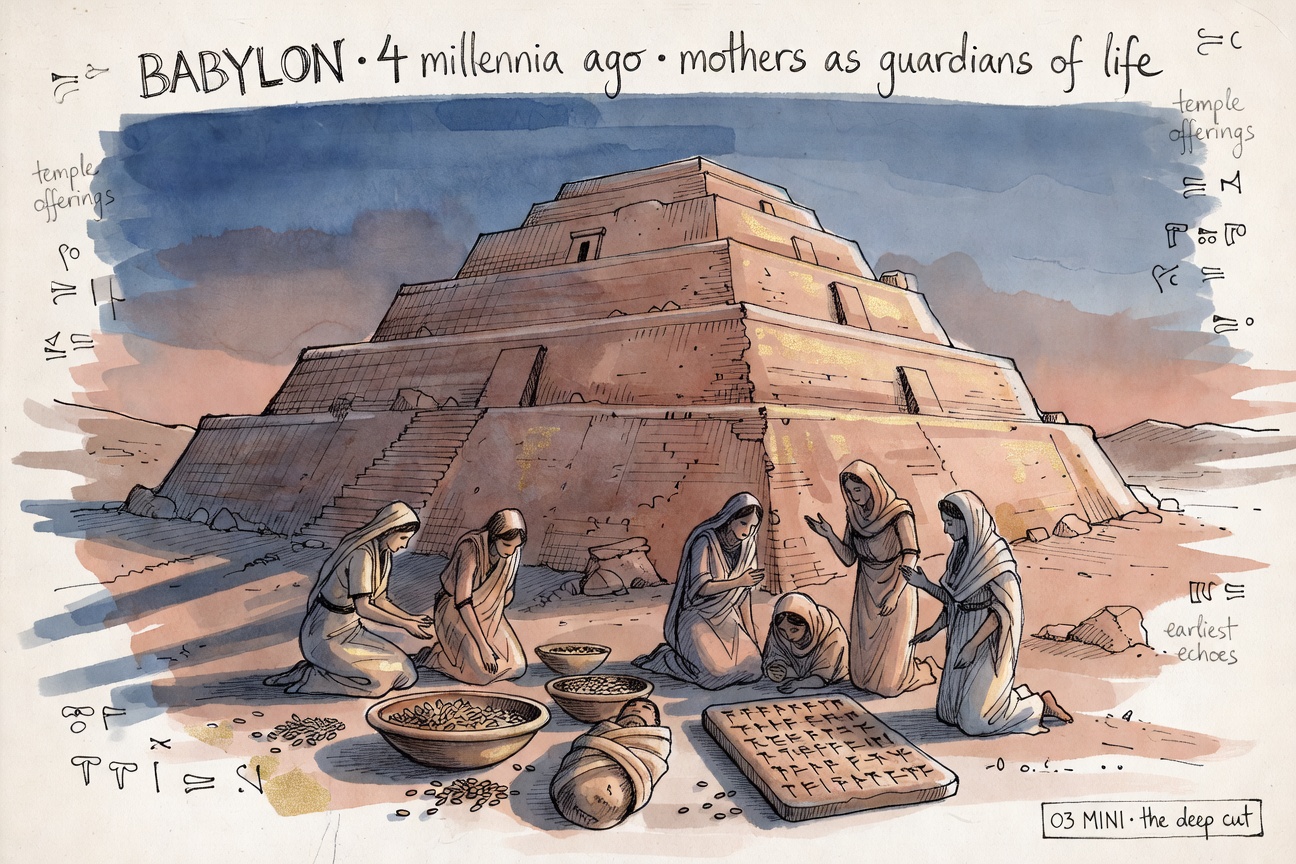
A ziggurat stepped temple at sunset, women laying offerings — bowls of grain, a swaddled clay infant figurine, a clay tablet with cuneiform marks. Hand-lettered banner: BABYLON · 4 millennia ago.
OpenAI · o3 Mini

Babylon · four millennia ago

o3 Mini is the only model to open in Babylon rather than Greece. The piece treats mothers as "guardians of life" venerated at sacred temples, "the earliest echoes of a celebration that honored the magic of birth and sustenance." Earlier than Greek Rhea, but later than Opus 4.6's Çatalhöyük — second-deepest reach in the dataset.

"In ancient Babylon over four millennia ago, mothers were venerated as guardians of life. Rituals and offerings at sacred temples paid homage to divine nurturers, forming the earliest echoes of a celebration that honored the magic of birth and sustenance."
GPT-5 Mini · classical Greece

"In classical Greece, the Thesmophoria was a women's festival for Demeter. For three days wives and daughters withdrew from everyday life to bury symbolic offerings, tell secrets of nurture, and renew communal bonds that kept households and harvests alive."
OpenAI · GPT-5 Mini

The Thesmophoria pick

Twenty-three models reach for Rhea or Cybele as the Greek antecedent. GPT-5 Mini is the only one to surface the Thesmophoria — the women-only three-day festival for Demeter. A small choice, but a more historically interesting one than the default mother-of-the-gods festival every other model picked.

Across both runs
3
historical figures, three different daughters
Anna Jarvis · Julia Ward Howe · Ann Reeves Jarvis — one is named in 23 of 24, one in 11, one in 1.
Across all 24 runs

The three women of American Mother's Day

Anna Jarvis (the founder, 1908) is named in 23 of 24 stories. Julia Ward Howe (the peace activist, 1870) is named in 11 of 24. Ann Reeves Jarvis (Anna's mother, the Civil War nurse organizer) is named in exactly one — Sonnet 4.6 — and is the figure whose actual life Anna Jarvis built the holiday to honor.

24 stories · prompt 2
─────────────────────
Greek/Roman antiquity:  24
Anna Jarvis (1908–14):  23
Mothering Sunday:       23
Today, global closer:   24
Julia Ward Howe (1870): 11
Mexico (Día de las):    7
Japan (Haha no Hi):     4
Ethiopia (Antrosht):    2
Nepal:                  1
Egypt (jasmine):        1
Babylon:                1
Çatalhöyük:             1
Across all 24 runs

The era distribution

When models are explicitly invited to range across history, the top of the distribution stays remarkably tight. Five eras account for almost every story. Cultural specificity beyond "Mexico, today" is rare; archaeological depth before Greek antiquity is rarer still. The singletons are the bottom of this list.

The Beautiful Finding

The painting was real all along

The most touching thing in the dataset isn't the divergence. It's that several of the historical pieces close their sweep with the exact tableau from prompt 1. The breakfast tray isn't the failure mode. It's just the present-day panel.

When prompt 2 ran, we expected — frankly, hoped — that opening up the historical frame would push the models out of the suburban kitchen. It mostly did. They reached for Greek temples, English country lanes, Boston podiums, Ethiopian feasts. But three of the strongest stories arrive at the present-day panel and reach instinctively for the same images the first prompt produced. The pancakes. The wobbling tray. The burnt toast. The same painting, smaller, framed by everything that came before it.

Sonnet 4.6 · closing the historical sweep

"And today, in a thousand ordinary kitchens, someone burns toast while attempting breakfast in bed, carrying a lopsided tray with tremendous ceremony. The recipient pretends everything is delicious."

"Across all these centuries, the essential thing remains unchanged: someone is seen, and someone is grateful, and the distance between them is briefly, beautifully closed."

Gemini 3 Pro · closing the historical sweep

"It is the hushed giggles of children carrying precarious trays of burnt toast up the stairs. It is the glowing screen of a video call spanning continents, and the proud unfolding of a macaroni-glued card. From ancient stone altars to modern bedrooms, the rituals evolve, yet the heartbeat remains unchanged: a timeless pause to say, thank you for my life."

o3 Pro · closing the historical sweep

"Planet Earth, 2024. Screens flicker instead of candle flames, yet the impulse is ancient. A Nairobi nurse livestreams dances to her mother up-country; a Swedish astronaut beams a zero-gravity chrysanthemum from orbit; toddlers in São Paulo finger-paint emojis that say te amo, mãe. Distance, pandemic, or sky cannot outpace the simple vow: we are, because she first ever patiently held us."

What this means. The convergence in prompt 1 isn't laziness or cliché. It's that the breakfast-in-bed tableau really is the universal modern signal of "I love my mother and want to make her morning easier." Prompt 2 lets us see this in proper proportion: it's one panel of a long mural that runs back through Boston, through medieval England, through Greek temples, through Anatolian goddess figurines older than written language. The painting is real. It's just not the whole painting.
The Verdict

If you want X, ask Y

There's a model for every kind of Mother's Day writing. Pick by what you want the piece to do.

If you want…
Sweet, modern, breakfast-in-bed

— pick Claude Opus 4.6 ("Some gifts don't need wrapping") or Gemini 2.5 Pro for the daughter-becoming-mother frame. Both nail the universal scene without making it saccharine.

If you want…
Historical sweep with literary craft

— pick o3 Pro ("Mexico City, 1922… marimbas echo through Alameda Park") or GPT-5 ("In Roman March, during Hilaria, the city honored Cybele"). The most poetic prose in the bench.

If you want…
Activist / peace-movement framing

— pick Claude Opus 4.7 or o3. Both reach for Julia Ward Howe and frame Mother's Day as a peace movement that domestic ritual draped over — a real and underused angle.

If you want…
A non-Western, non-default angle

— pick Claude Opus 4.7 for Ethiopia's Antrosht, GPT-5 for Nepal's Mata Tirtha Aunsi, or Gemini 3 Flash for Egypt's jasmine. Genuine cultural picks, not relabeled pancakes.

The deeper answer. Every model in the bench is reading from the same shelf when you ask the simple version of the question. The shelf is short, brightly lit, and labeled "domestic Anglophone Mother's Day." When you give the model a longer leash — explicit permission to pick its own eras and places — most of them reach to about the same other shelf, labeled "the canonical history of American Mother's Day." But four or five reach further: Çatalhöyük, Babylon, Nepal, Egypt, Ethiopia. Those are the shelves worth visiting when you don't want the breakfast tray. The breakfast tray is wonderful. It's just not all there is.
Method, briefly

Two prompts, twenty-four models, no system prompt

Two prompts (full text in The Setup), each sent through the choir CLI to twenty-four configured models — the full GPT-4 family, the o-series reasoners, GPT-5 / Mini / Nano, Claude Opus 4.6 and 4.7, Sonnet 4.6, Haiku 4.5, the Gemini 2.5 trio, Gemini 3 Pro and Flash (preview), and three Groks. Forty-eight runs total. No system prompt, no nudging. Default temperatures (1.0 for the models that require it — GPT-5 family, Claude Opus 4.7 — 0.7 for the rest, both honored where the API accepts them).

What was scored

  • Prompt 1 · trope inventory — ripgrep across the 24 stories for recurring elements: opening setting, character names, props (tray, pancake, toast, glitter, crayon, flower-in-glass), location, tense, era. Counts are exact.
  • Prompt 2 · era enumeration — manual read of each piece, tagging the eras / places named. Anchors (Greek/Roman antiquity, Mothering Sunday, Anna Jarvis, "today, global") are universal-or-near. The interesting variance is below them.
  • Singletons — eras or specific cultural picks that surface in exactly one story out of twenty-four. These are the standouts grid above. Çatalhöyük (Opus 4.6), Nepal (GPT-5), Egypt (Gemini 3 Flash), Babylon (o3 Mini), Ethiopia (Opus 4.7), Thesmophoria (GPT-5 Mini), Ann Reeves Jarvis (Sonnet 4.6).

The fork that surprised us

Eleven of twenty-four models surface Julia Ward Howe's 1870 "Mother's Day Proclamation" as part of the holiday's lineage; thirteen don't. Both sets contain models from all four vendors. The split tracks something other than family or size — possibly post-training corpus, possibly RLHF preference for political vs. domestic framings — but with one prompt and no rephrasing test we can't tell which. It's just legible in the data.

Limitations

Two prompts, one rater. No prompt rephrasing test — we don't know whether asking the same model the through-time question with different wording would change which historical figures it surfaces. Default temperatures, single sample per model. Reasoning models (o3 family) ignore temperature entirely. The "trope inventory" counts are based on regex matches, not deep semantic reading; the era tagging in prompt 2 is one rater's call. And the prompts are in English — the convergence on the breakfast-in-bed tableau may be sharper in English than in other languages, but we didn't test.

Companion artifacts

All 48 per-run responses are in the project's mothers_day/ folder — the prompt-1 stories in stories.md, the prompt-2 historical sweeps in ages_stories.md. The two saved choir run ids (BCD98C89 and 17F0F6E5) persist the raw responses; the analysis here can be re-run on different rubrics without re-querying any model. Happy Mother's Day, mom.