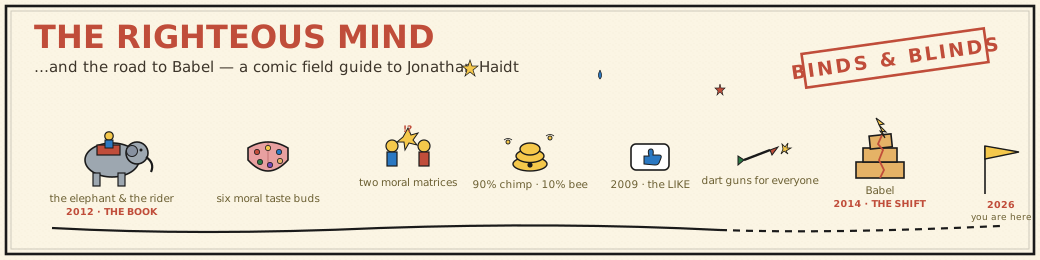
This is Jonathan Haidt's The Righteous Mind: Why Good People Are Divided by Politics and Religion (2012), retold in thirty-one panels in a hand-drawn margin-doodle style — and then carried forward into his 2022 Atlantic essay, Why the Past 10 Years of American Life Have Been Uniquely Stupid, which picks up the story where the book leaves off. The book explains why decent people durably disagree; the essay explains what happened when those disagreements got wired through machines that reward outrage.
The drawings are the hook; the captions under each panel carry the actual argument. Read it straight through in about fifteen minutes, or wander.
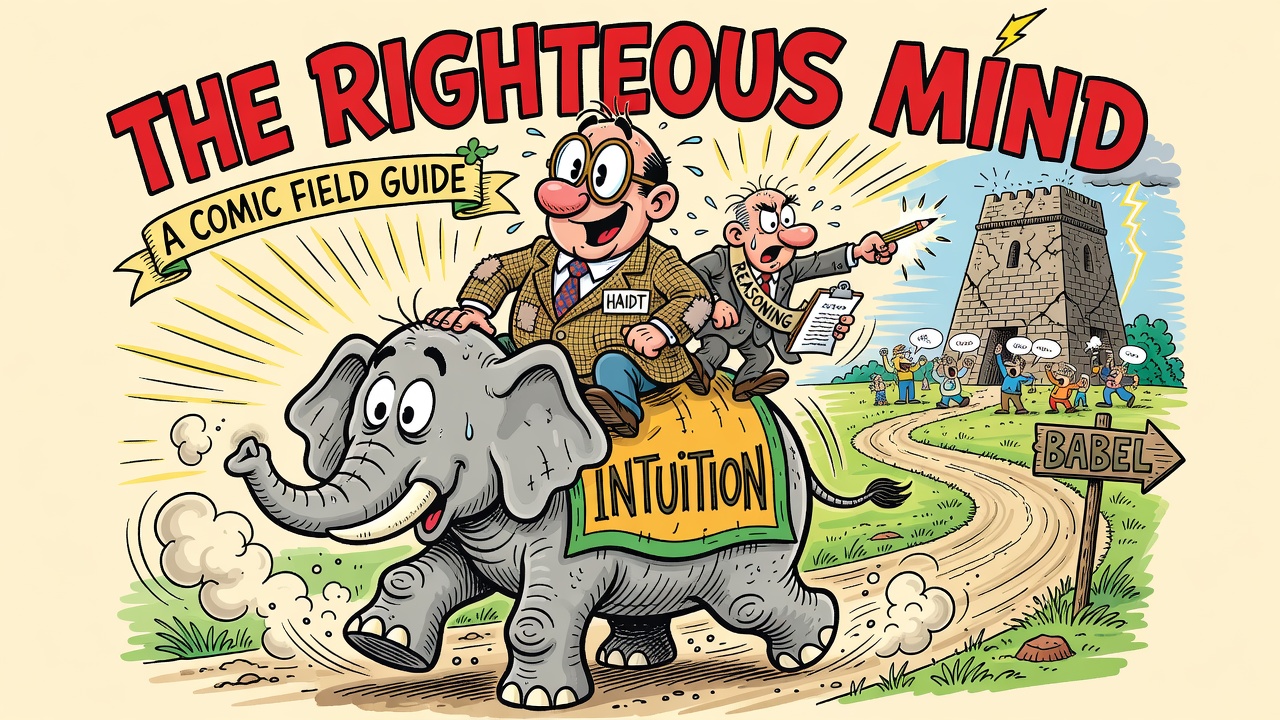
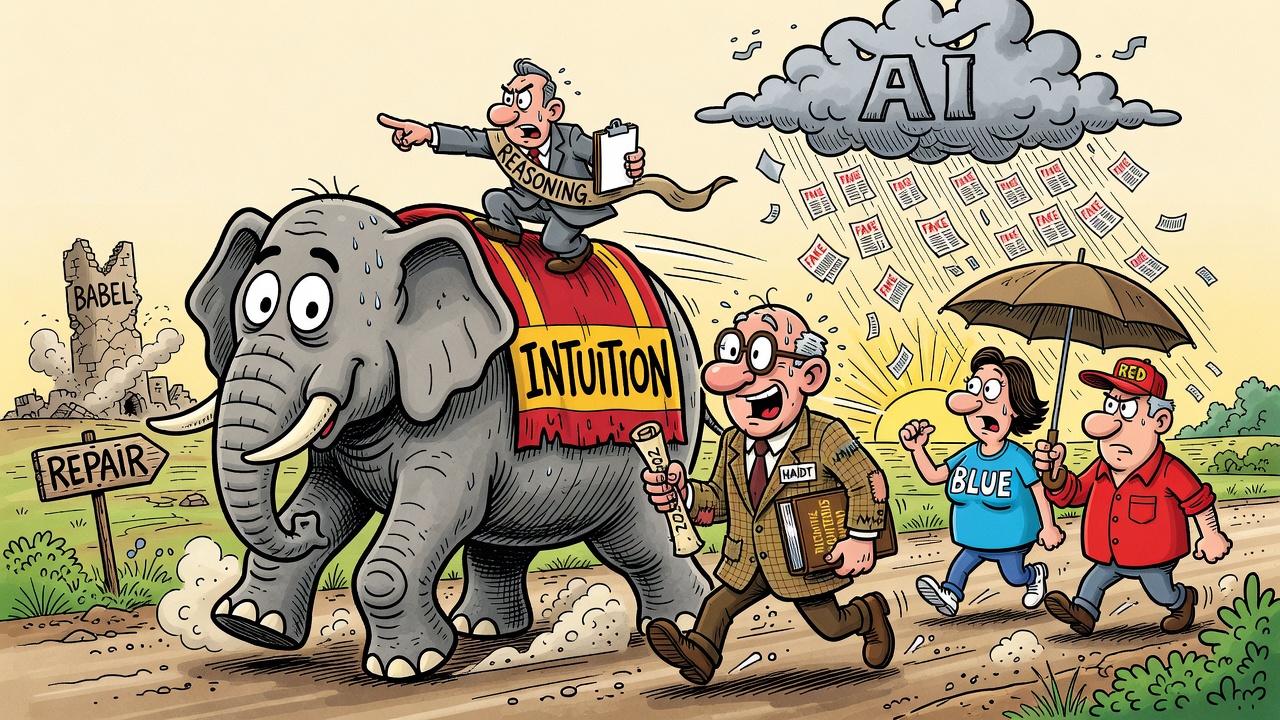
The whole journey in one frame Professor Haidt, one very large elephant, one very small rider — and a cracked tower waiting at the end of the road.
PART I
Intuitions Come First, Strategic Reasoning Second
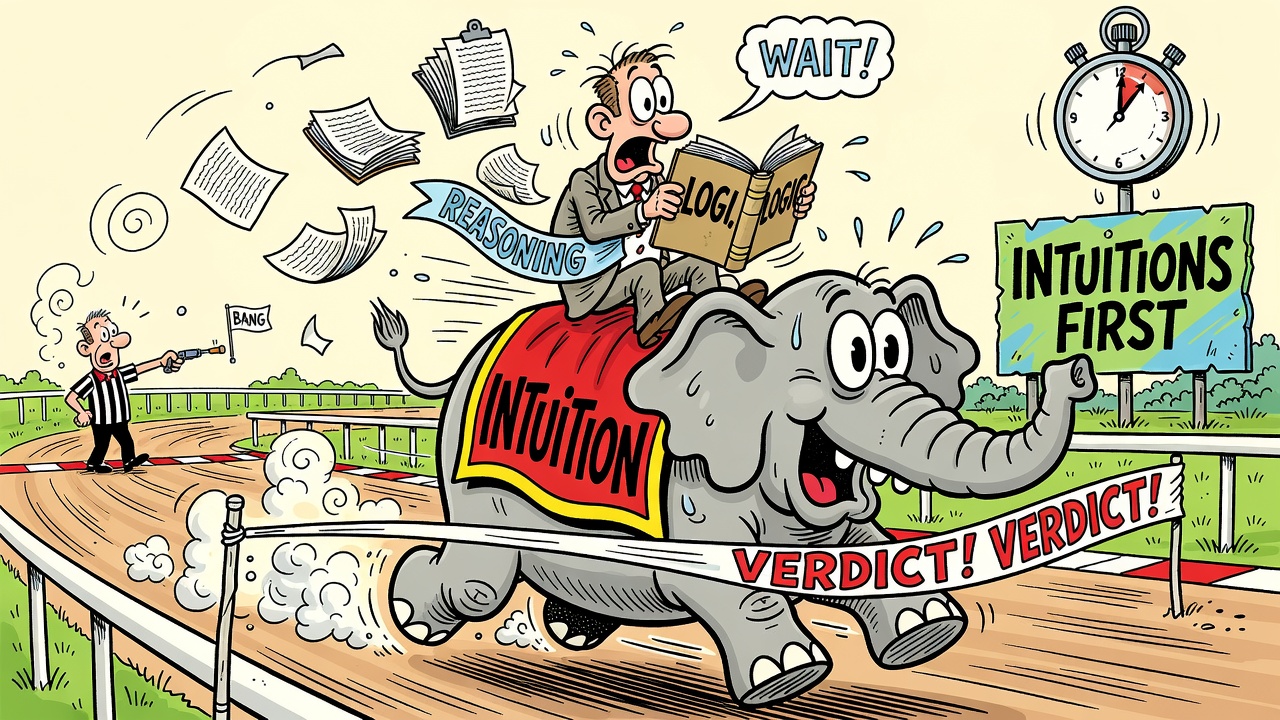
Before Haidt says a word about politics or religion, he starts with the machinery of moral judgment itself — and the news is humbling. Our gut reactions fire instantly and automatically, and conscious reasoning shows up afterward, mostly to justify what the gut already decided. Haidt pictures the pair as a tiny rider perched on a huge elephant, and once you meet them you will recognize them in every argument you have ever lost.
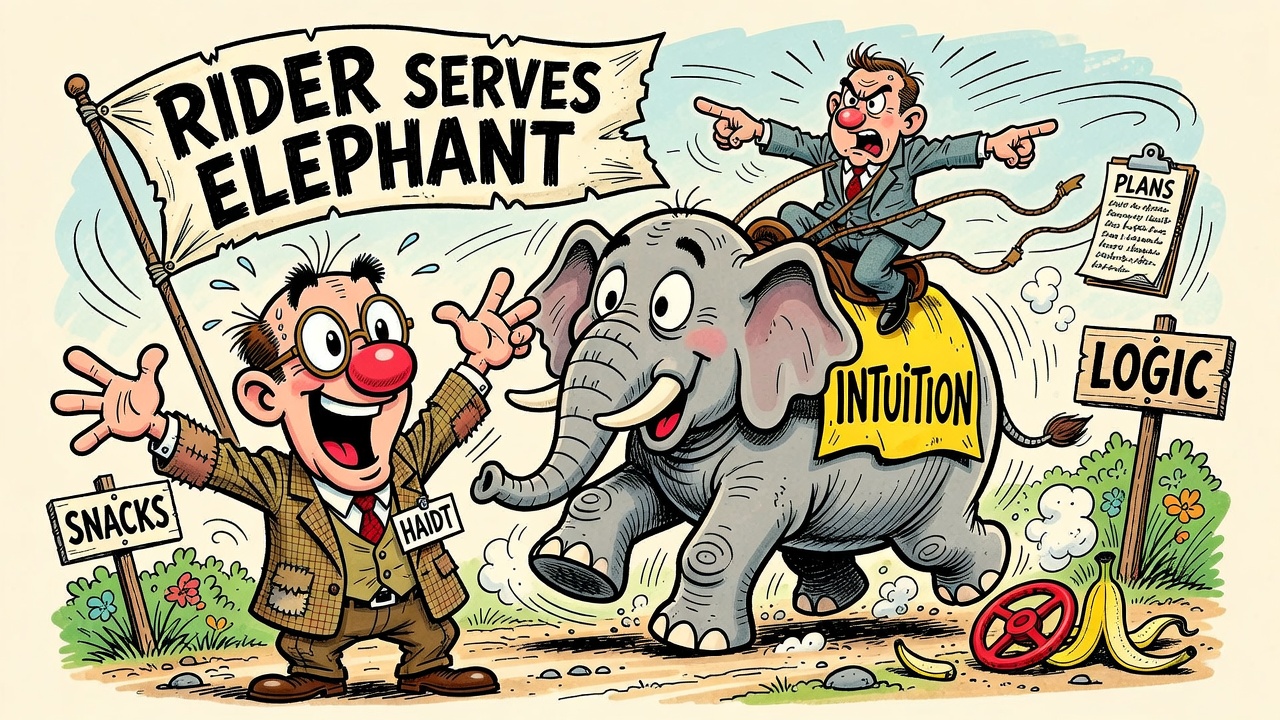
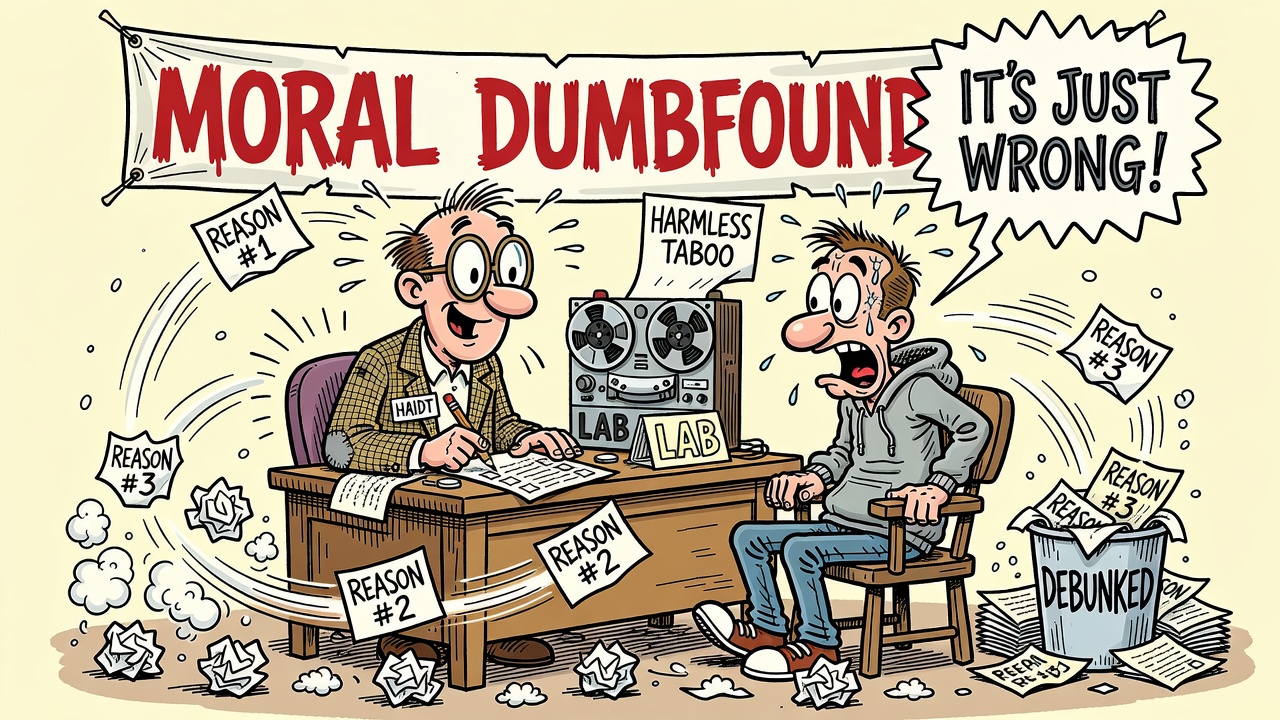
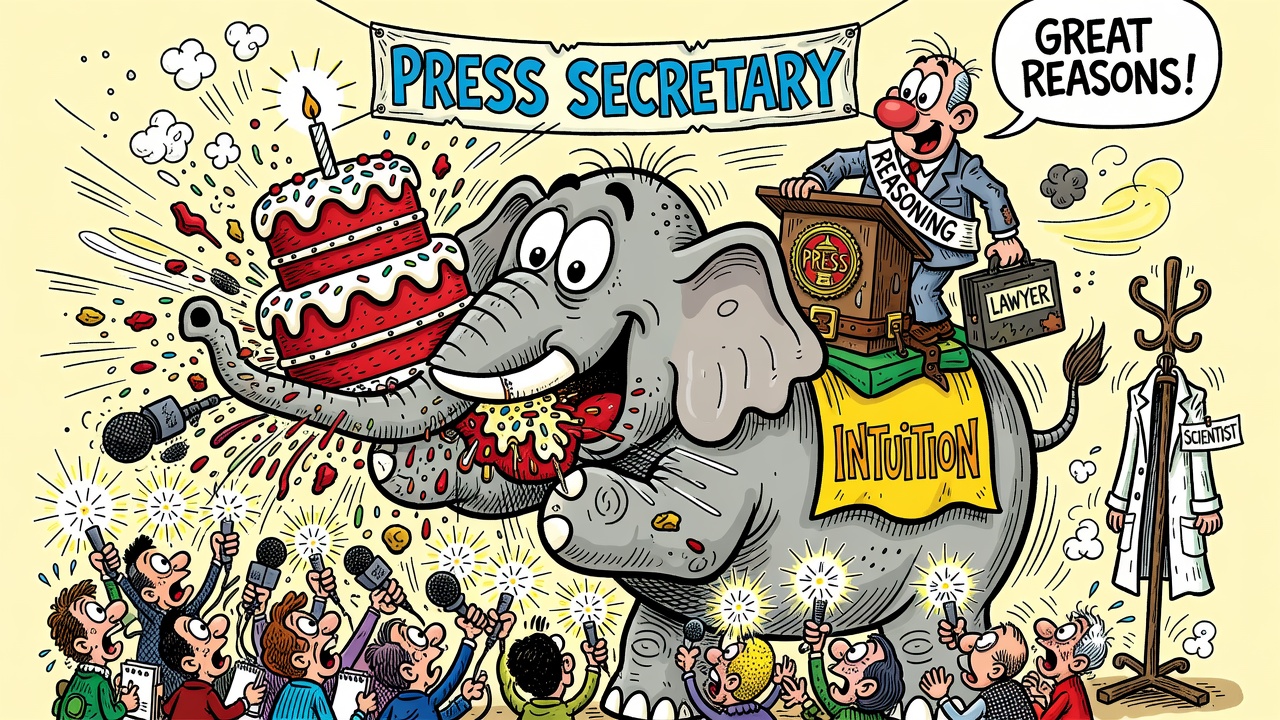
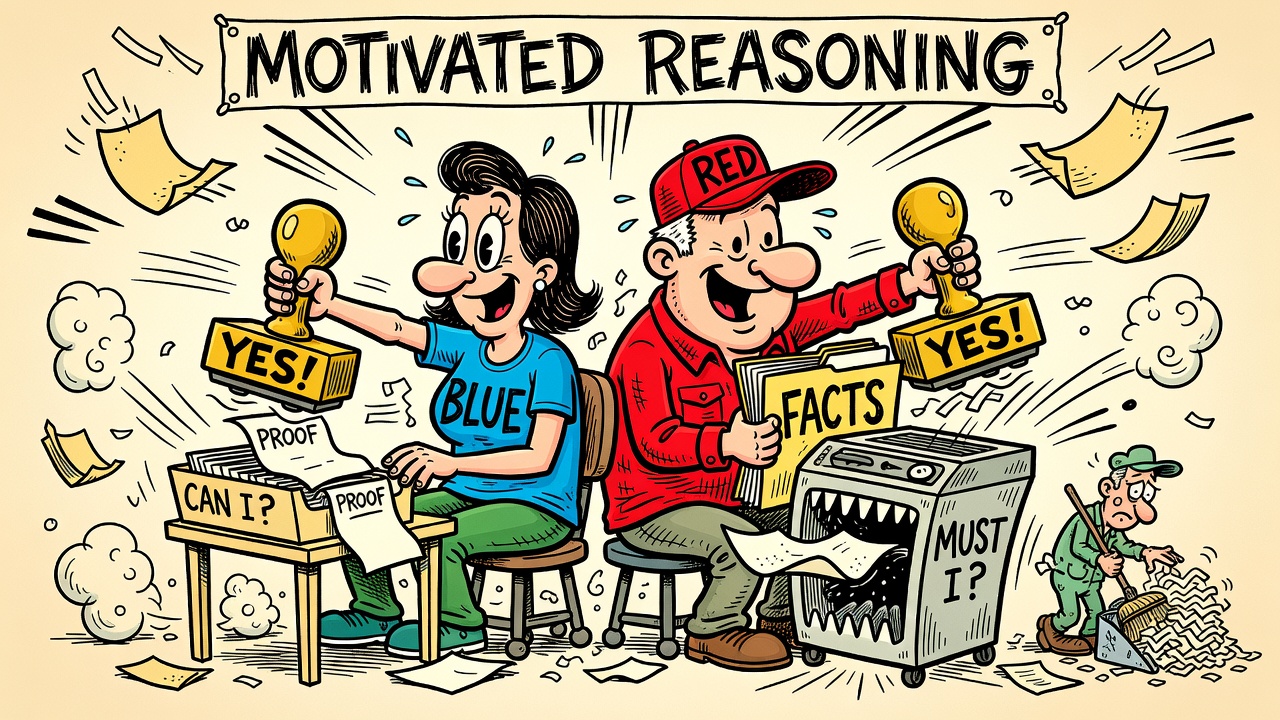
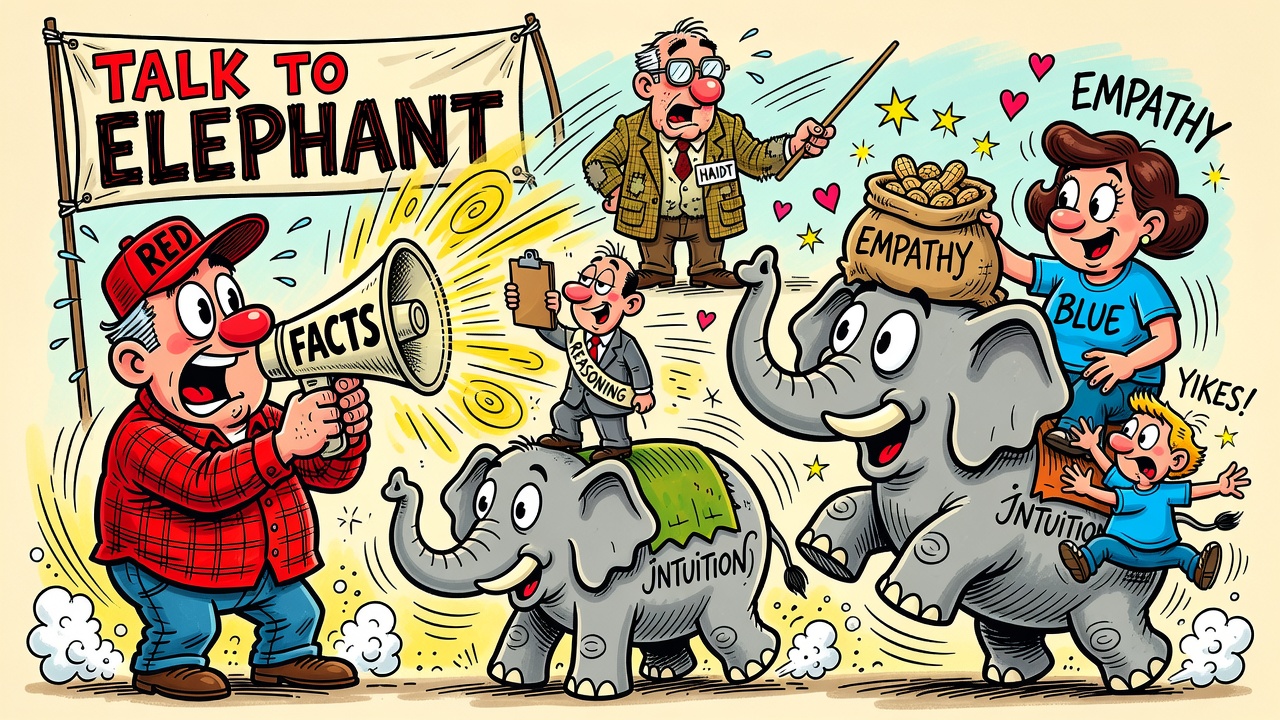
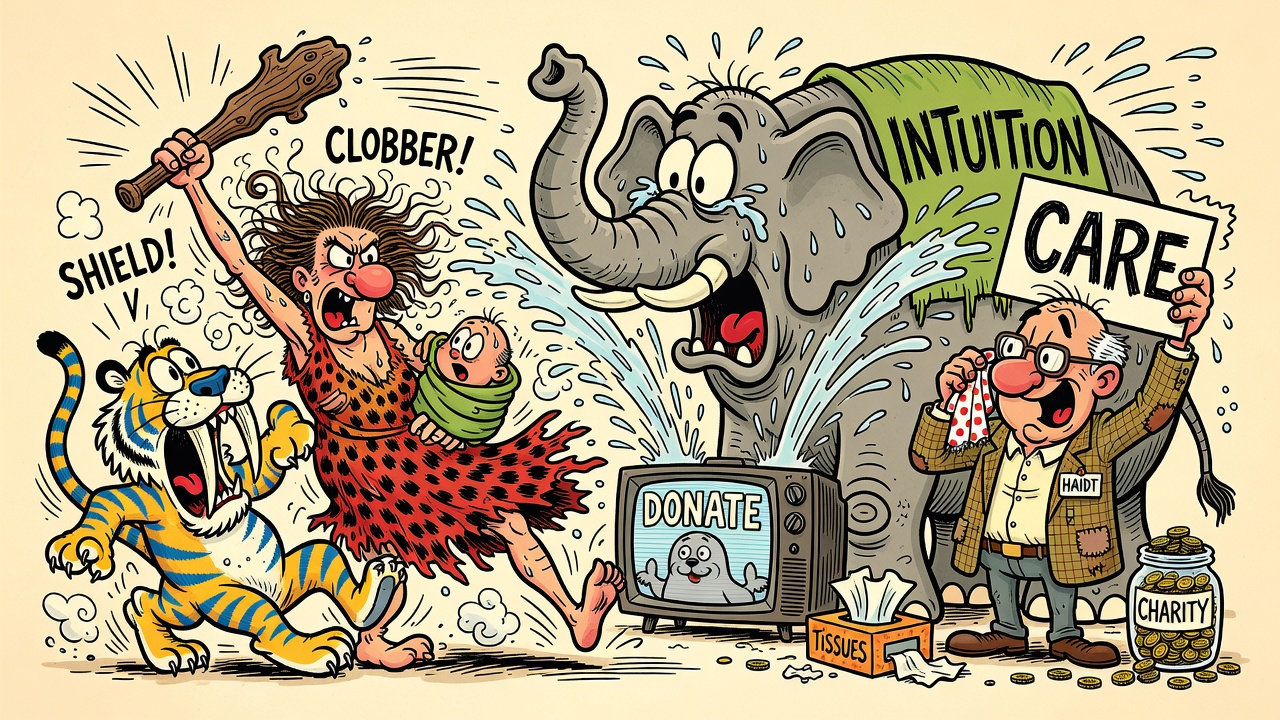
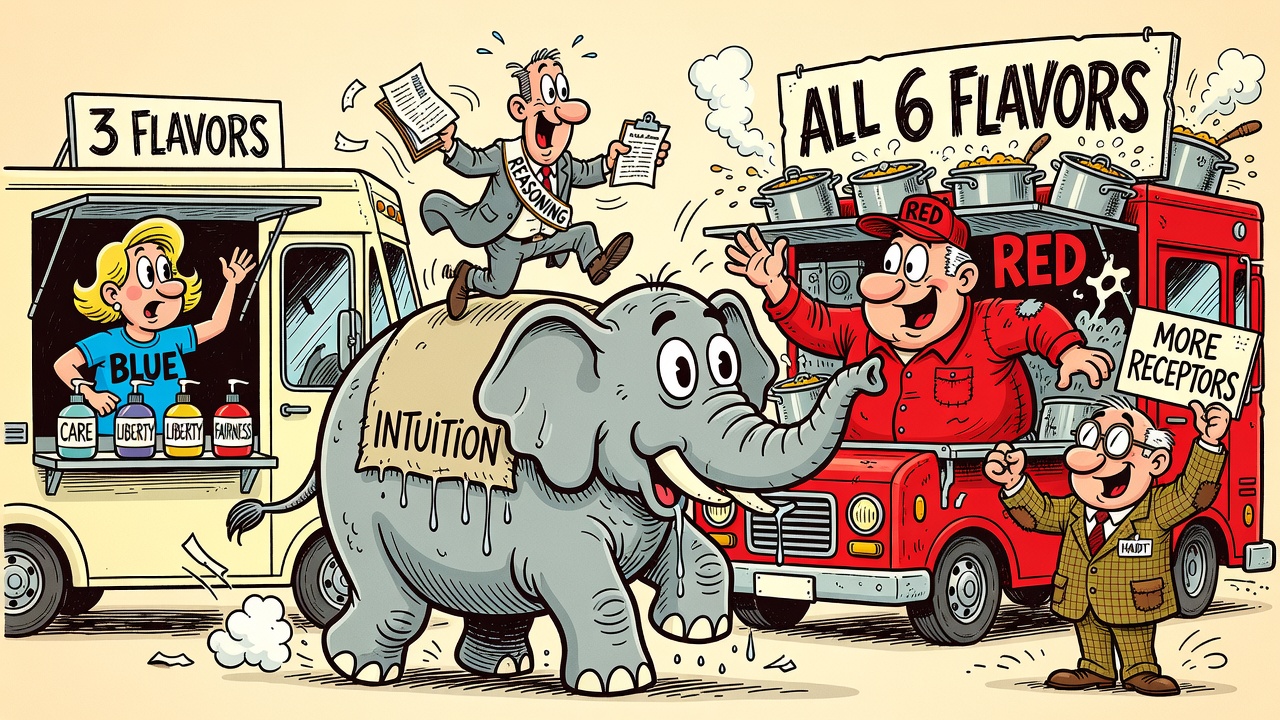
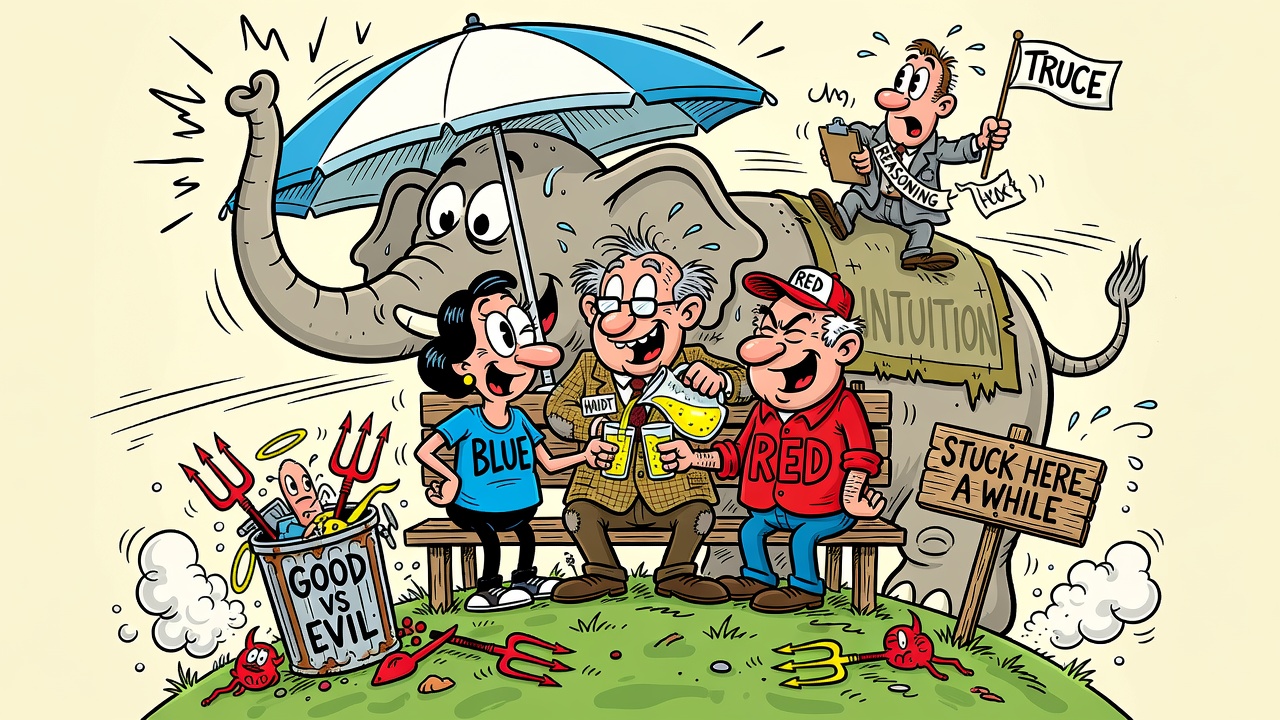
The Rider and the Elephant Haidt's central metaphor: the mind is divided like a tiny rider on a huge elephant. The rider is conscious, controlled reasoning; the elephant is everything automatic — intuition, emotion, gut feeling — and the rider evolved to serve the elephant, not to steer it.Moral Dumbfounding In Haidt's 'harmless taboo' experiments, people instantly condemned strange-but-victimless stories, then couldn't defend the verdict once each of their reasons was gently debunked — yet they stuck with it anyway: 'I can't explain it, it's just wrong.' The judgment came first; the reasons were manufactured afterward.Intuitions Come First This is Haidt's social intuitionist model: moral judgment works like a rigged race, where the flash of intuition crosses the finish line in milliseconds and strategic reasoning only starts running afterward — to explain the verdict, not to produce it.The Inner Press Secretary The rider works less like a scientist searching for truth and more like a press secretary or inner lawyer: whatever the elephant already did or leaned toward, the rider's full-time job is issuing confident public justifications for it.Can I? vs. Must I? Motivated reasoning in one question: when we want to believe something we ask 'Can I believe it?' and accept the flimsiest supporting scrap, but when we don't want to, we ask 'Must I believe it?' and hunt for any excuse to reject it. Everyone does it — left and right alike — and we almost always find what we're looking for.Talk to the Elephant The practical upshot: you can't win a moral argument by refuting the rider, because the rider will simply draft new talking points. Speak to the elephant first — warmth, empathy, genuine relationship — because when the elephant leans, the rider follows.
PART II
There Is More to Morality than Harm and Fairness
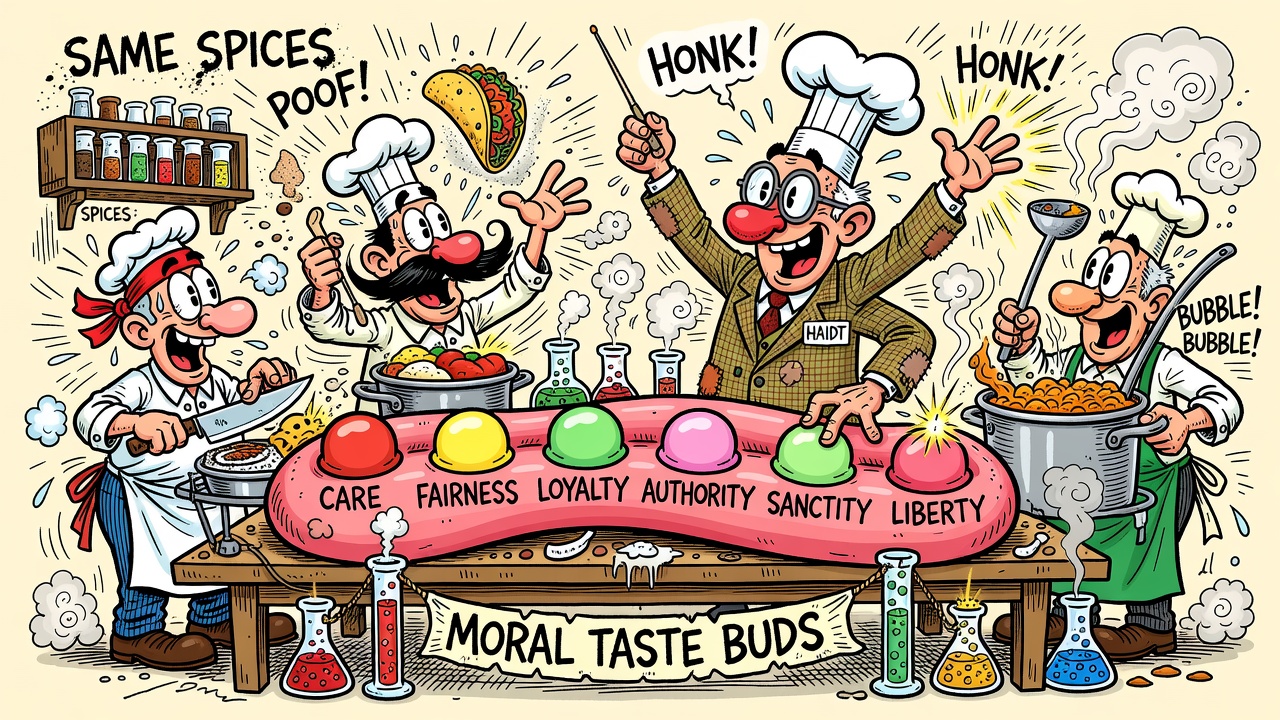
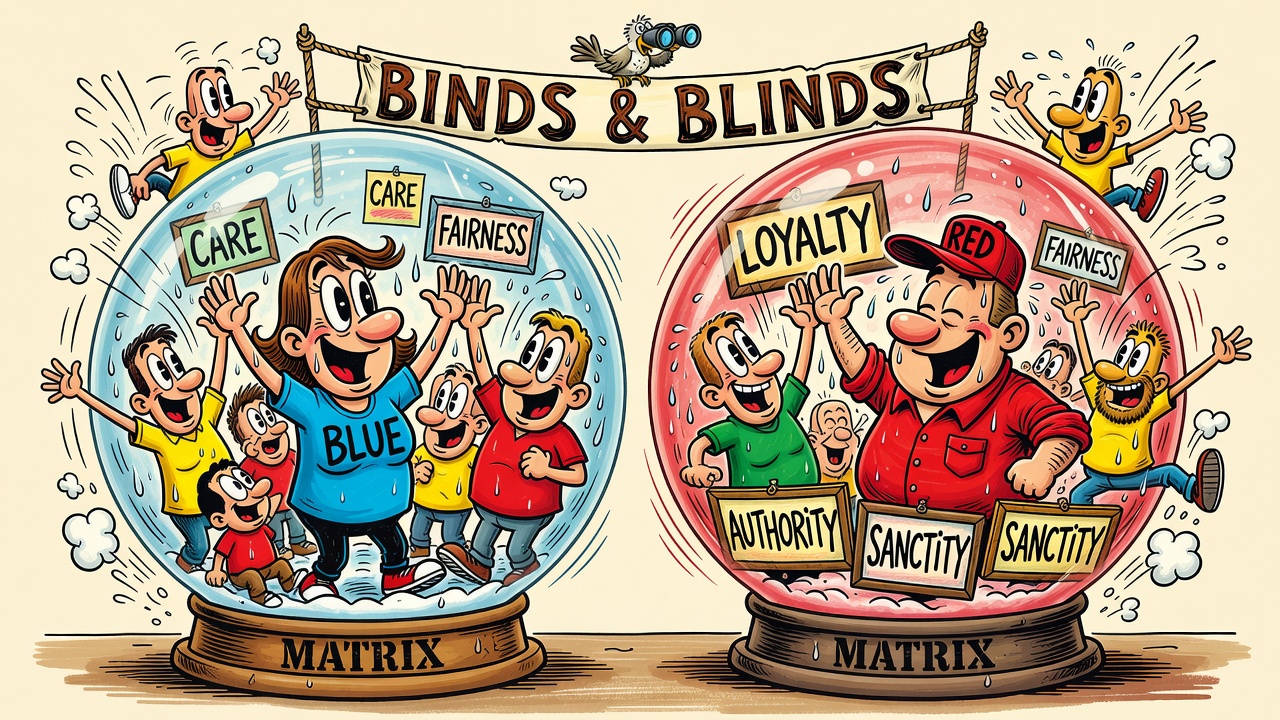
Psychology's picture of morality, it turns out, was drawn almost entirely from the strangest people on Earth — and Part II of The Righteous Mind is where Haidt widens the lens. His second principle: there's more to morality than harm and fairness. The righteous mind works like a tongue with six moral taste receptors — Care, Fairness, Loyalty, Authority, Sanctity, and Liberty — and every culture and political tribe cooks its own cuisine on the same six buds. Which side's cooking hits more receptors turns out to matter enormously at the ballot box.
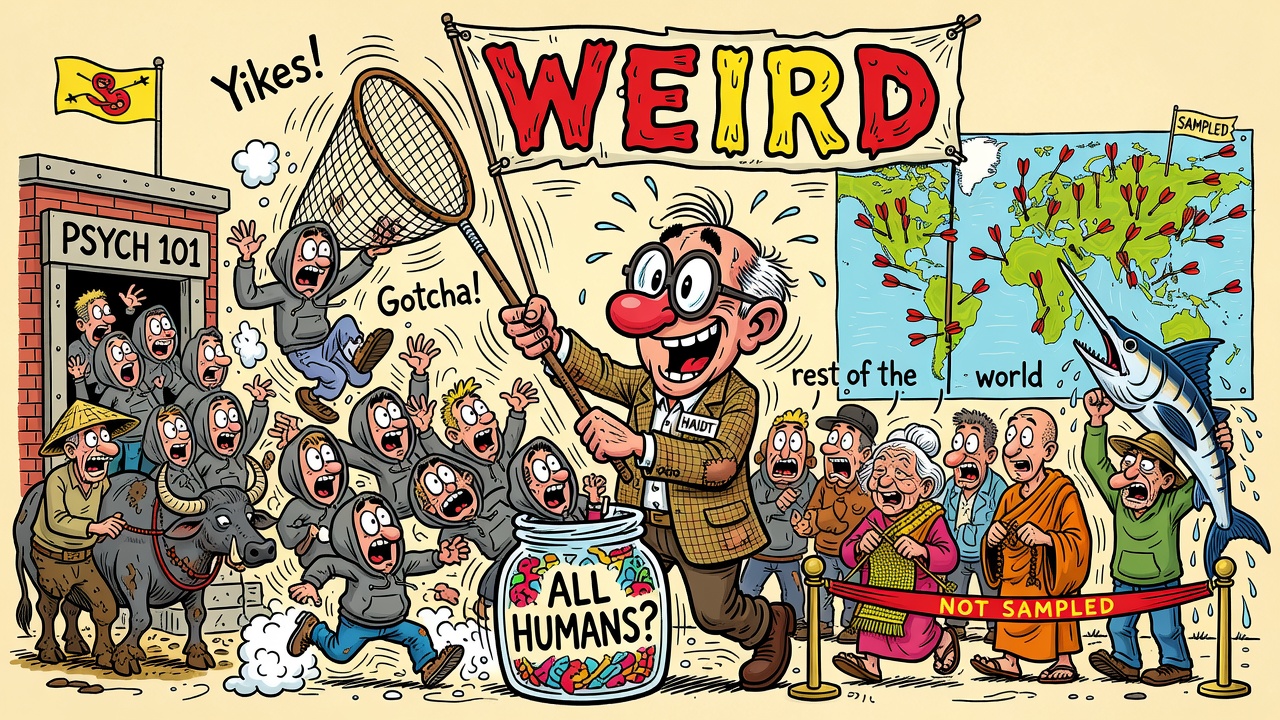
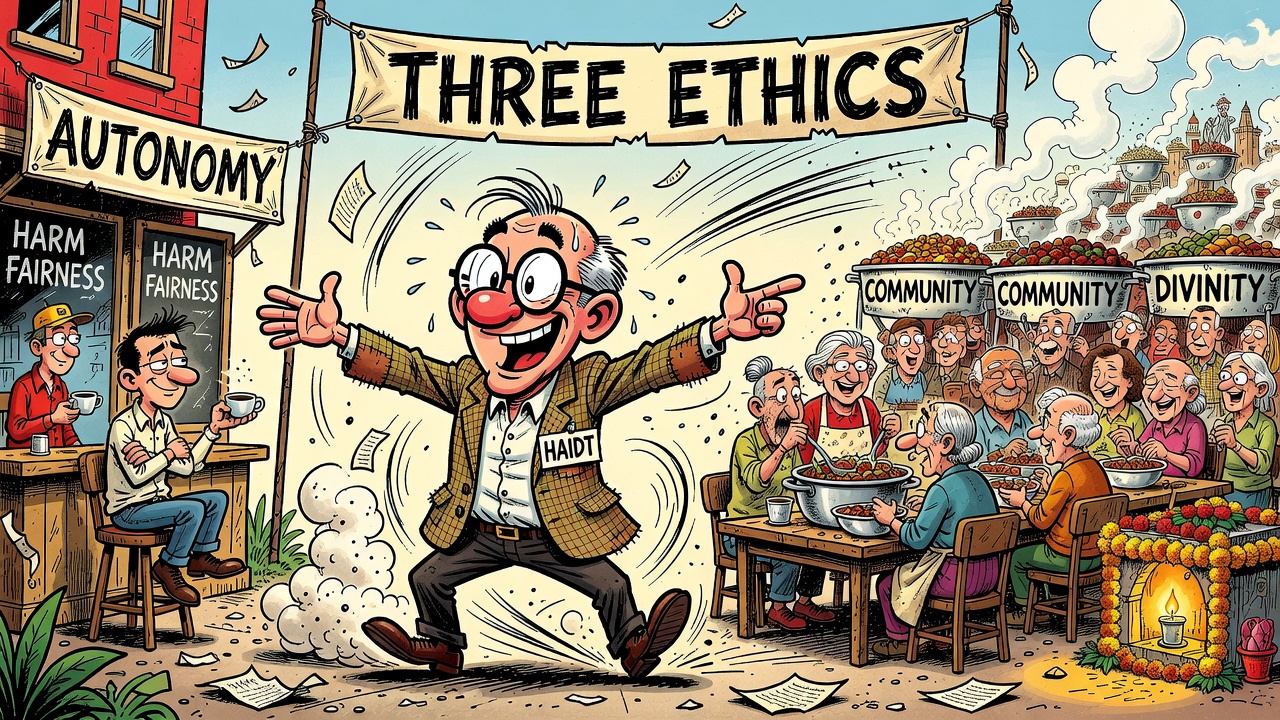
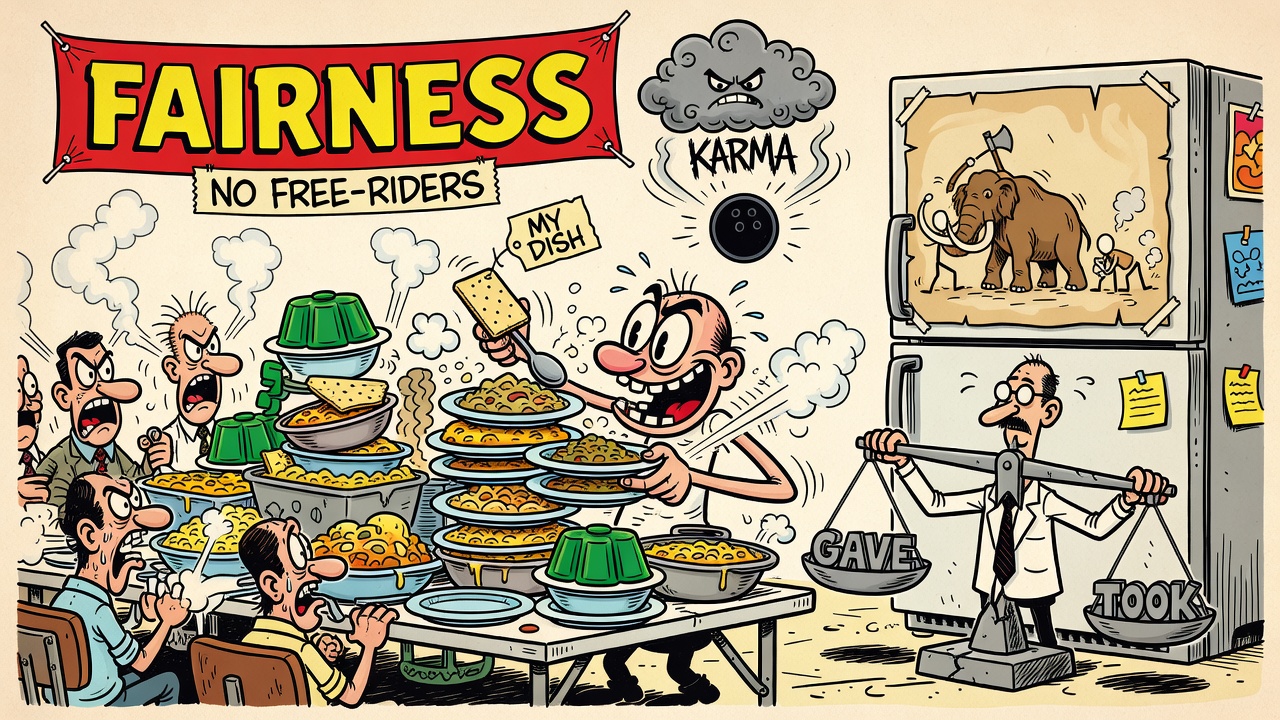
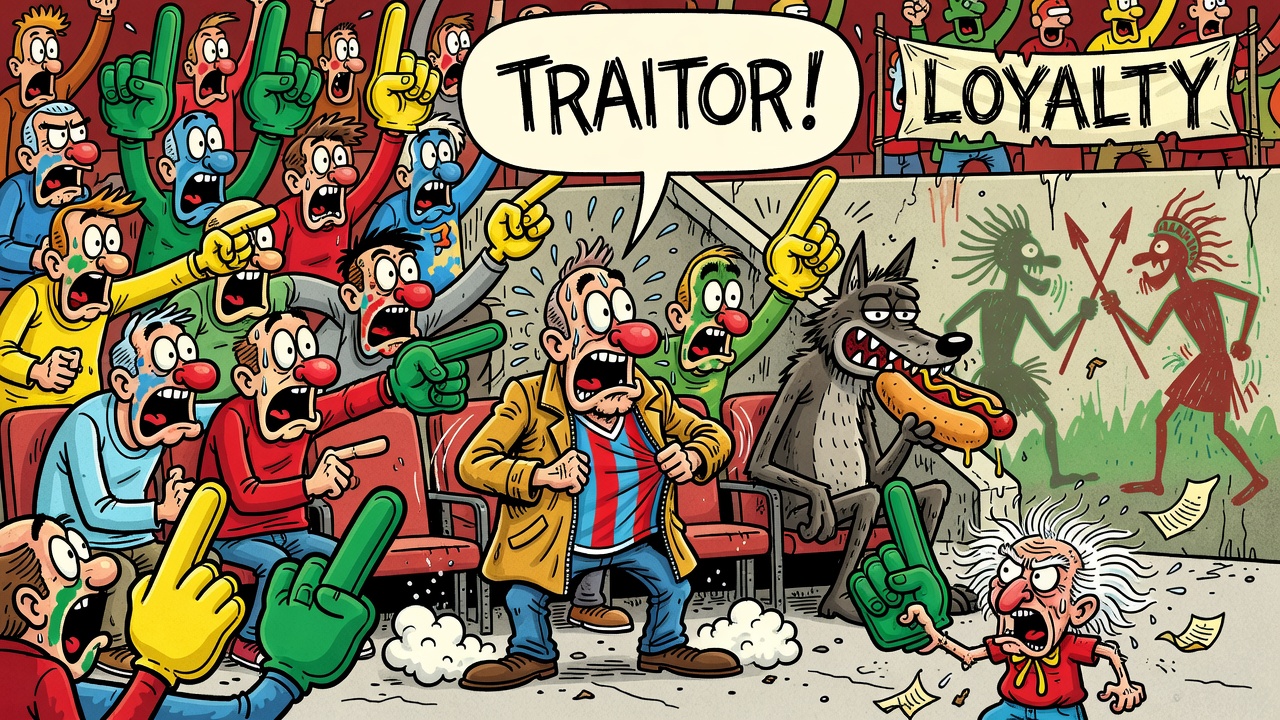
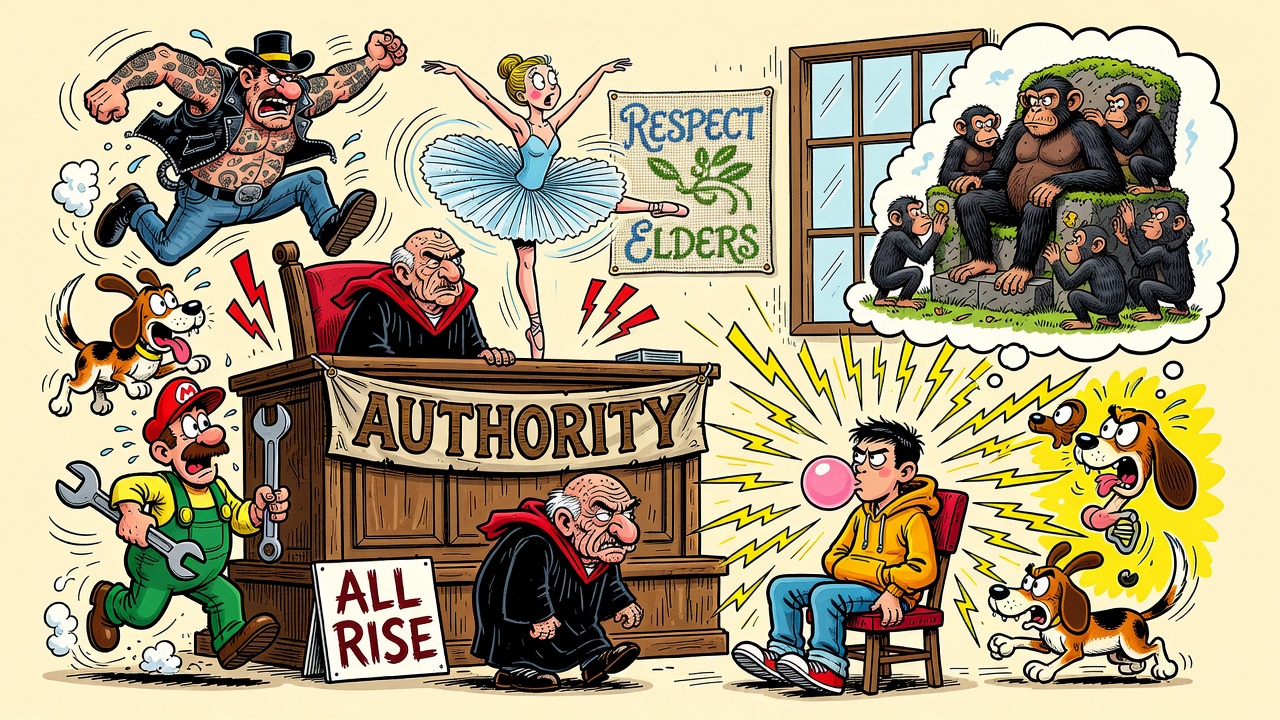
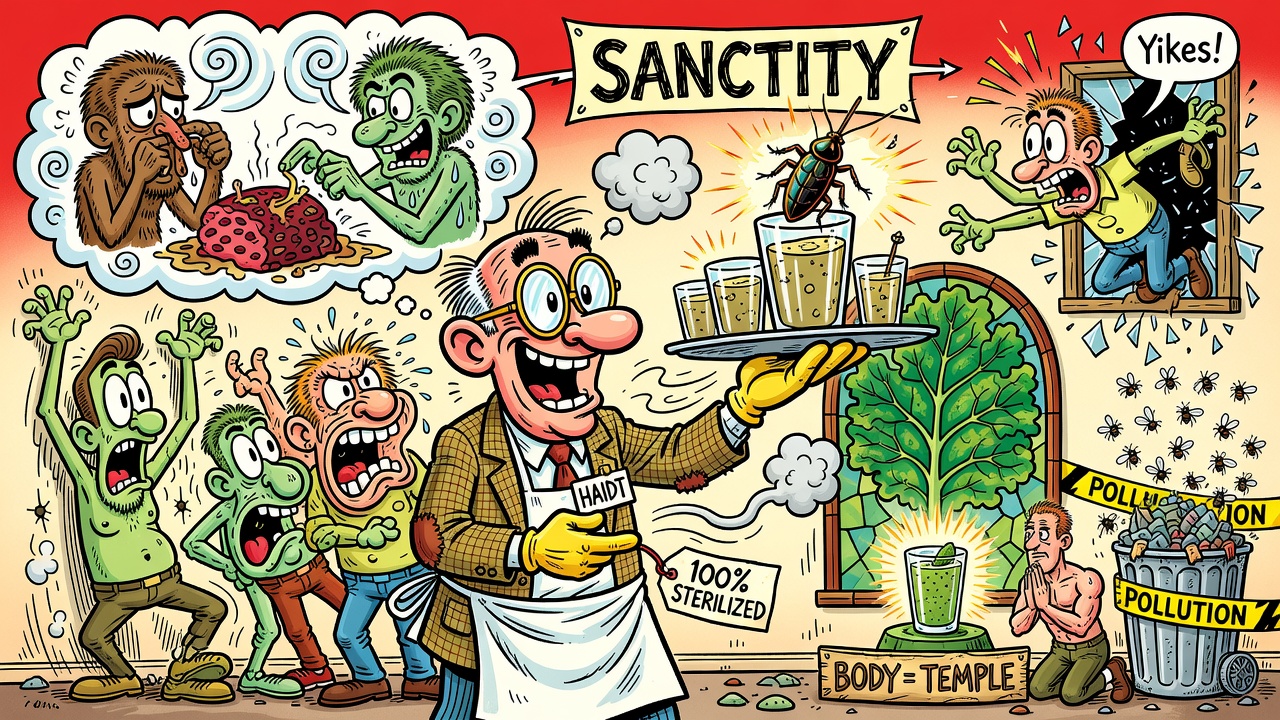
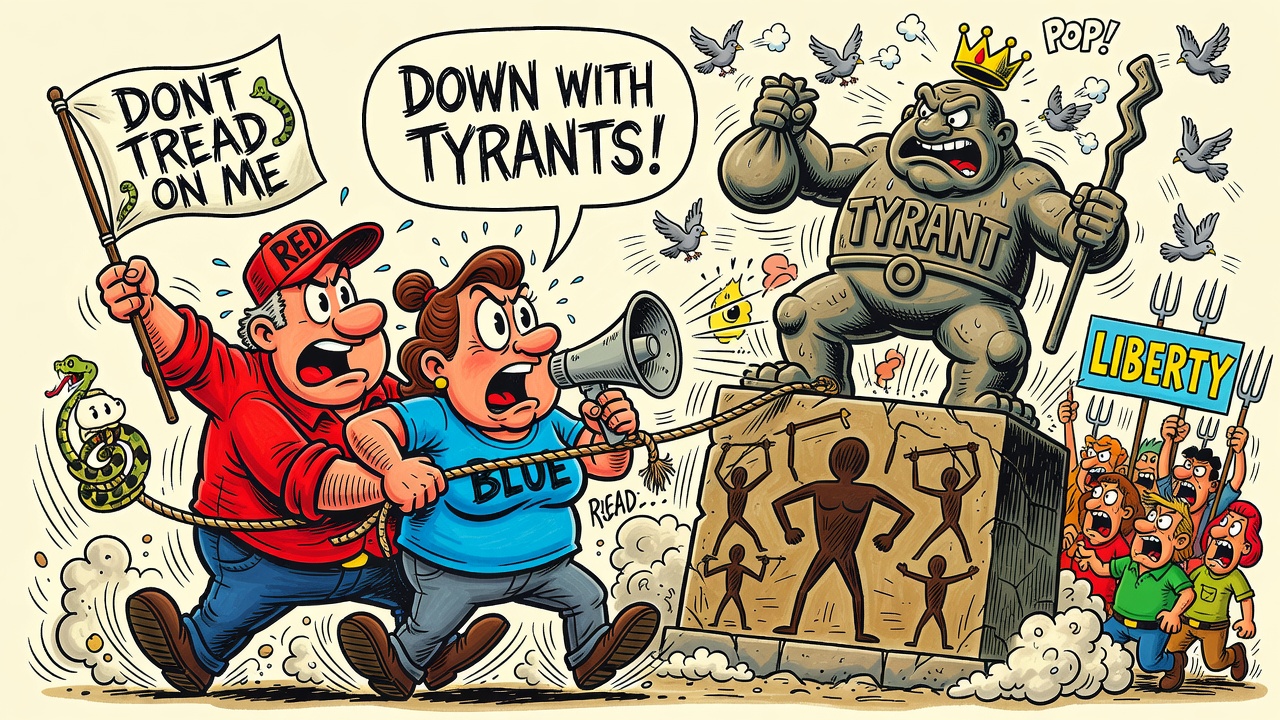
The WEIRD Outliers Moral psychology was built almost entirely on subjects who are Western, Educated, Industrialized, Rich, and Democratic — statistical outliers who are among the least representative humans on Earth. WEIRD people tend to shrink morality down to harm and fairness; most of humanity's moral world is far bigger.A Bigger Moral Menu Richard Shweder found that most cultures moralize in three registers: an ethic of autonomy (individual rights and harm), of community (duty, family, group honor), and of divinity (purity and the sacred). WEIRD societies order almost exclusively off the autonomy menu — the other two ethics feed most of the world.Six Moral Taste Buds Haidt's central image: the righteous mind is like a tongue with six moral taste receptors. Cultures and ideologies are cuisines — endlessly different dishes, all cooked on the same evolved receptors.Care / Harm The Care/harm foundation evolved for the mammalian job of protecting vulnerable children, and it now fires at any sign of suffering or cruelty — baby seals, sad-eyed puppies, cartoon victims. Nurture soothes it; cruelty sets it ablaze.Fairness / Cheating Fairness/cheating evolved to make reciprocal partnership pay: cooperate with those who cooperate, and punish cheaters and free-riders. Haidt stresses that it runs on proportionality and karma — people should get what they earn — not on equality of outcomes.Loyalty / Betrayal Loyalty/betrayal grew out of our long history of forming coalitions that competed with rival groups — team sports are its modern playground. It is why the traitor inside the group is hated far more fiercely than the enemy outside it.Authority / Subversion Authority/subversion evolved for life in hierarchies, where rank and deference kept the peace. It underlies respect for elders, institutions, and traditions — and the flash of outrage when somebody refuses to stand for the judge.Sanctity / Degradation Sanctity/degradation is built on disgust and contamination psychology, which first protected our omnivore ancestors from pathogens. It lets people treat the body as a temple and things as sacred or polluted — which is why a perfectly sterilized cockroach still ruins the juice.Liberty / Oppression Liberty/oppression — the sixth foundation, which Haidt added later — is the ancient hatred of bullies and would-be dominators. It powers both the don't-tread-on-me right and the egalitarian left's rage against tyrants: everybody grabs the rope to pull the bully down.The Conservative Advantage Liberal morality rests chiefly on Care, Liberty, and Fairness; conservative morality draws on all six foundations more evenly. That is the 'conservative advantage': appeals built on six receptors hit more of the moral tongue, and they speak straight to the elephant.
PART III
Morality Binds and Blinds
In the final part of The Righteous Mind, Haidt zooms out from individuals to groups. We are mostly selfish primates, he argues, but evolution also gave us a bee-like capacity to fuse into teams — and religion, ritual, and politics all run on that hive wiring. The catch is that the same shared morality that binds each team together also blinds it to what other teams can plainly see. The way out is not to declare a winner, but to notice that left and right each guard truths the other side needs.
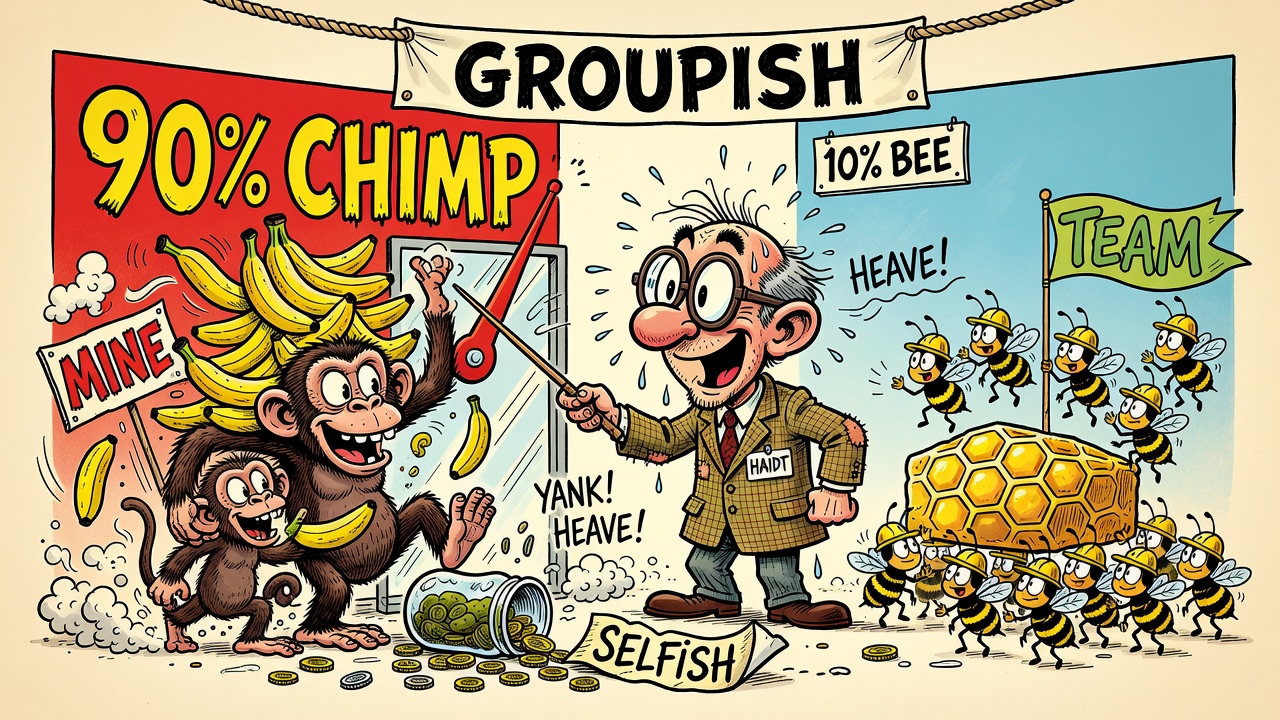
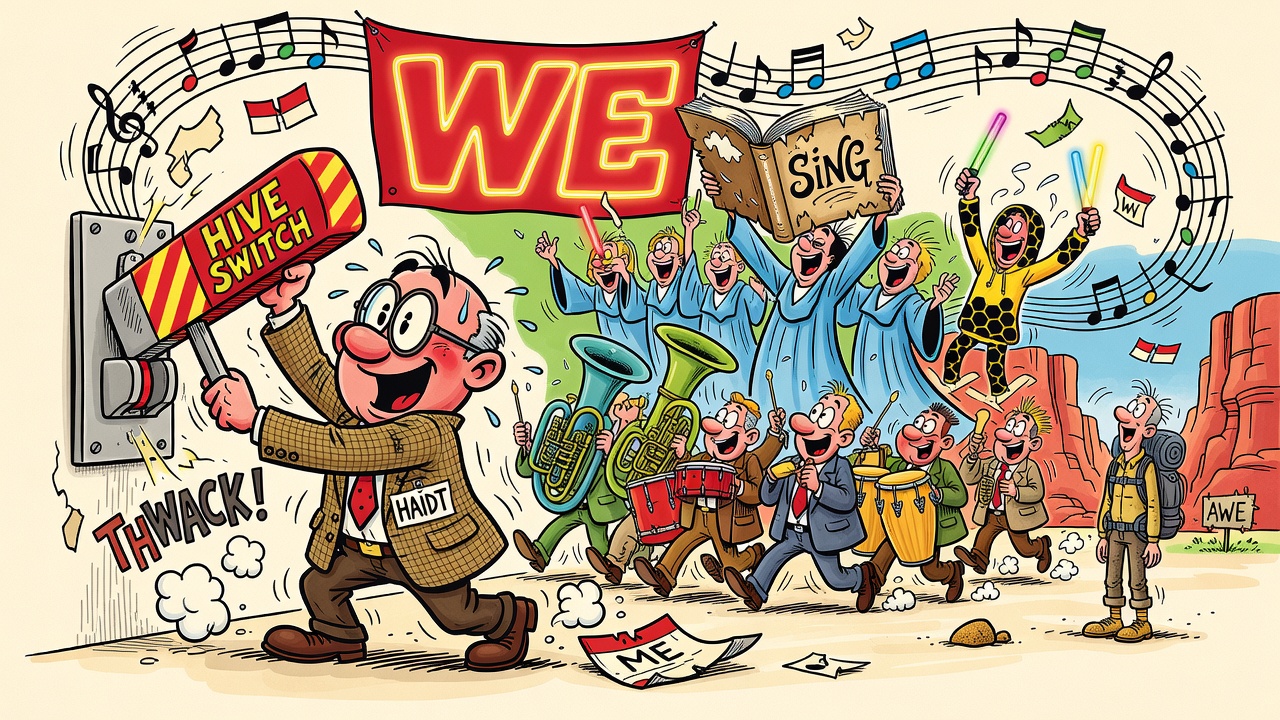
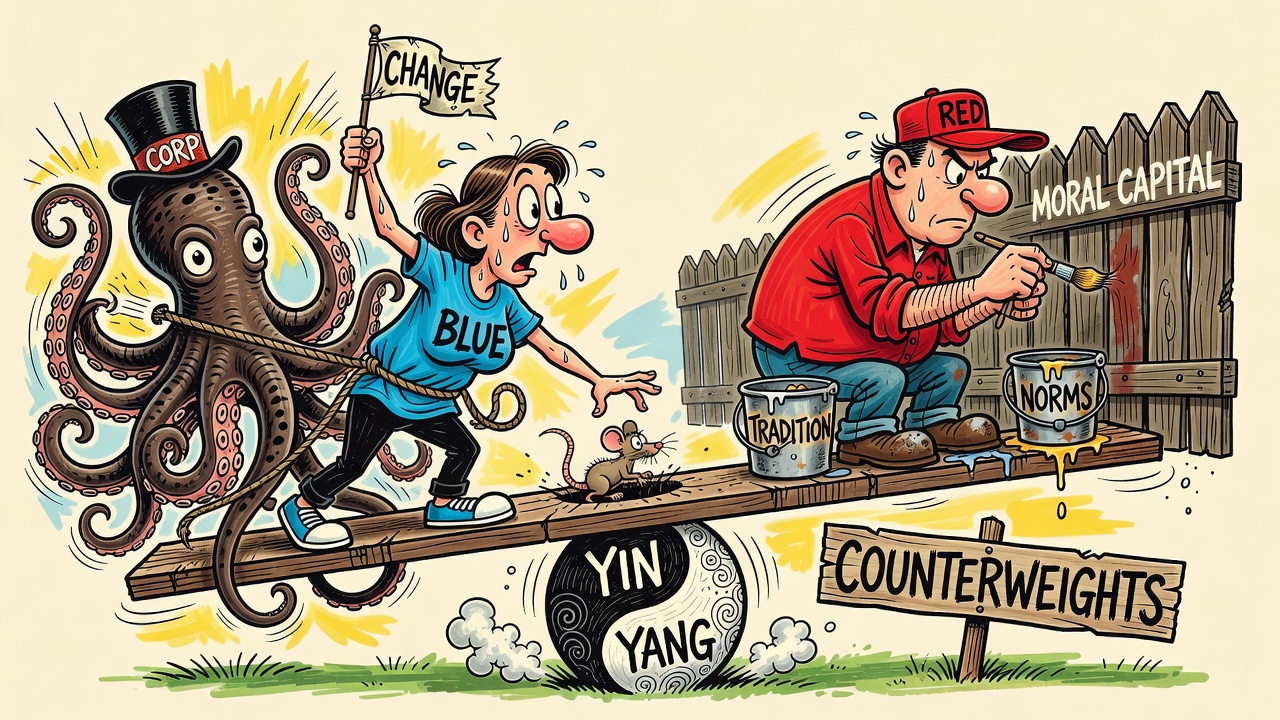
90% Chimp, 10% Bee Haidt's formula for human nature: we are roughly 90 percent chimp — self-interested primates competing with one another — and 10 percent bee. Multilevel selection layered a groupish overlay onto our selfish core, so under the right conditions we can stop scrambling for ourselves and fuse into cooperative teams.The Hive Switch The 'hive switch' is that bee-like capacity in action. Under the right conditions — marching in step, dancing, singing together, raves, or awe at nature — the boundaries of the self dissolve and people flip into self-transcendence, feeling briefly like part of a larger whole.Religion as Team Sport Haidt rejects the view of religion as a parasitic 'mind virus.' Seen functionally, it works more like a team sport: it binds communities together and solves problems of trust and cooperation — and the evidence suggests the benefits flow from belonging and shared practice more than from belief itself.Binds and Blinds Every moral team lives inside a matrix of shared meanings — values, symbols, and sacred stories — that holds it together, and because that matrix feels like plain reality from the inside, it also blinds members to the genuine truths visible from other matrices. That is the book's motto: morality binds and blinds.Yin and Yang Haidt casts left and right as yin and yang: liberals genuinely see victims and push needed change — caring for the powerless and restraining corporate superorganisms — while conservatives genuinely guard moral capital, the traditions, institutions, and norms that cooperation depends on. Each side is a counterweight the other needs to keep society balanced.Stuck Here Together Haidt closes by urging us out of the Manichaean good-versus-evil frame, quoting Rodney King: 'we're all stuck here for a while.' Once you grant that the other side is made of good people guided by a different moral matrix, disagreement stops being war and starts being useful.
✦ TEN YEARS LATER ✦
The book ended in 2012 with a handshake: good people, different matrices, stuck here together. Then everyone was handed a dart gun. The sequel is the story of what the dart guns did.
THE SEQUEL · 2022
Why the Past 10 Years of American Life Have Been Uniquely Stupid
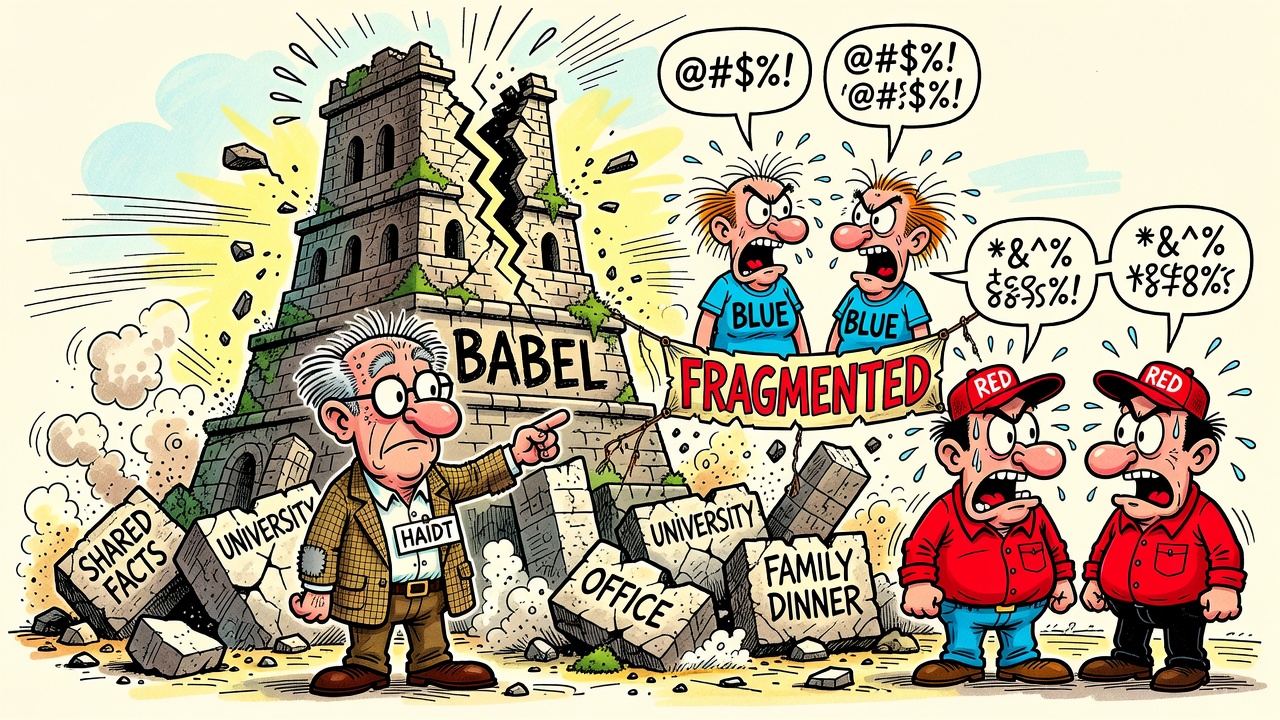
A decade after The Righteous Mind, Haidt wrote a sequel of sorts: a 2022 Atlantic essay called "Why the Past 10 Years of American Life Have Been Uniquely Stupid." The book explained why good people disagree; the essay asks what happened when those disagreements got wired through machines that reward outrage. His answer borrows an old image — the Tower of Babel — because America didn't just split in two, it shattered into pieces that no longer share a language.
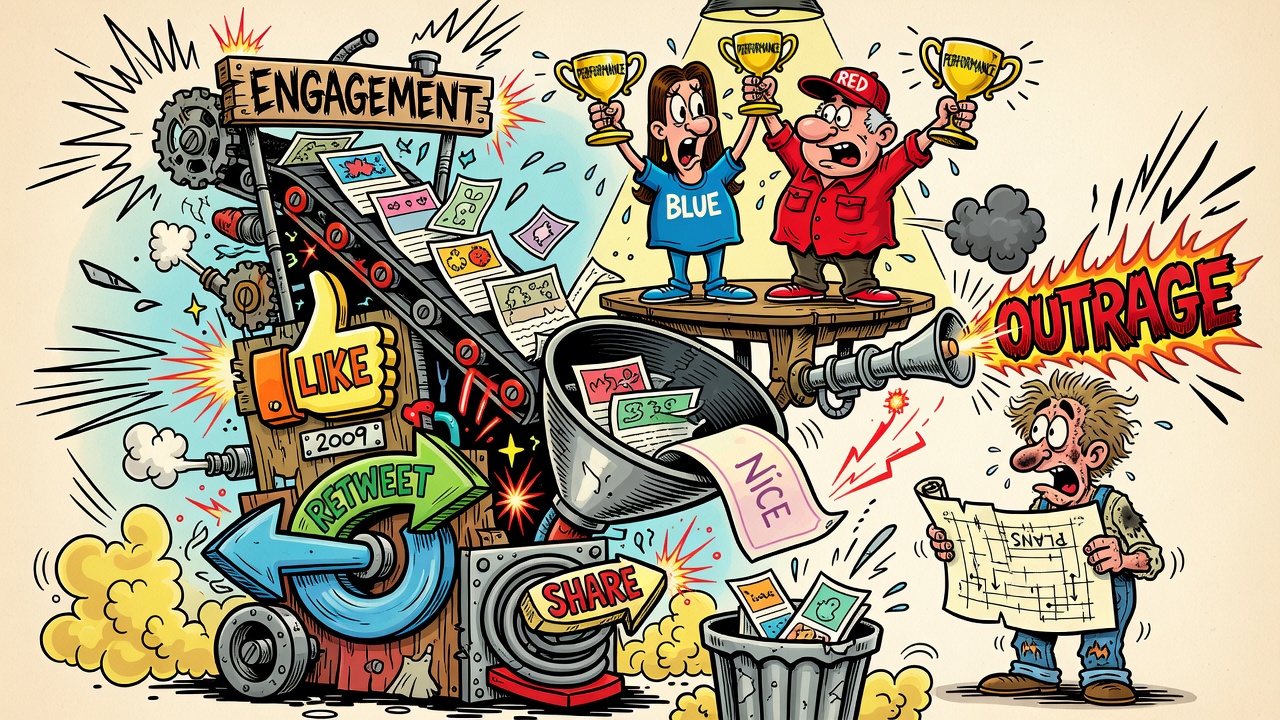
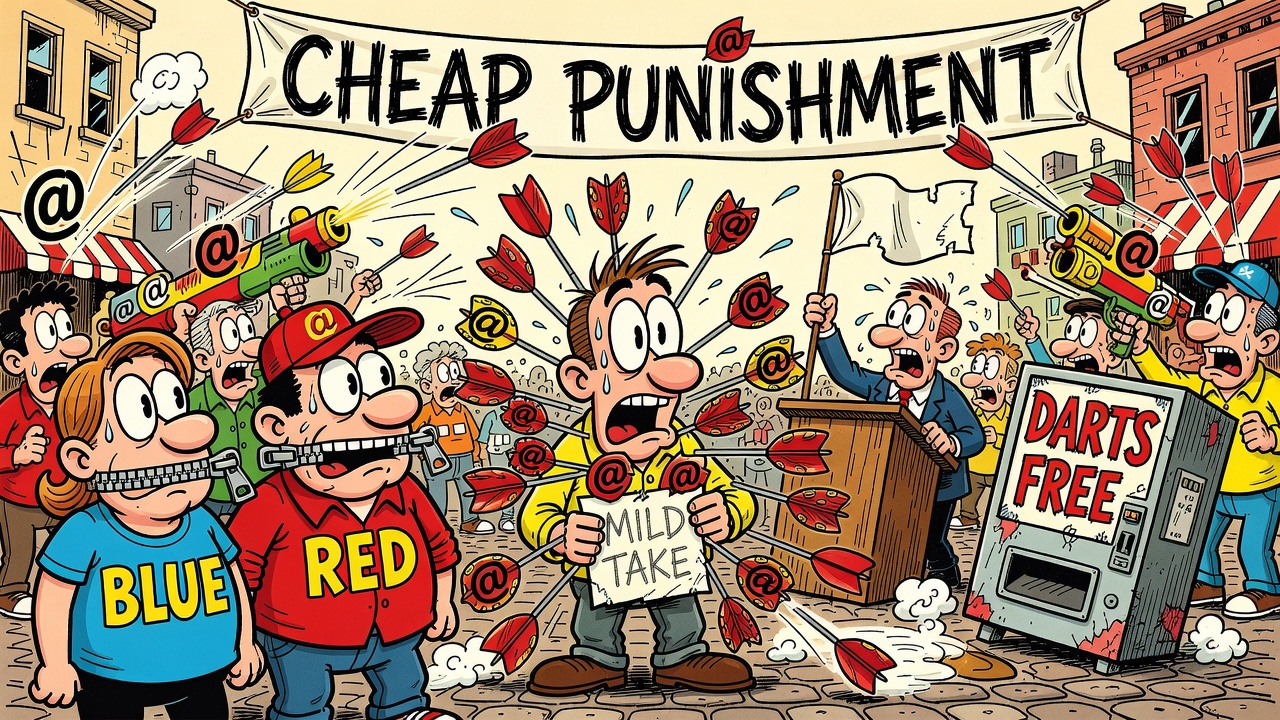
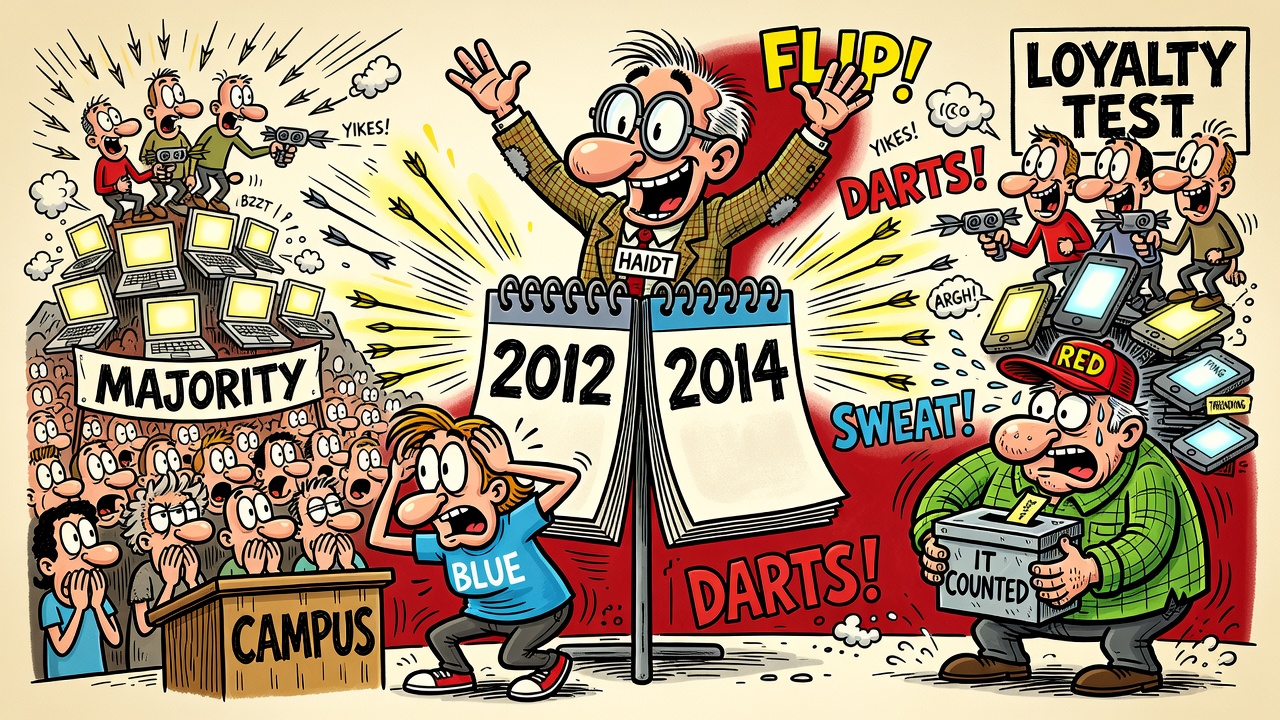
The Tower Falls Haidt's image for the 2010s isn't a country split neatly in two — it's the Tower of Babel. America fragmented: shared stories and shared facts crumbled, and the cracks run within the left, within the right, and straight through universities, companies, and family dinner tables.Before the Like Button Through the 2000s, social media was mostly benign connective tissue — old classmates found, baby photos shared. The machinery of mass outrage hadn't been installed yet.The Outrage Machine Between 2009 and 2012 the Like button, the Retweet, the Share button, and engagement-ranked feeds rewired everything: tools for connecting became stages for performing. Research later showed each moral-emotional word in a post makes it travel measurably farther — outrage is the algorithm's favorite fuel.Everyone Gets a Dart Gun The new platforms handed everyone a dart gun: a way to punish anyone, instantly and publicly, at zero cost to the shooter. Few people actually fire, but everyone feels watched — and the fear of being darted quietly changed how people talk in every room.Structural Stupidity Institutions stay smart only when members can voice dissent and correct each other's errors. When darts made disagreement dangerous, that error-correction died — and Haidt argues universities, scholarly associations, creative industries, and political organizations became structurally stupid almost in unison.The 2014 Switch Around 2014 the power-and-privilege frame swept left-leaning institutions — not by persuading a majority, but because a small, extremely-online cohort made dissent suddenly expensive; the mirror-image dynamic on the right punished disloyalty and marched toward stolen-election claims. Different pathologies, same dart guns.Three Buckets of Fixes Haidt's prescriptions come in three buckets: harden democratic institutions against outrage (open primaries, ranked-choice voting), reform the platforms (verify that users are human, add friction before things go viral), and give kids back a free-range, phone-free childhood.Back to the Elephant The Righteous Mind explains why decent people durably disagree; the essay explains why, around 2014, disagreement turned into enforcement. And Haidt warns that the next chapter arrives armed — AI can flood the zone with limitless fake content — which is why the repairs can't wait.