Two sibling websites · one idea

The Places You Will Go & The People You Know

started Jul 21, 2026 · last update Sep 5, 2026

Two websites about the same simple thing: the people who love you would like to know where you are. One tells the story of a single trip while it’s happening. The other keeps a rough map of everyone you know — the city, never the address.

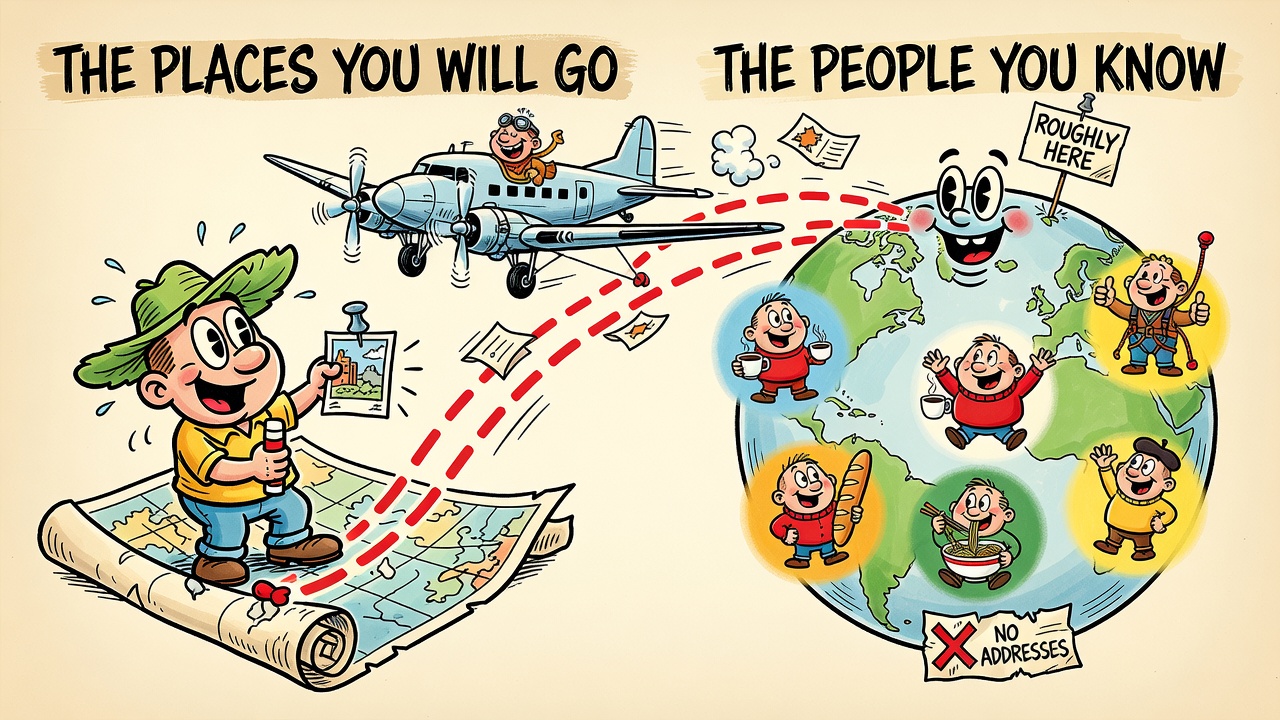
Sergio-Aragonés-style cartoon in two halves. On the left, under a banner reading THE PLACES YOU WILL GO, a grinning traveler in a floppy green hat stands on an unrolled route map holding up a snapshot, while a DC-3 with a goggled pilot tows a red dashed route line off the map. The line arcs across to the right, under a banner reading THE PEOPLE YOU KNOW, onto a smiling cartoon globe where friends wave from soft colored circles instead of sharp pins: one with coffee, one with a baguette, one with ramen, one in a climbing harness. A sign on the globe reads ROUGHLY HERE, and a card at its foot reads NO ADDRESSES with a big red X.
For one trip

The Places You Will Go

Your trip as one live, hand-drawn map that family and friends can follow from home. You log stops as you go; the page draws the route, knows where you are right now, and counts down to what’s next.

$25 per trip · paid once · no subscription

For everyone you know

The People You Know

A globe you can spin, with your friends’ faces on it, each at the city they’re roughly in. No GPS, no addresses, no feed — just a quiet answer to “where are you these days?”

Free · in alpha · optional $7 avatar pack

The short version

Same family, different jobs. Here they are side by side.

Question
The Places You Will Go
The People You Know
What it is
A travel page for one journey
A friends map for all your people
The question it answers
“Where are you now — and how’s the trip?”
“Who’s roughly where these days?”
What you do
Log moments as you go: a place, a time, a photo, a few words
Pick your city, add your friends, tap “still here” now and then
What they see
Your route drawn on a map, where you are now, your photos and notes in order, countdowns to what’s next
A globe with friends’ drawn faces at the cities they’re in, plus lines for any trips they’ve linked
How exact
As exact as you pin it. The guide’s advice: pin the city, not the hotel
City level, by design. There is no address field; anywhere else is blurred to a ~25 km grid before it’s saved
Who can see it
Anyone you send the link to — or only people you also give a passcode
Only your friends. You start with one (Sean); every other friendship needs both sides to say yes
How long it lasts
One trip. Afterwards it’s a keepsake you can download and keep forever
Ongoing. Pins fade when they go stale, so the map never pretends
What it costs
$25 per trip, paid once
Free. An optional $7 pack buys extra avatar drawings
Status
Live since July 2026
Alpha since September 2026
Which one is for me?

You’re going somewhere, and someone at home texts “where are you now?” twice a day.

The Places You Will Go. Send one link before you leave. Every stop you log answers the question before anyone has to ask it.

Your friends are spread across three continents and you can never remember who lives where.

The People You Know. Everyone plants a rough pin once. Next time you’re headed to Lisbon, you’ll see who’s near Lisbon.

Both of those sound like you.

Link them. Every trip you write on The Places You Will Go draws itself onto your globe on The People You Know, and your pin moves with you. How that works ↓

the-places-you-will-go.com

The Places You Will Go

A travelogue for one journey · issued to bearer

You’re going somewhere. The people who love you would like to know where you are. This turns that into one web page, at one address, that fills itself in as you go.

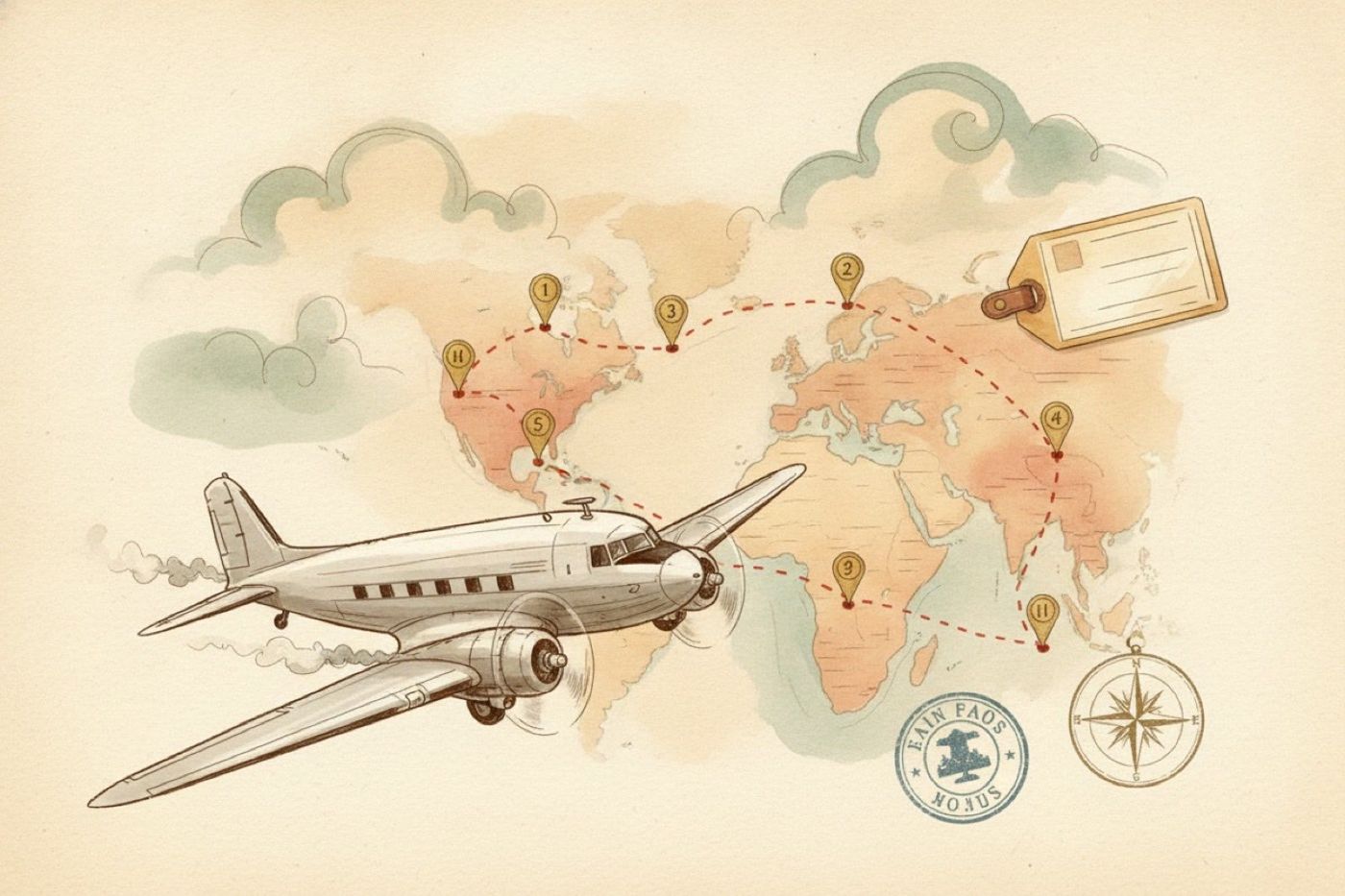
Watercolor illustration: a silver DC-3 propeller plane flies across a pastel world map, trailing a red dashed route that hops between numbered gold pins, with a luggage tag, a passport stamp and a compass rose around it.

What it is — and what it isn’t

Not a blog. There’s no homepage, no categories, no archive, and no pressure to write well. A place, a photo and one true sentence is a complete entry.
Not a social feed. No likes, no followers, no algorithm. You send the link to the people you want reading it, and that’s the audience.
Not a tracking app. Nothing follows your phone. The page knows only what you tell it — and it’s perfectly happy for you to tell it a day late.
It’s a route card. The old 1930s idea: the whole journey on one sheet, drawn as it happens, for the people following along at home.
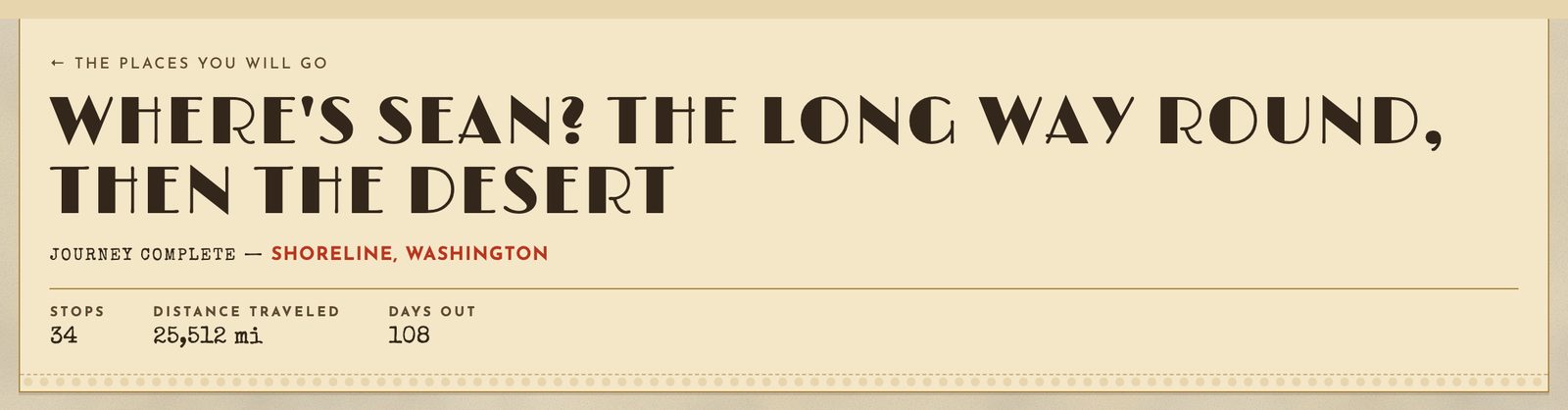
Screenshot of the top of a real travelogue: the title WHERE'S SEAN? THE LONG WAY ROUND, THEN THE DESERT, the status line JOURNEY COMPLETE — SHORELINE, WASHINGTON, and stats: 34 stops, 25,512 miles traveled, 108 days out.
The top of a real one — Sean’s own 2026, now finished. Nobody typed “Journey complete.” The page worked it out from the dates.

What your people see

The route, drawn the way you traveled

Flights arc like flights. Drives and trains stay close to the ground. Walks are a dotted trail. You can invent your own — a cable car, a dogsled, a hot-air balloon.

Where you are right now

“Currently at Bangkok · next leg Chiang Mai.” You never set it. The page reads your dates and works out what’s past, where you are, and what’s still to come.

Your story, in order

Each moment is a card: a photo, a few words, and how you got there. A week in one city gets its own close-up map, so seven stops don’t pile up on one pin.

The plan, too

Log stops before they happen and they show as dashed cards stamped PROVISIONAL, with a live countdown to the next one. Add the photo when you get there.

What time it is there

A row of small clocks — where you are, where you’re headed, where the reader is — answers the real question: is it a reasonable hour to call?

A calendar of the days away

Month grids with tiny polaroids stuck on every day something happened — the whole trip at a glance.

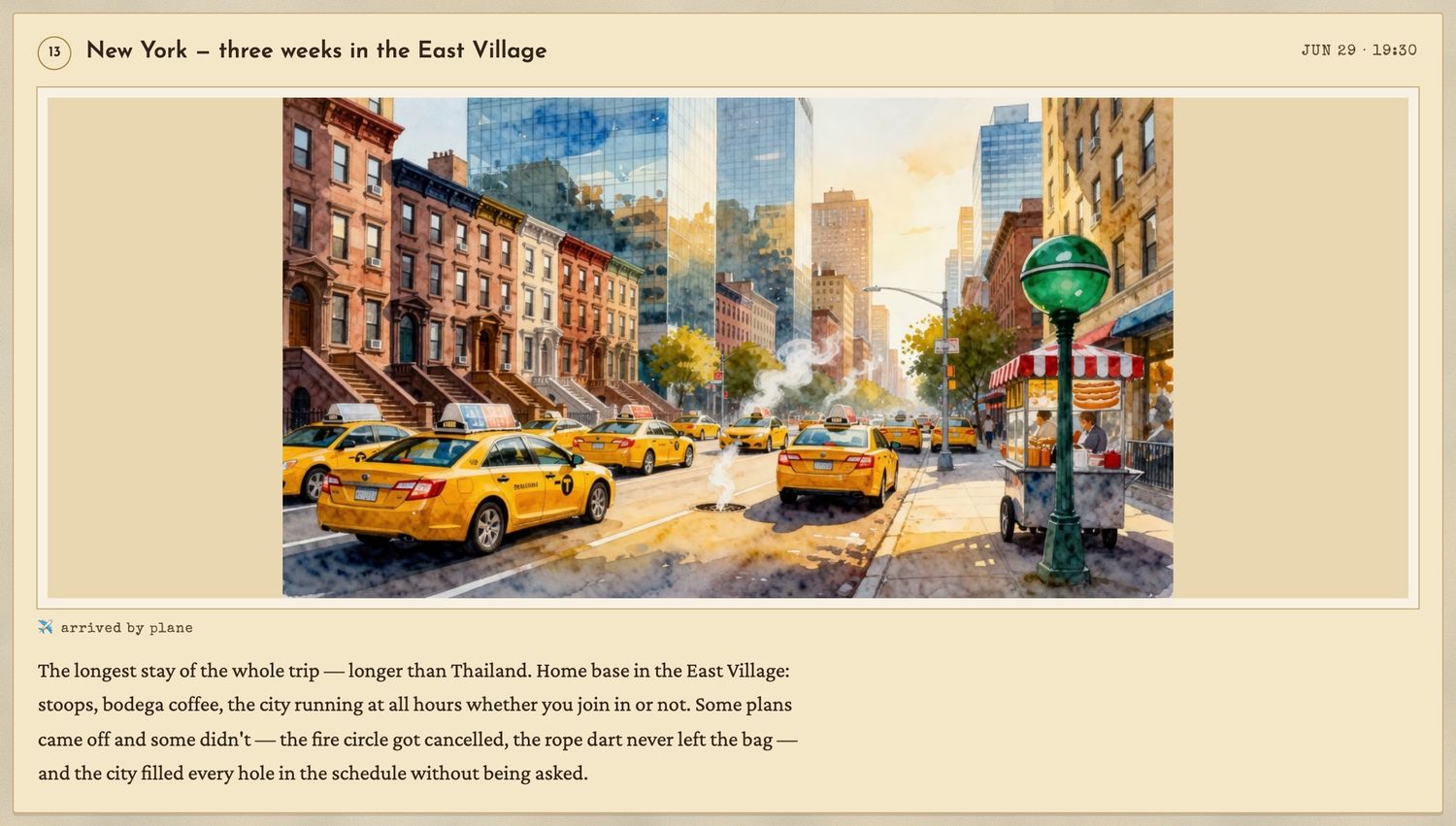
Screenshot of one moment card: stop 13, New York — three weeks in the East Village, June 29 at 19:30, a watercolor of brownstones and yellow cabs, a small note reading arrived by plane, and a paragraph about the longest stay of the trip.
One moment: a place, a time, a picture, a few words, and how you arrived. This trip’s pictures are illustrations; yours can be photos, art, or both.

How it works

  1. A vintage steamship ticket with a punched hole.

    1 Get a ticket — $25

    Buy one for yourself, or as a present. Tickets are printable and “issued to bearer”: whoever holds the code can start the journey. Nothing starts ticking until your first stop, so you can buy in March for a trip in October.

  2. A brass map pin standing on an old folded map with a dotted route curving away.

    2 Name it

    The name becomes the address — /sites/marias-big-year — and that’s the link you send. Choose carefully; it can’t be changed later.

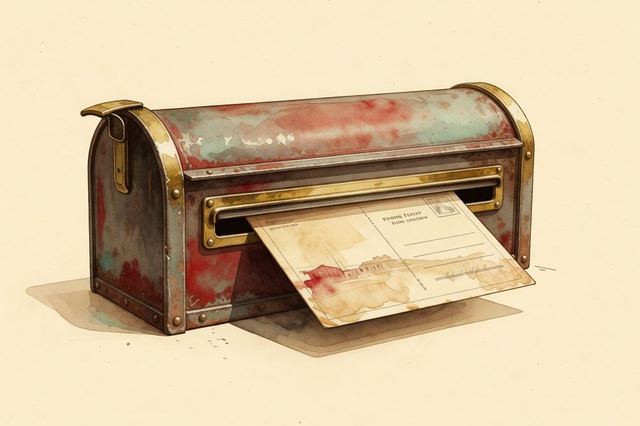
  3. A postcard being posted into a cast-iron mailbox.

    3 Log moments as you go

    A place, a date and time, a photo, a few words, how you got there. Only the place is required. Pick a photo and it can fill in the pin and the date for you. Once a day is plenty; three times a week is fine.

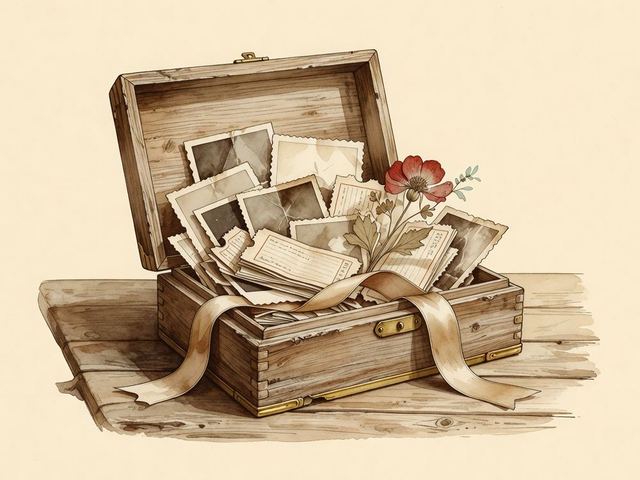
  4. An open wooden keepsake box holding photographs, tickets and a ribbon.

    4 Share it, then keep it

    Send the address. When you’re home, download the keepsake: one zip with every original photo and a page that opens with no internet, no account and no map service. It’s yours forever, even if the site isn’t.

Make it yours

  • Four looks. Air Mail 1934 (an aged route card in red ink with a DC-3 riding the line), Noir, Plain, or your own colors and type.
  • Pick what shows. Map, calendar, itinerary, stats, the share button — turn each one on or off.
  • Illustrations. Any moment can be redrawn as art, and you can write one short brief for the whole trip so every picture shares a style.
  • Give it away. Buy one as a gift: email the ticket, or print it, fold it into a card and hand it over.
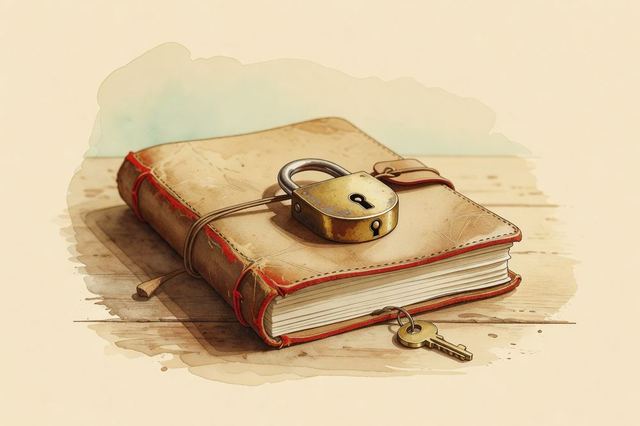
A small brass padlock resting on a closed leather journal.

Keep it private

  • Unlisted. Your page isn’t in any directory. People find it because you sent them the link.
  • Passcode. Lock the page and everything — words, photos, the data behind them — needs the code. Search engines are asked to stay away.
  • Clean photos. The location and camera details hidden inside a photo are stripped on the way up, so a photo never says more than the pin you chose.
  • Pin the bigger place. “Bangkok” tells your people everything they need. Nobody needs your hotel’s name, and it’s fine to post after you’ve left.
See a real one

Where’s Sean? The long way round, then the desert. The author’s own 2026: Doha, Bangkok and Tokyo, three weeks in New York, home for a breath, then five weeks in the Nevada desert at Black Rock City. 34 stops, 25,512 miles, 108 days.

the-people-you-know.com

The People You Know

a globe of rough whereabouts

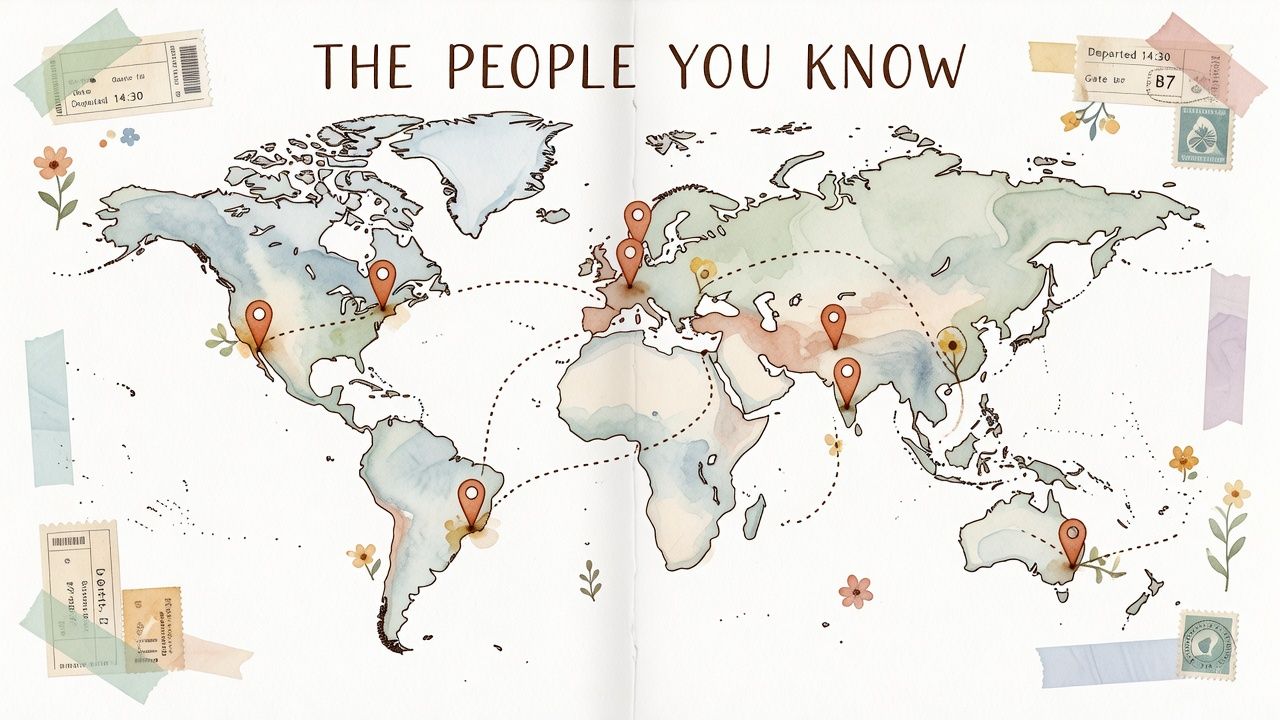
The places were great. But it was always about the people. This is a globe of your friends — the city, the zone, the general vicinity. Never the address. Not even the street. Just close enough to say “oh hey, you’re near Tokyo now?”

Watercolor world map titled THE PEOPLE YOU KNOW, with terracotta pins scattered across the continents, dotted lines arcing between them, washi tape, flowers and old ticket stubs around the edges.

What it is — and what it isn’t

Not a tracker. Location-sharing apps answer “where’s Dana?” with a dot that follows a phone around. There is no GPS anywhere in this one. You choose a city, and that is all the site ever has.
Not a social network. No feed, no posts, no messages. Your profile is a face, a name, a short bio, and links to wherever you actually talk — Signal, Instagram, your own site.
Not the group chat. Nobody has to ask “where are you these days?” and nobody has to announce a move. You glance at the globe.
It’s a postcard, really. Postcards had it right: wish you were roughly here. Warm, a little vague, and good enough to start a conversation.
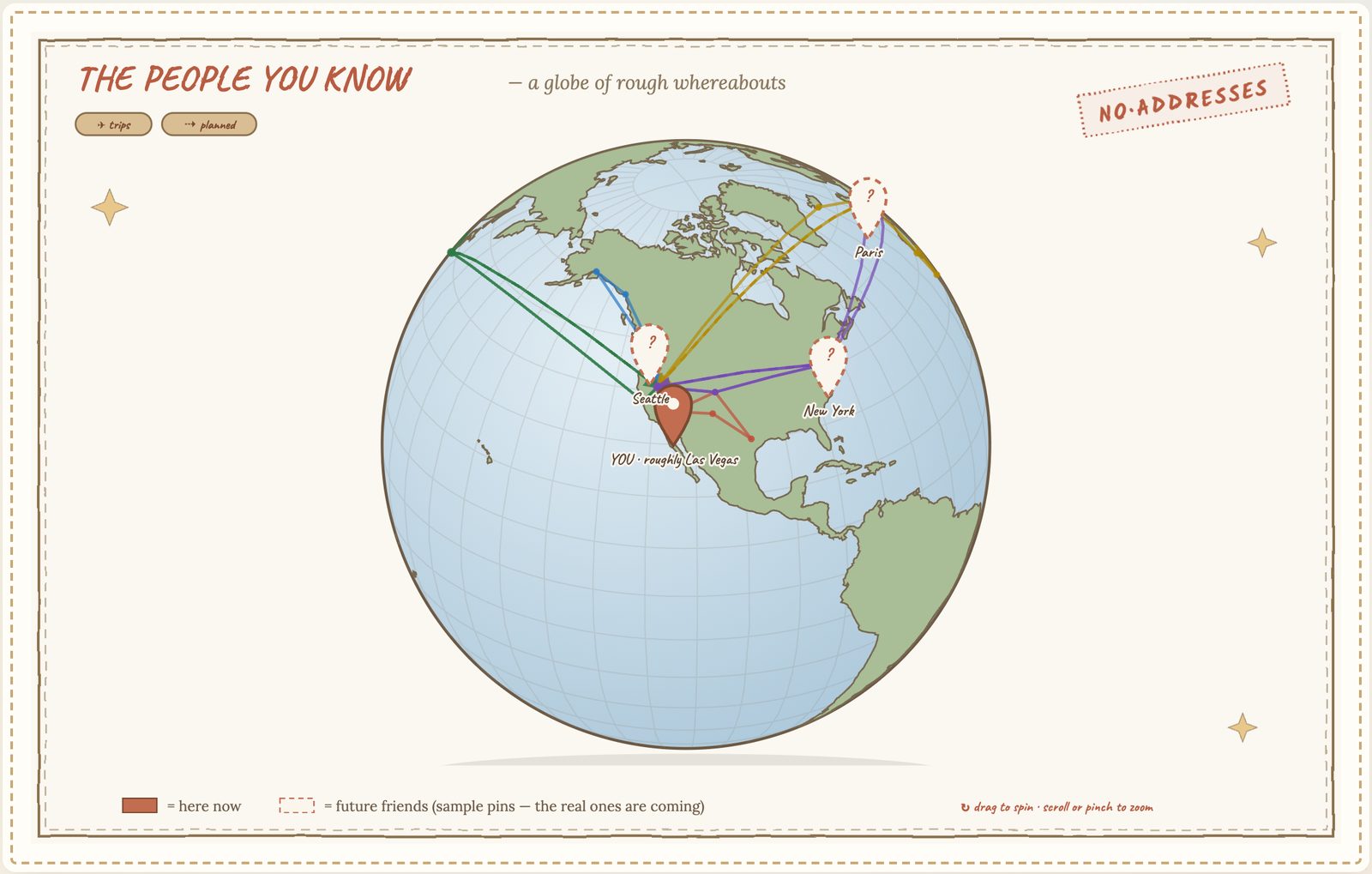
Screenshot of the globe on the-people-you-know.com: a hand-drawn orthographic globe centered on North America, a big terracotta pin labeled YOU, roughly Las Vegas, dashed question-mark pins over Seattle, New York and Paris, colored lines arcing between cities, and a rubber stamp reading NO ADDRESSES.
The globe on the front page. Visitors see sample pins; signed in, it’s your actual friends. Drag to spin, pinch to zoom. The colored lines are trips — solid where someone’s been, dashed where they’re going.

How it works

  1. 1 Join — it’s free

    An email, a password, a handle. You start with one friend already — Sean, MySpace-Tom style — who can be removed like anyone else.

  2. 2 Plant a rough pin

    Pick your city from a list of 34,000 world cities. Somewhere that isn’t a city — a campsite, a stretch of desert — is snapped to a coarse grid, about 25 km apart, before it’s saved. Add a short note if you like: “until the 14th.”

  3. 3 Add your people

    Send friend requests. Apart from that first one, nobody sees anybody until both sides say yes. Blocking is total: block someone and you vanish from each other everywhere, at once.

  4. 4 One tap keeps it honest

    A pin stays bright for a week, then slowly fades, and looks washed out by about seven weeks. One tap — still here — brings yours back. No tracking needed; the map just tells the truth about how old it is.

Get drawn

Upload a photo of yourself and an artist draws you — in one of seven styles (Doodle, Neon, Deco, Blueprint, Paper, Terminal, Aqua) or one you describe in your own words. That drawn face is what sits on your friends’ globes.

The photo is used for about an hour and then deleted. What’s kept is the drawing, plus a few written words about how to draw you, so every new style still looks like you.

Ten drawings a day are free. The Avatar Pack adds 50 more for $7, once.

Globes for your crews

Community globes are a standing map for a group — climbers, a camp, a volunteer crew, the family. A keeper approves who joins, and each member chooses how roughly that globe sees them: their city, just their region, or just their country.

Event globes are for one big convergence — a wedding, a reunion, a festival camp. Everyone pins where they’re coming from, then taps “I’m here!” when they arrive.

Both are free while the site is in alpha.

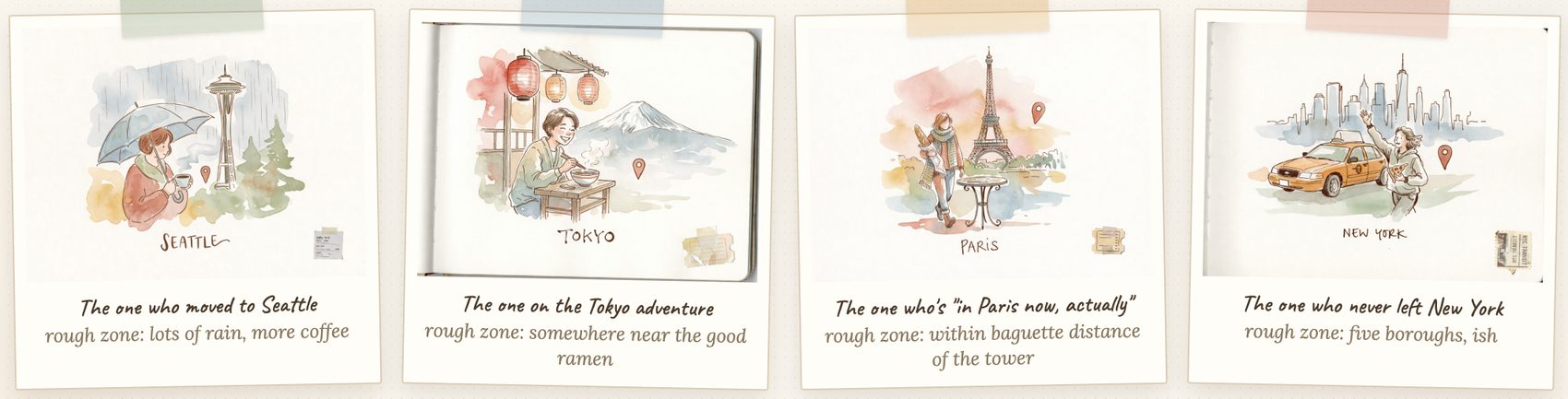
Screenshot of four watercolor friend cards: The one who moved to Seattle (rough zone: lots of rain, more coffee), The one on the Tokyo adventure (somewhere near the good ramen), The one who's in Paris now, actually (within baguette distance of the tower), and The one who never left New York (five boroughs, ish).
The “rough zone” the whole site is built around. Lots of rain, more coffee: that’s Seattle, and that’s enough.

The promise

  • 📍 The map is city level. No addresses. Ever.
  • 🛰️ No GPS anywhere in the product. It never asks where you are.
  • 🚫 No ads, and no selling data — not the map, not the friend list, not “insights.”
  • 🗑️ Delete your account and everything goes, drawings included.

How they fit together

The places are the story. The people are the reason.

The Places You Will Go

You write the trip

Stops, photos, notes and times. All of it stays on the travel site, shown to whoever has your link.

Link your accounts · optional
What crosses over
  • the place name you typed
  • a point blurred to ~25 km
  • the dates
What never does
  • your notes
  • your photos
  • exact times or coordinates
The People You Know

Your friends glance

The trip shows on your globe as a line: solid where you’ve been, dashed with an arrow where you’re going. Your pin moves with you, city-grade.

Each site works fine on its own. Together, the trip you’re writing up for your family quietly tells your friends you’ll be roughly in Lisbon until the 14th — which is exactly how you end up having dinner with someone you haven’t seen in six years.

Questions

Can anyone find my address?

On The People You Know, no — there is nowhere to type one, the pin is a city or a point blurred to a ~25 km grid, and the blur is baked into what’s saved. On The Places You Will Go, a stop is as exact as you make it; the guide recommends pinning the city while you’re there, adding a passcode if you’re traveling alone, and sharpening pins after you get home if you want to.

Do I need to install an app?

No. Both are websites. They work in any browser, on a phone or a computer, and the globe spins and pinches on an iPhone.

What does it cost?

The Places You Will Go is $25 per trip, paid once, by card through Stripe. Nothing recurs, and an unused ticket doesn’t expire. The People You Know is free; the only thing for sale is the optional $7 Avatar Pack of 50 extra drawings, which never expire either.

What happens if I stop posting?

A travelogue closes itself after 90 quiet days. Nothing is deleted — the page stays exactly where it is, everyone keeps their link, it just stops taking edits, and you can reopen it any time. On The People You Know, a stale pin simply fades until you tap “still here.”

What happens to my photos?

Trip photos live with your travelogue, with hidden location data stripped on upload, and the keepsake download hands every original back to you. The face photo you give The People You Know is used for about an hour to draw you, then deleted; only the drawing stays, unless you choose to use the photo as-is.

Can I give one as a present?

Yes — a trip is the classic one. Choose “as a gift” at checkout, then either email the ticket or print it, fold it into a card and hand it over. Whoever holds the code starts the journey.

Who makes these?

Sean — one person, the same one behind everything else on Sean Makes Stuff. Trips: seansp@saasaas.llc. The globe: hello@the-people-you-know.com.