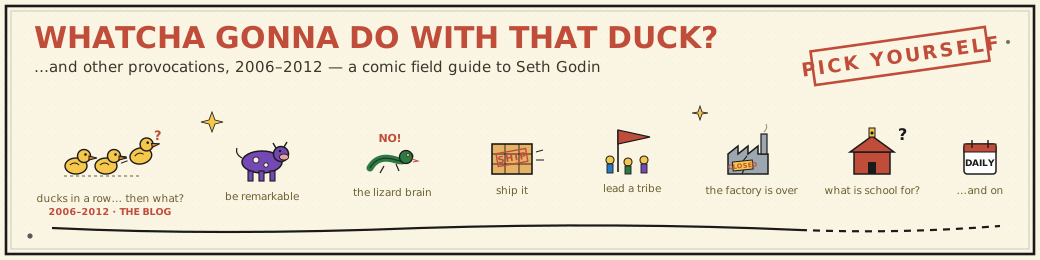
This is Seth Godin’s Whatcha Gonna Do with That Duck? And Other Provocations, 2006–2012 (Portfolio, December 2012) — six years of his daily blog, sorted by theme into roughly 600 pages — retold in thirty-three panels in a hand-drawn margin-doodle style. The book has no argument to follow from front to back; the publisher’s own line is that it’s “made for dipping into again and again.” So this guide doesn’t try to summarize it. It takes the posts that became Godin’s vocabulary — the lizard brain, pick yourself, first ten, sheepwalking — and files each one under the book’s own eight sections, in the book’s own order.
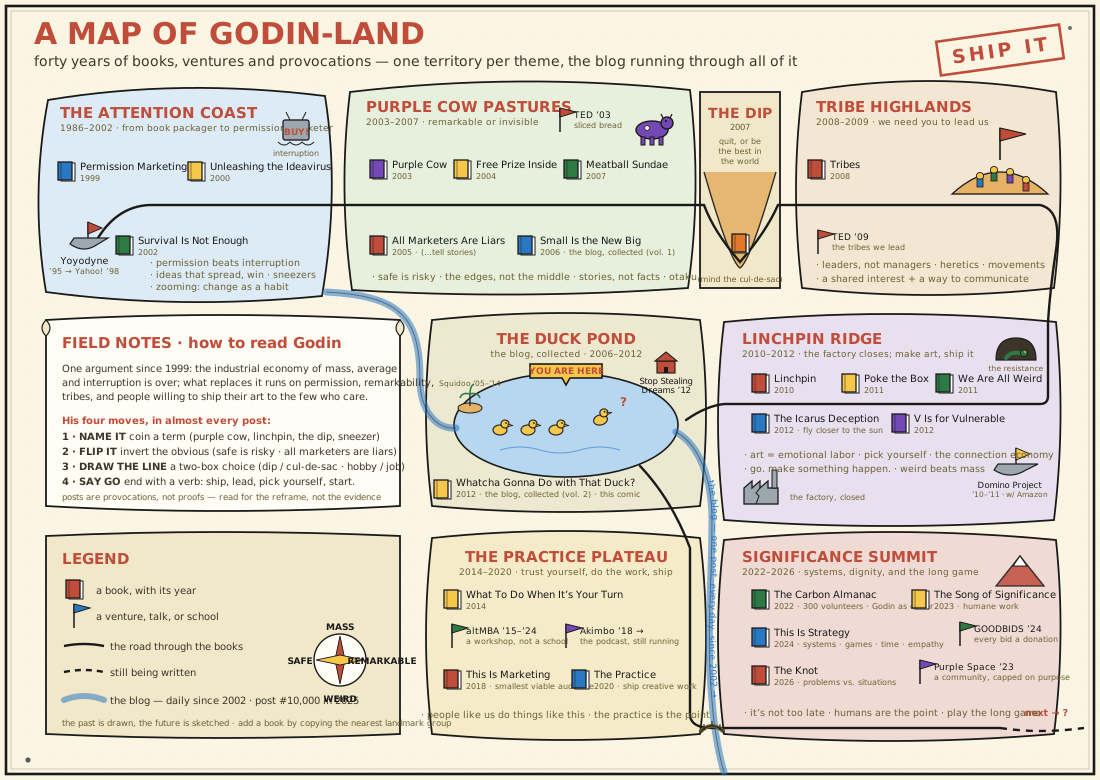
Then it zooms out. The second half of the page is a hand-drawn-style map of everything else Godin has written — twenty-odd books across forty years of projects, one territory per theme — and a loose framework for reading him without getting lost. The drawings are the hook; the captions under each panel carry the actual words. Read it straight through in about twenty minutes, or wander.
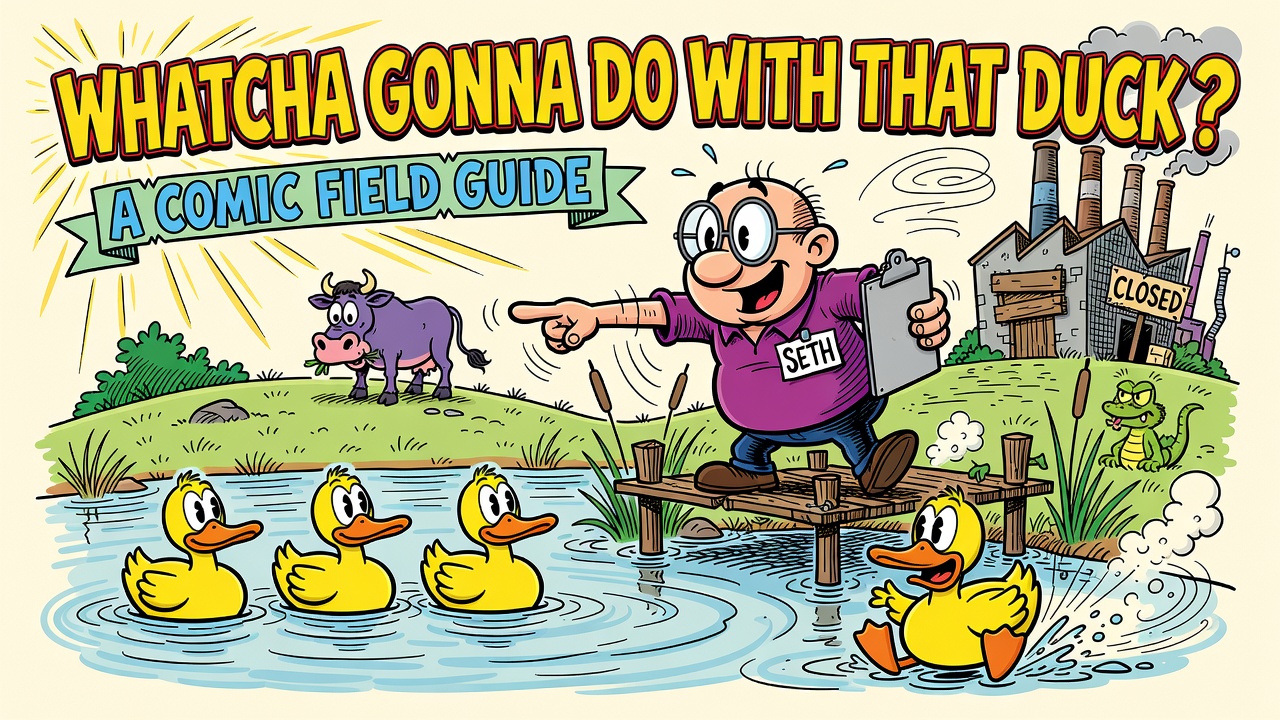
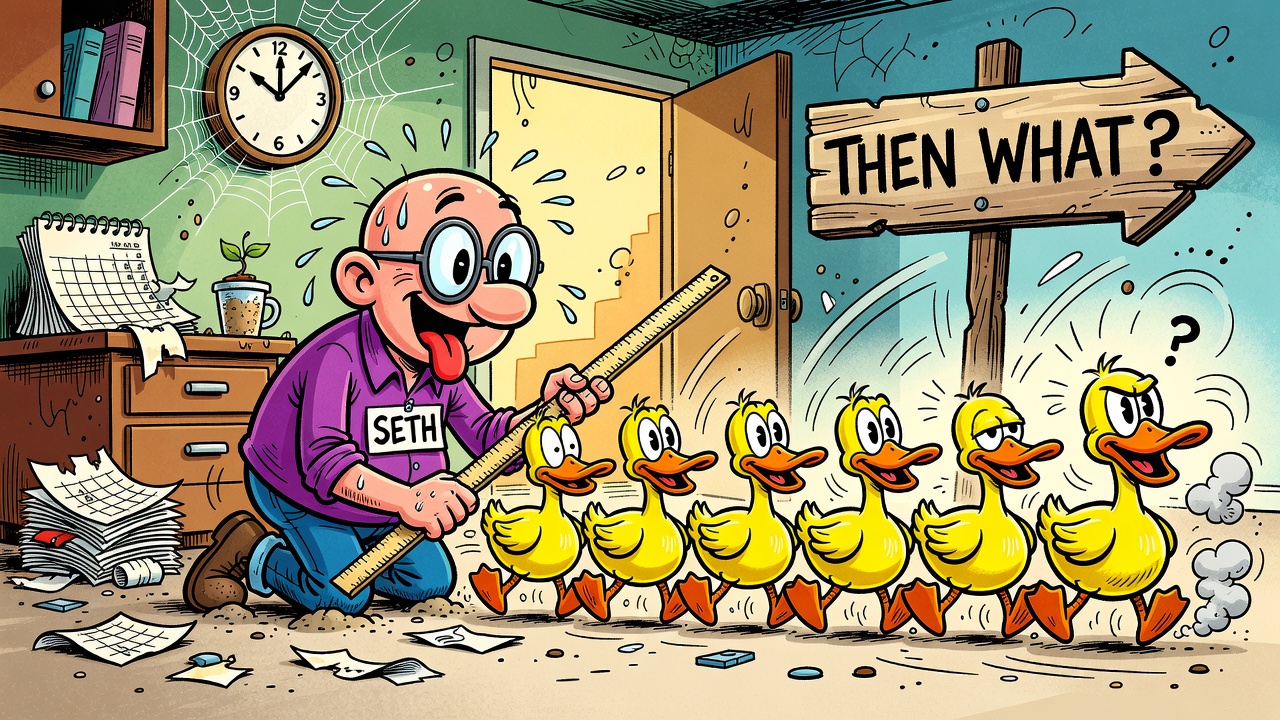
The whole book in one frame Three ducks in a row, and one duck that stopped waiting. The post that gave a 600-page book its name is three sentences long, from November 2010: “Getting your ducks in a row is a fine thing to do. But deciding what you are going to do with that duck is a far more important issue.”
SECTION I
Now Was Always a Good Time to Start
Opportunity. Choosing and doing. Picking yourself. The book opens where Godin’s blog posts almost always end: with a verb. These are the posts about the gap between getting ready and starting — and about the oldest excuse there is, which is waiting for someone else to choose you.
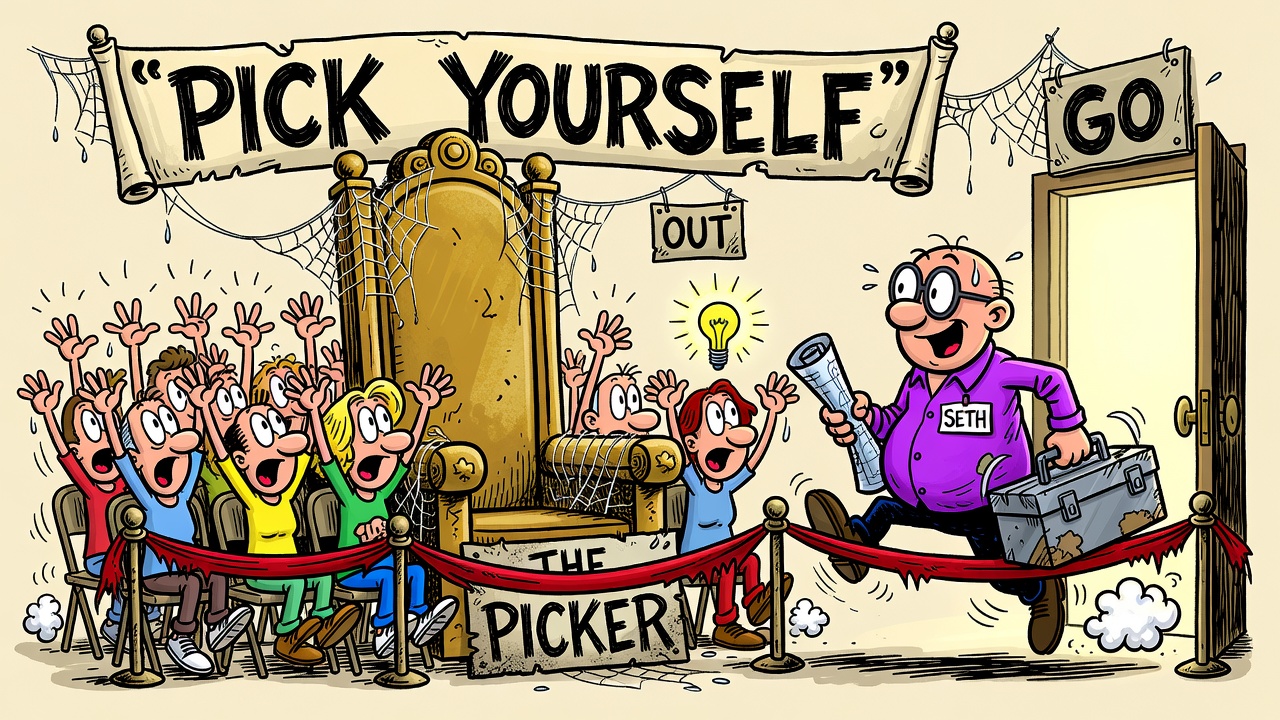
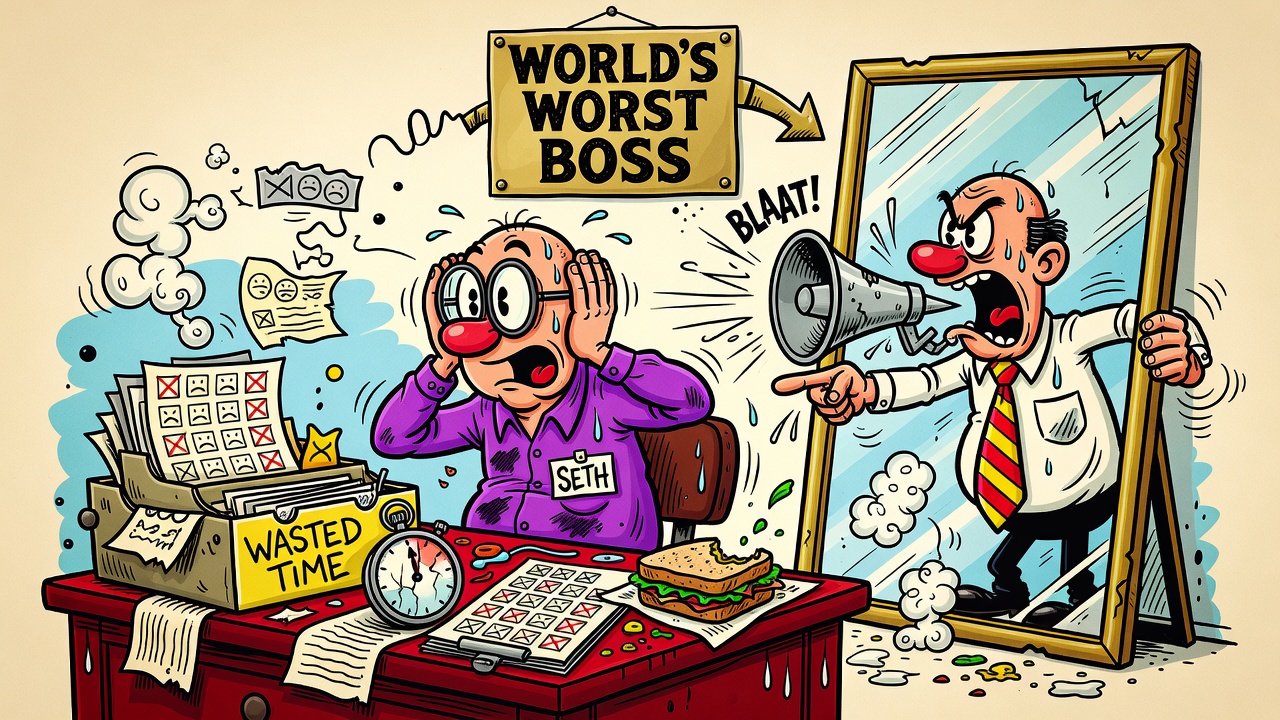
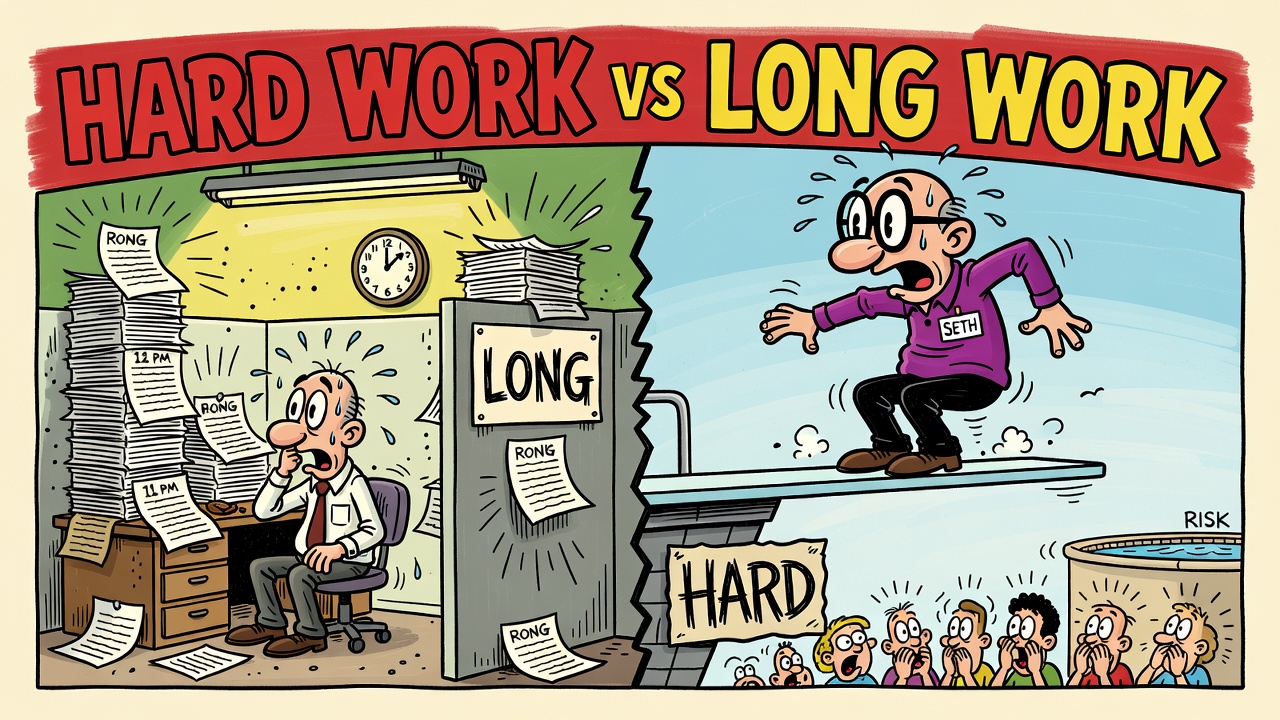
Ducks in a Row “Watcha gonna do with that duck?” (November 17, 2010) begins: “We’re surrounded by people who are busy getting their ducks in a row, waiting for just the right moment…” Lining up the ducks feels like work. It looks like work. The post’s whole provocation is that it is usually a very tidy way of not starting.Pick Yourself “Reject the tyranny of being picked: pick yourself” (March 21, 2011). “It’s a cultural instinct to wait to get picked.” Once you accept that no one is coming — “that Prince Charming has chosen another house” — you can actually get to work. “No one is going to pick you. Pick yourself.” Probably the most-quoted sentence of the whole six years.The World’s Worst Boss (December 4, 2010.) “That would be you.” “If you had a manager that talked to you the way you talked to you, you’d quit. If you had a boss that wasted as much of your time as you do, they’d fire her.” There are few good books on being a manager, Godin notes — and fewer still on managing yourself.The Forever Recession “The forever recession (and the coming revolution)” (September 29, 2011). There are two recessions: the cyclical one, which ends, and the one with the loss of “good factory jobs,” which Godin fears “is here forever.” The revolution is the other half: “When everyone has a laptop and connection to the world, then everyone owns a factory.” “Job creation is a false idol. The future is about gigs and assets and art and an ever-shifting series of partnerships and projects.”Hard Work vs. Long Work (May 3, 2011.) “Hard work is frightening. We shy away from hard work because inherent in hard work is risk.” Long work is just hours, and hours are safe: “You can’t fail at long work, you merely show up.” Which is exactly why long work is so popular.
SECTION II
Care More Than the Competition
Respect and authenticity. This is the theme Godin keeps returning to for the next decade, all the way to The Song of Significance (2023): the organizations that win are the ones where people are allowed to care, and the ones that train caring out of people pay for it — slowly, then all at once.
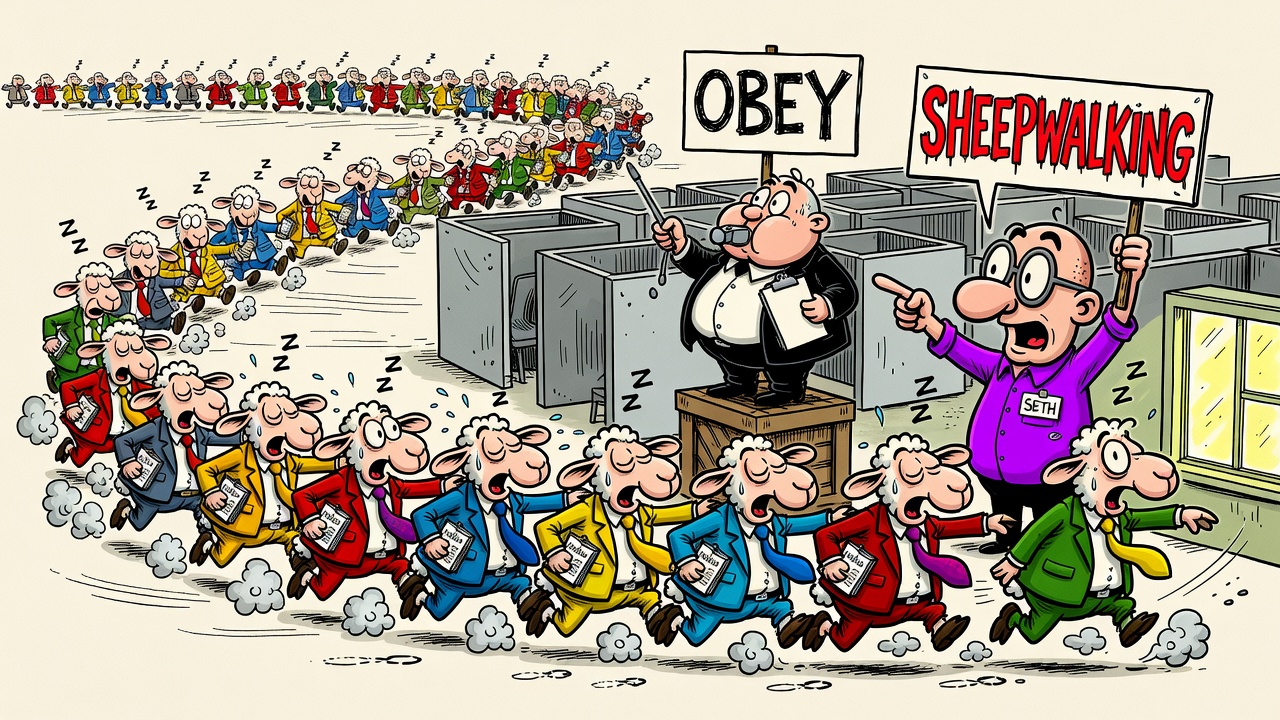
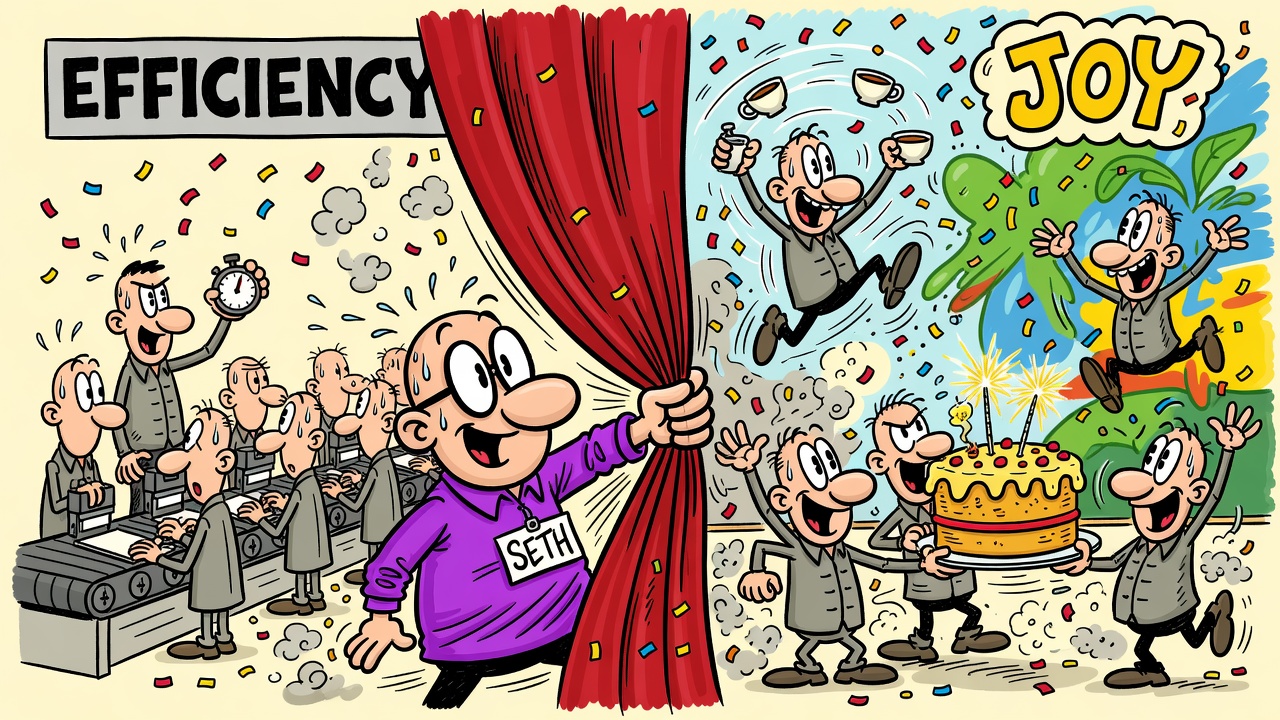
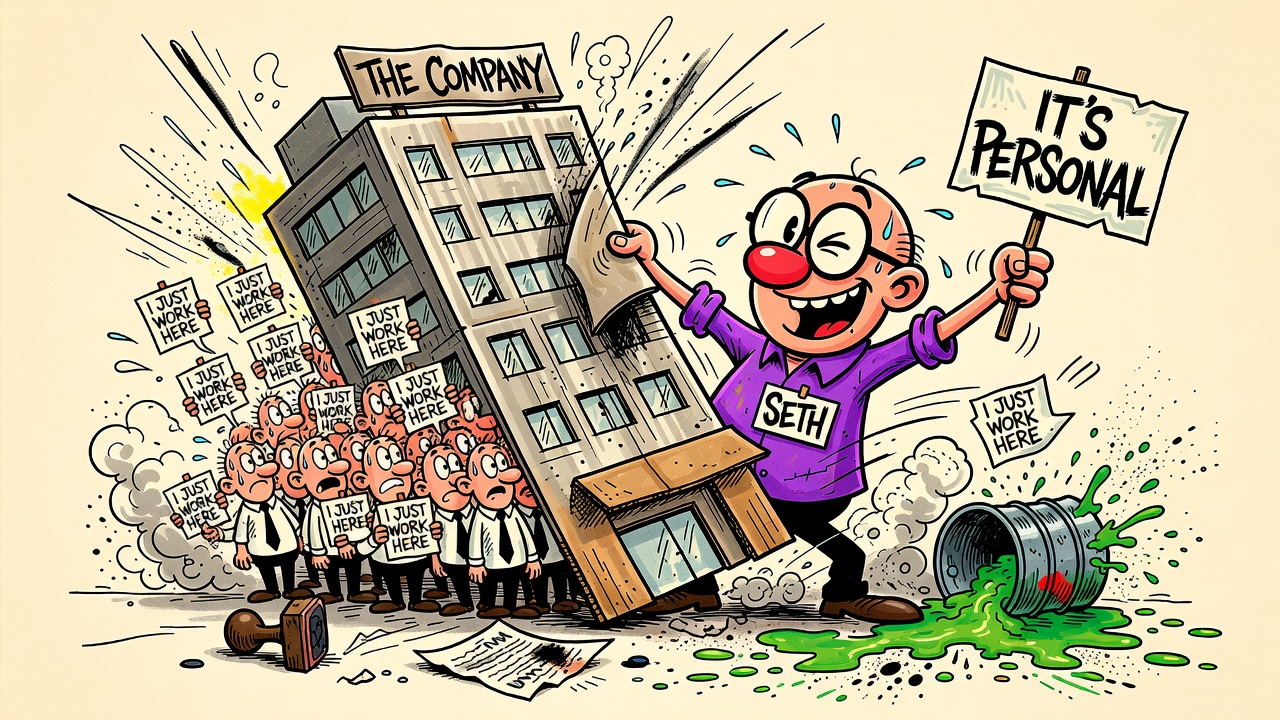
Sheepwalking (February 10, 2007.) “I define ‘sheepwalking’ as the outcome of hiring people who have been raised to be obedient and giving them a braindead job and enough fear to keep them in line.” The cure is the opposite hire: “When you hire amazing people and give them freedom, they do amazing stuff.” And a very Godin close: “Step one is to give the problem a name. Done.”Organizing for Joy (October 25, 2010.) Big companies are “organized for efficiency. Or consistency. But not joy.” The alternative is to give people “the freedom (and yes, the expectation) that they will create, connect and surprise.” Not a perk — an expectation.No Such Thing as Business Ethics (July 25, 2011.) “It comes down to this: only people can have ethics.” The company is a cardboard cutout; the people behind it are the ones deciding. “‘I just work here’ is the worst sort of ethical excuse.” “It’s not business, it’s personal.”
SECTION III
Telling Stories and Spreading Ideas
Marketing — the section readers of Purple Cow and Permission Marketing came for. Godin’s definition of the word is narrower than the industry’s: it isn’t the ads, and it isn’t the logo. It’s a story a person already wants to hear, told to the few who trust you, who then tell the rest.
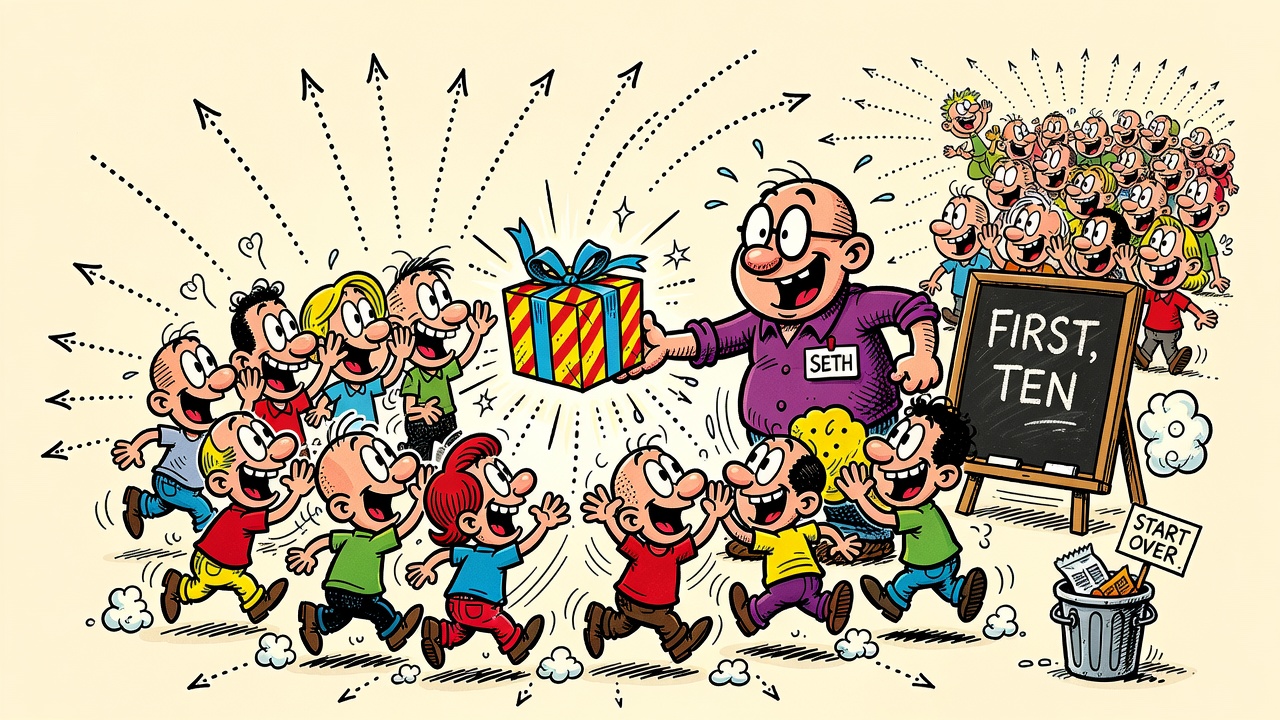
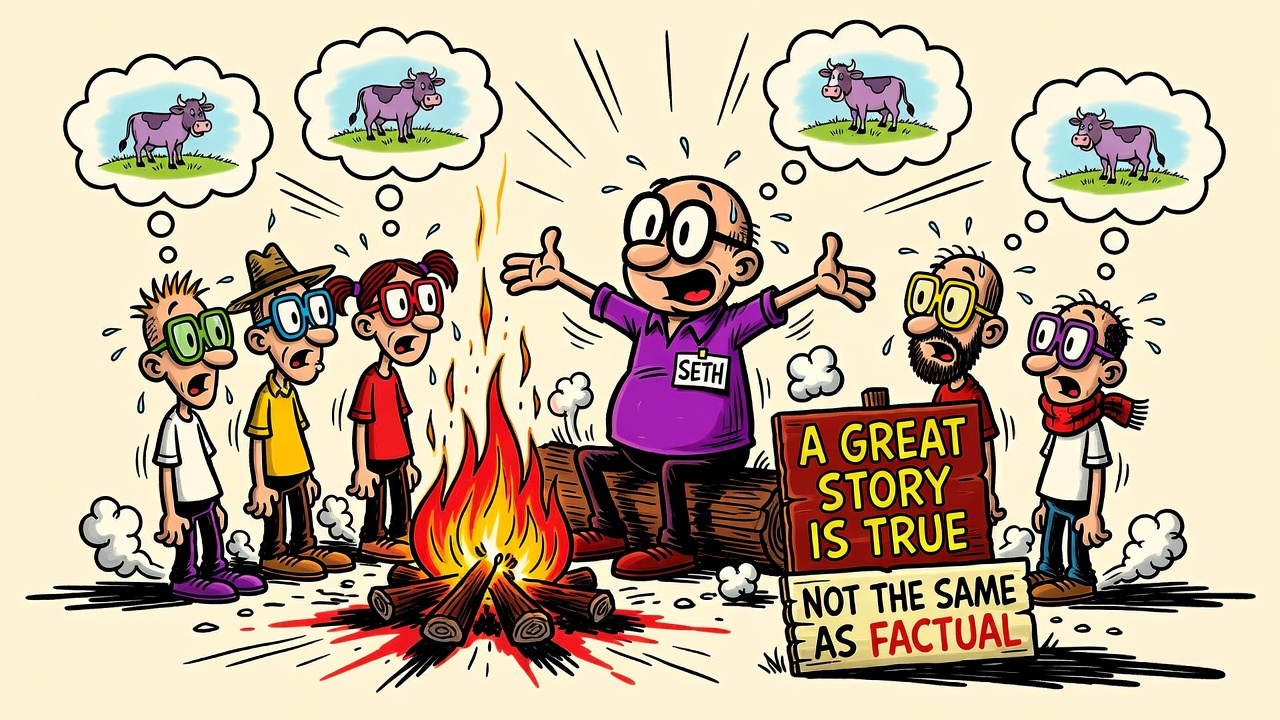
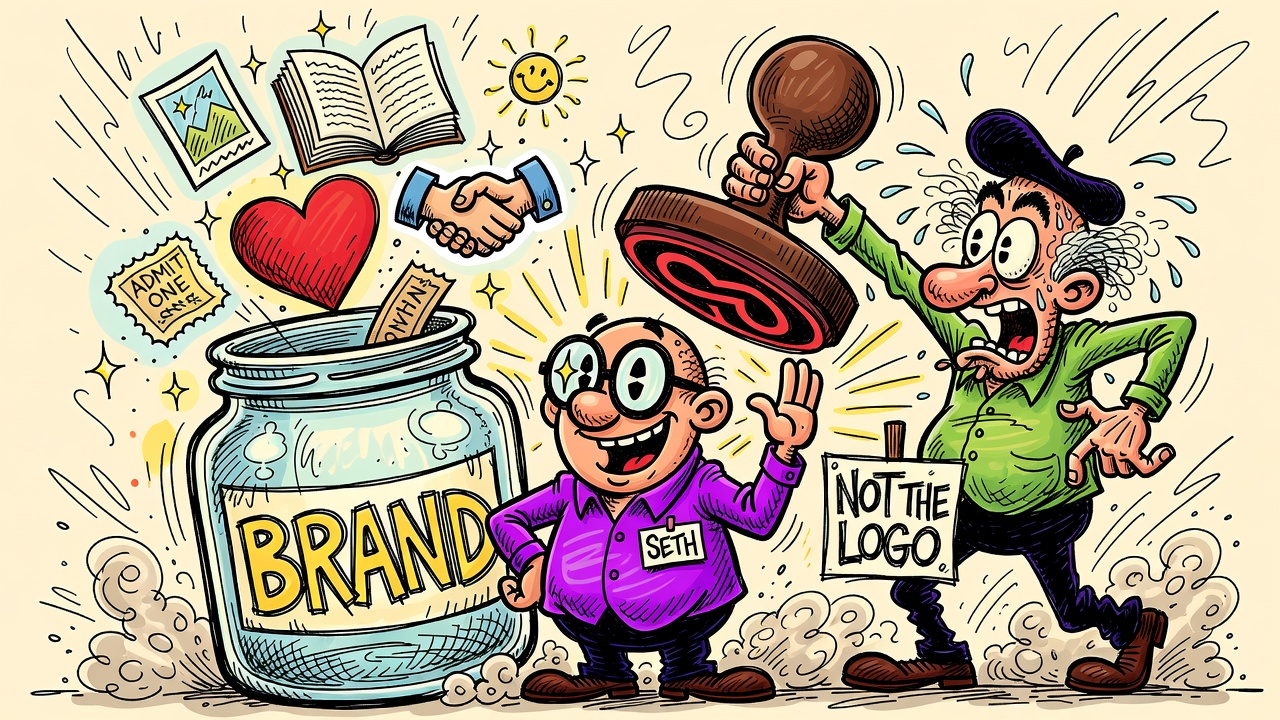
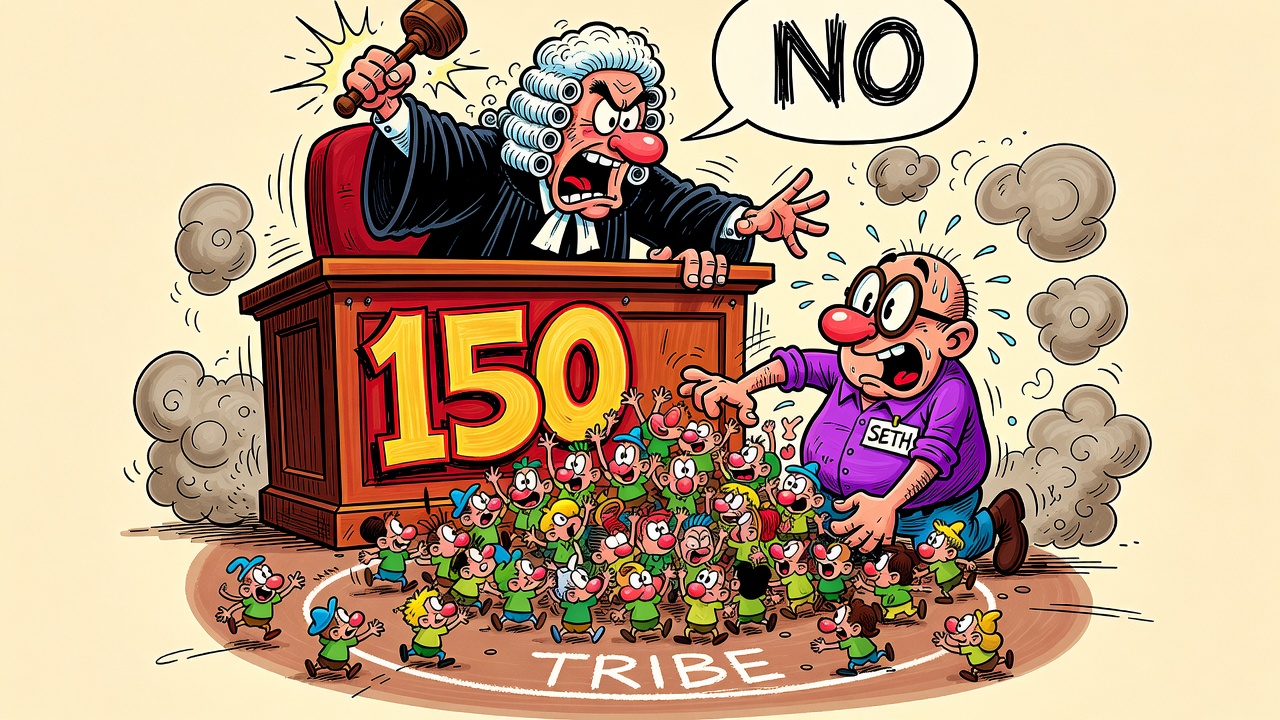
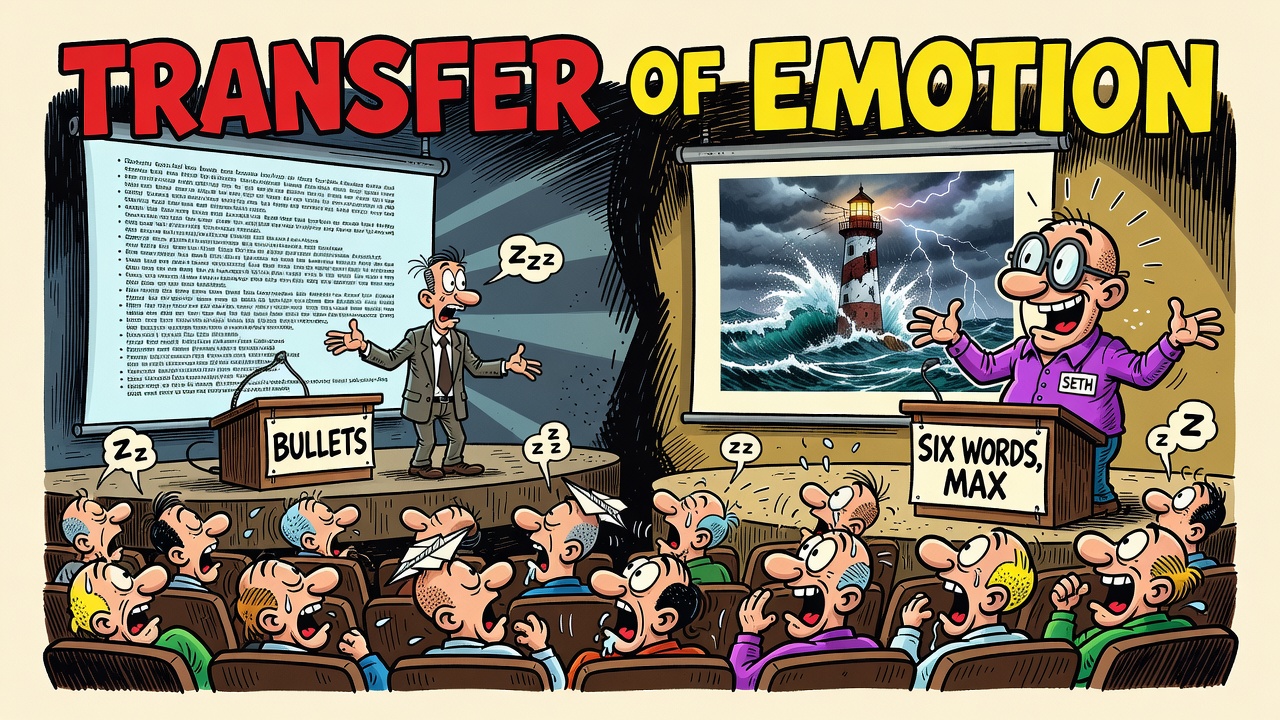
Permission “Permission Marketing” (January 31, 2008), the blog’s restatement of his 1999 book: permission is “the privilege (not the right) of delivering anticipated, personal and relevant messages to people who actually want to get them.” The test for whether you have it: “if you stop showing up, people complain, they ask where you went.”First, Ten (April 2, 2009.) “This, in two words, is the secret of the new marketing. Find ten people.” Ten who trust you, respect you, need you, listen to you. If they love it, “they’ll each find you ten more people.” If they don’t, “you need a new product. Start over.”A Great Story Is True “Ode: How to tell a great story” (April 27, 2006). “A great story is true. Not necessarily because it’s factual, but because it’s consistent and authentic.” And the line that explains why marketing to everyone fails: “Most of all, great stories agree with our world view.” You can’t tell a story that argues with the listener’s glasses.define: Brand (December 13, 2009.) “A brand is the set of expectations, memories, stories and relationships that, taken together, account for a consumer’s decision to choose one product or service over another.” The designer with the logo stamp gets a polite no: “Design is essential but design is not brand.”Dunbar’s Law “Dunbar’s Number isn’t just a number, it’s the law” (October 26, 2009). “Dunbar’s number is 150. And he’s not compromising, no matter how much you whine about it.” You might stretch to 200 or 400 — “but no, you can’t effectively engage at a tribal level with a thousand people.” A hard ceiling on what a tribe can be, written the year after Tribes.Really Bad PowerPoint (January 29, 2007.) “Communication is the transfer of emotion.” Put the facts in a handout; put the feeling on the screen. “No more than six words on a slide. EVER.” A 2007 repost of an ebook he’d written four years earlier, and the advice most often ignored.
SECTION IV
Success, Failure, and the Sure Thing
Doing the work. Risk and fear. The heart of the book, and of Linchpin (2010), which came out in the middle of these posts. The enemy finally gets a name — the resistance, borrowed with credit from Steven Pressfield — and a face: a small green lizard that gets louder the closer you get to shipping.
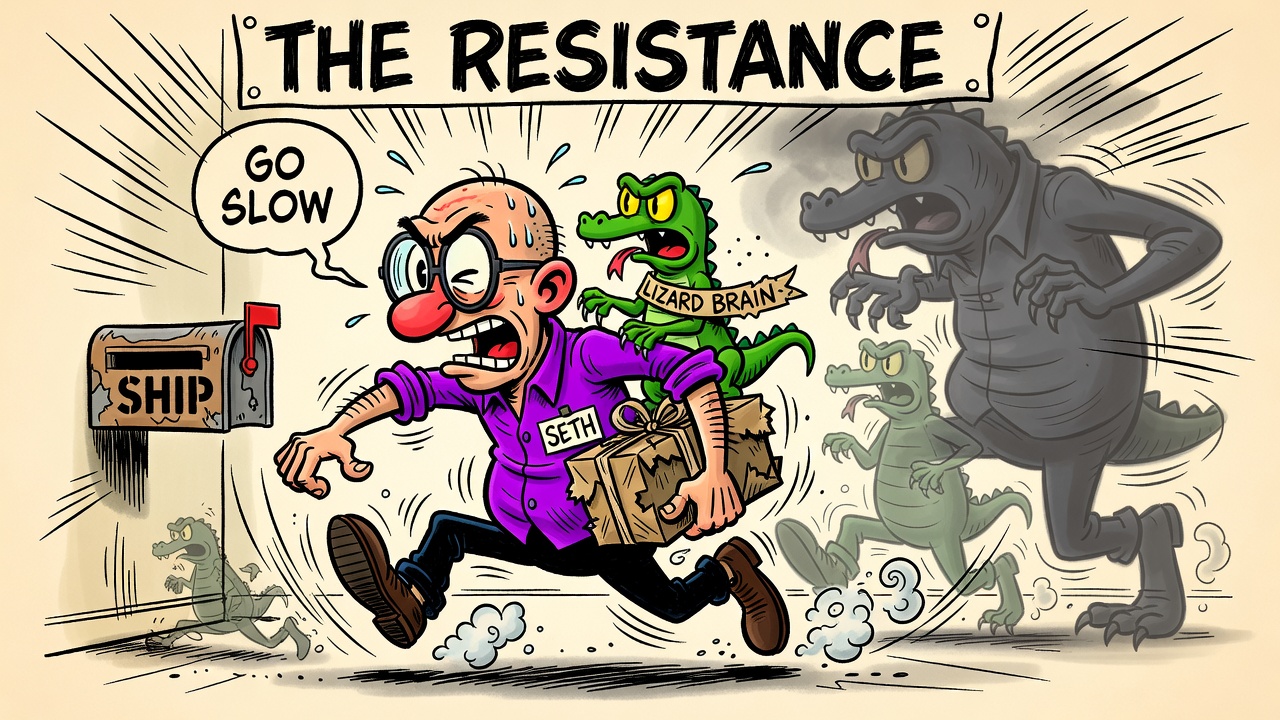
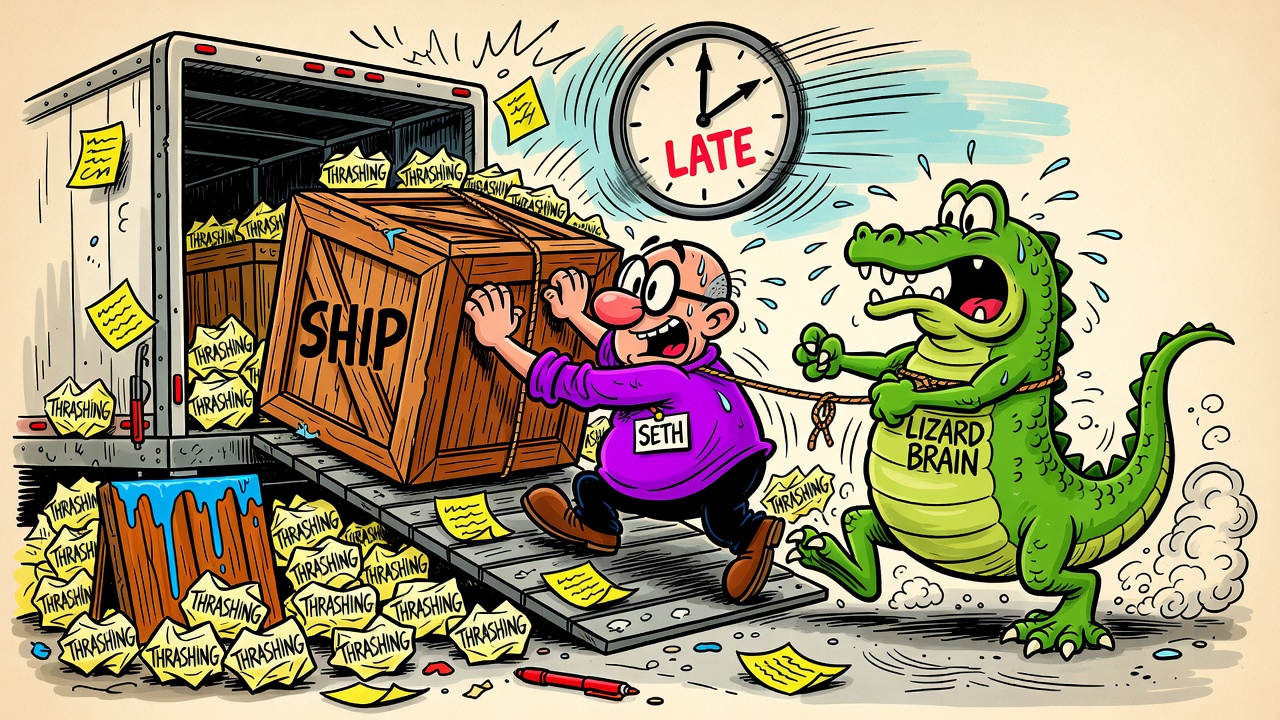
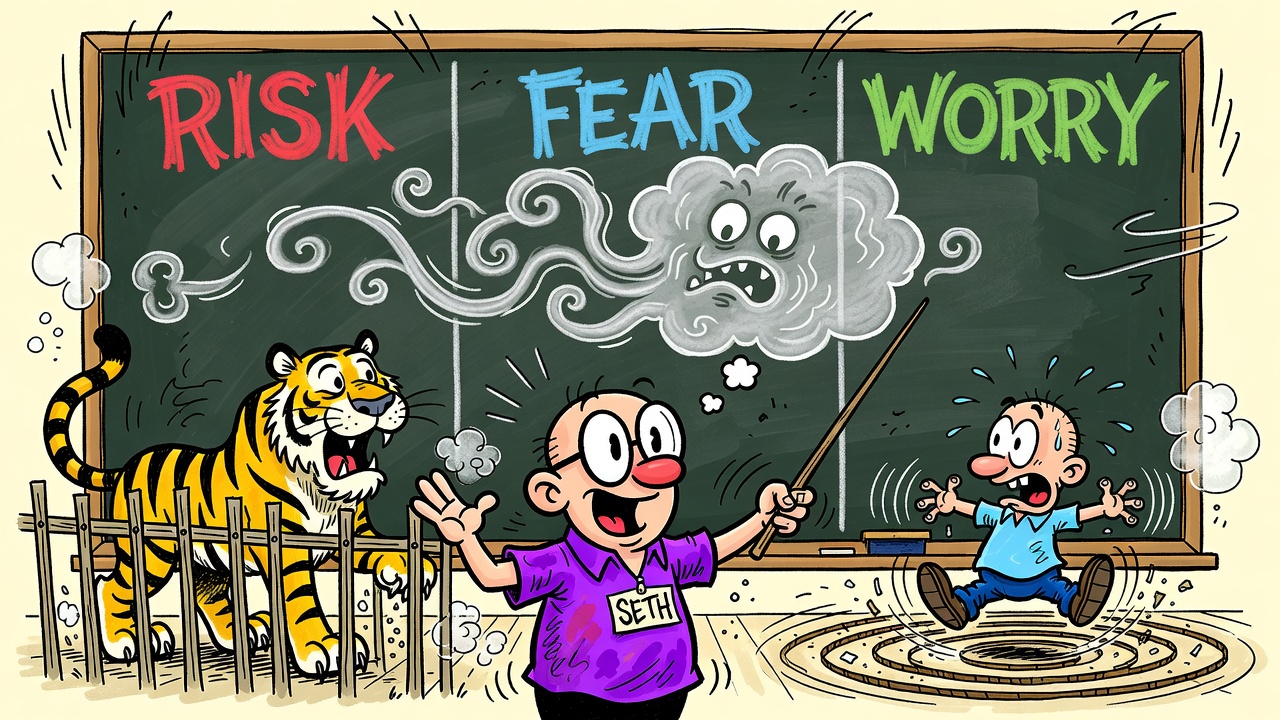
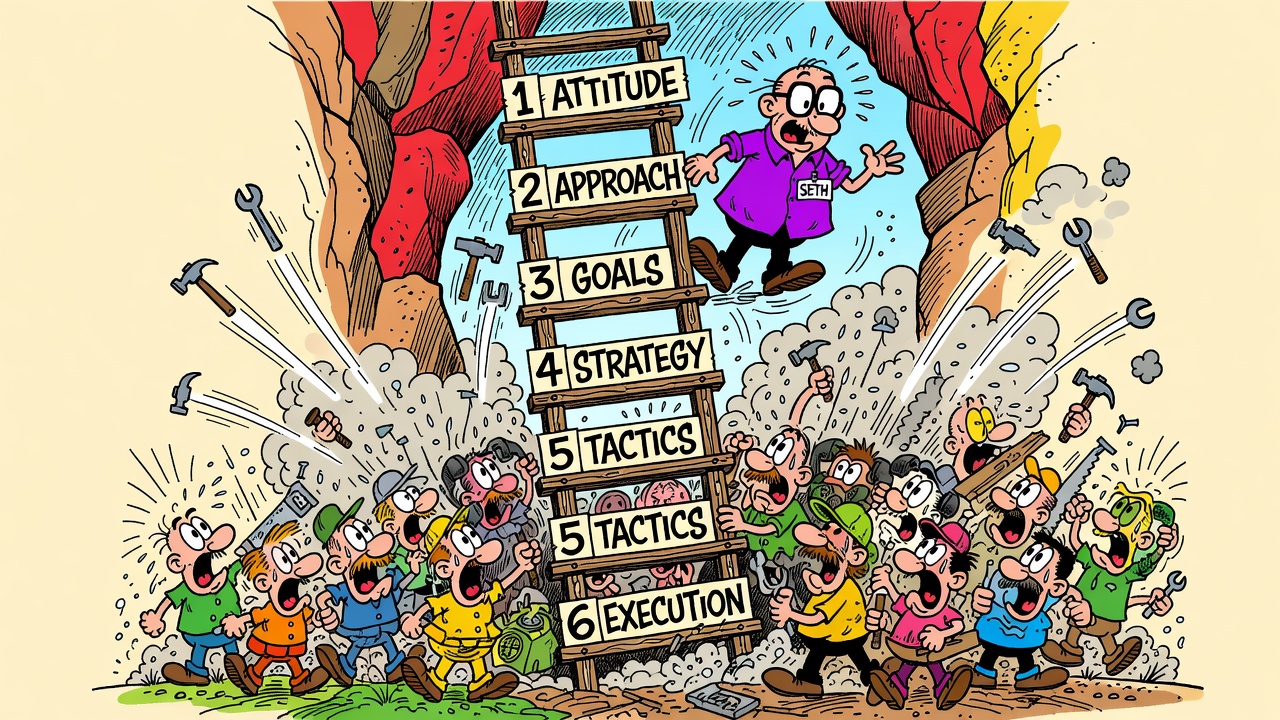
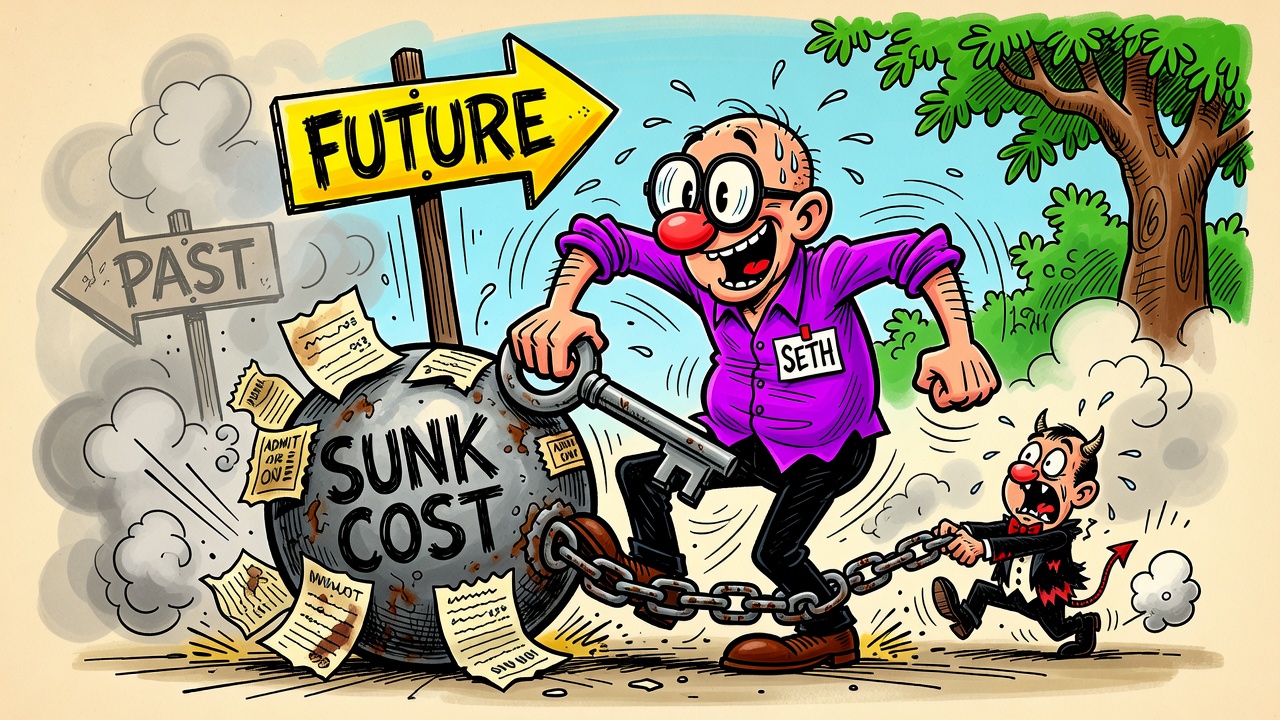
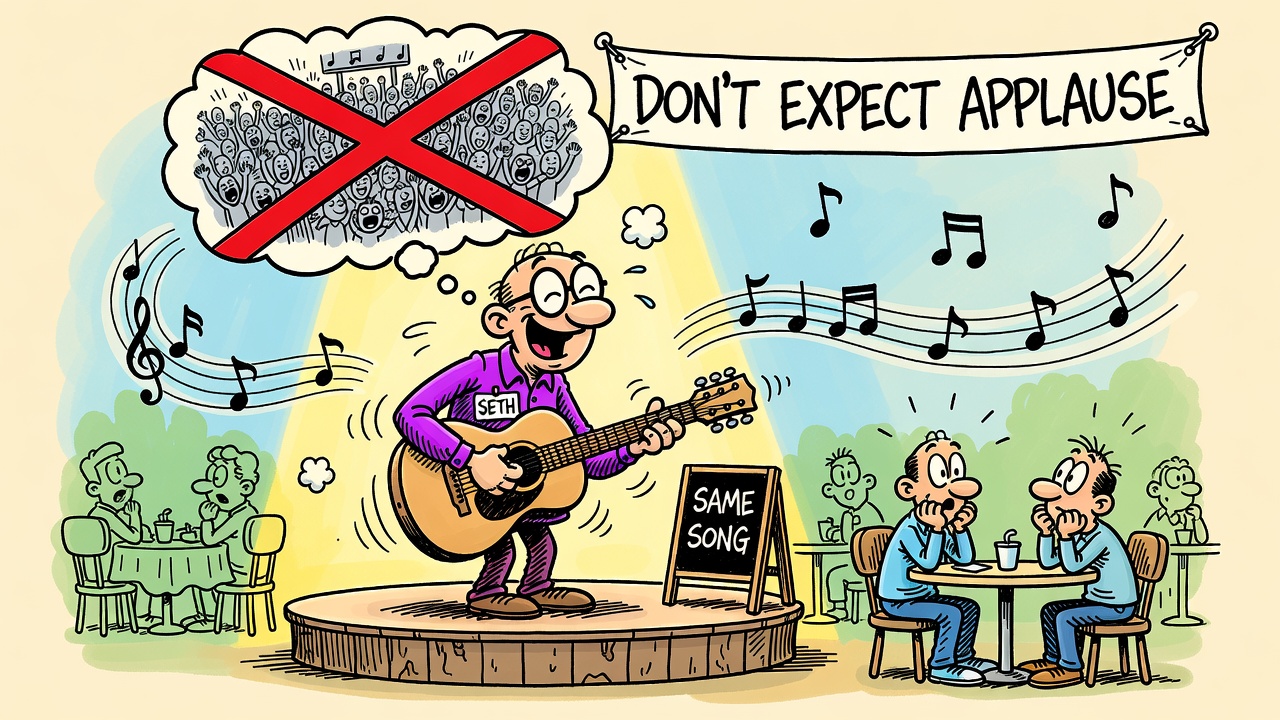
The Lizard Brain “Quieting the lizard brain” (January 28, 2010). “The resistance is the voice in the back of our head telling us to back off, be careful, go slow, compromise.” It “grows in strength as we get closer to shipping … because the lizard hates change and achievement and risk.” You don’t beat it: “Your lizard brain is here to stay, and your job is to figure out how to quiet it and ignore it.”Fear of Shipping (June 11, 2010.) “Shipping is fraught with risk and danger.” “Everyone is afraid. Where do you put the fear?” The pile on the ramp is from the Linchpin session transcript (April 27, 2010): “Every project that ships late ships late for exactly the same reason” — thrashing, the last-minute churn of changes, because “the closer we get to shipping the louder the lizard brain gets.” Hence the rule from Linchpin: thrash early.Risk, Fear and Worry (July 24, 2012.) “They’re not the same.” “While risk is real and external, fear exists only in our imagination.” Worry is the useless third thing — pacing a groove into the floor. “Separate first, eliminate false causation, then go ahead and do your best work.”The Hierarchy of Success (September 14, 2009.) Top to bottom: attitude, approach, goals, strategy, tactics, execution. “We spend all our time on execution.” But “if the top of the hierarchy is messed up, no amount of brilliant tactics or execution is going to help you at all.” Fifteen years later this is the skeleton of This Is Strategy.Ignore Sunk Costs (May 12, 2009.) The parable is a pair of $55 Springsteen tickets and a scalper’s $500 offer at the door. “When making a choice between two options, only consider what’s going to happen in the future, not which investments you’ve made in the past.”Don’t Expect Applause (April 25, 2012.) “Accept applause, sure, please do. But when you expect applause, when you do your work in order (and because of) applause, you have sold yourself short.” “To play a beautiful song for two people or a thousand is the same song, and the amount of thanks you receive isn’t part of that song.” The seed of The Practice, eight years early.
SECTION V
Standing Out and Fitting In
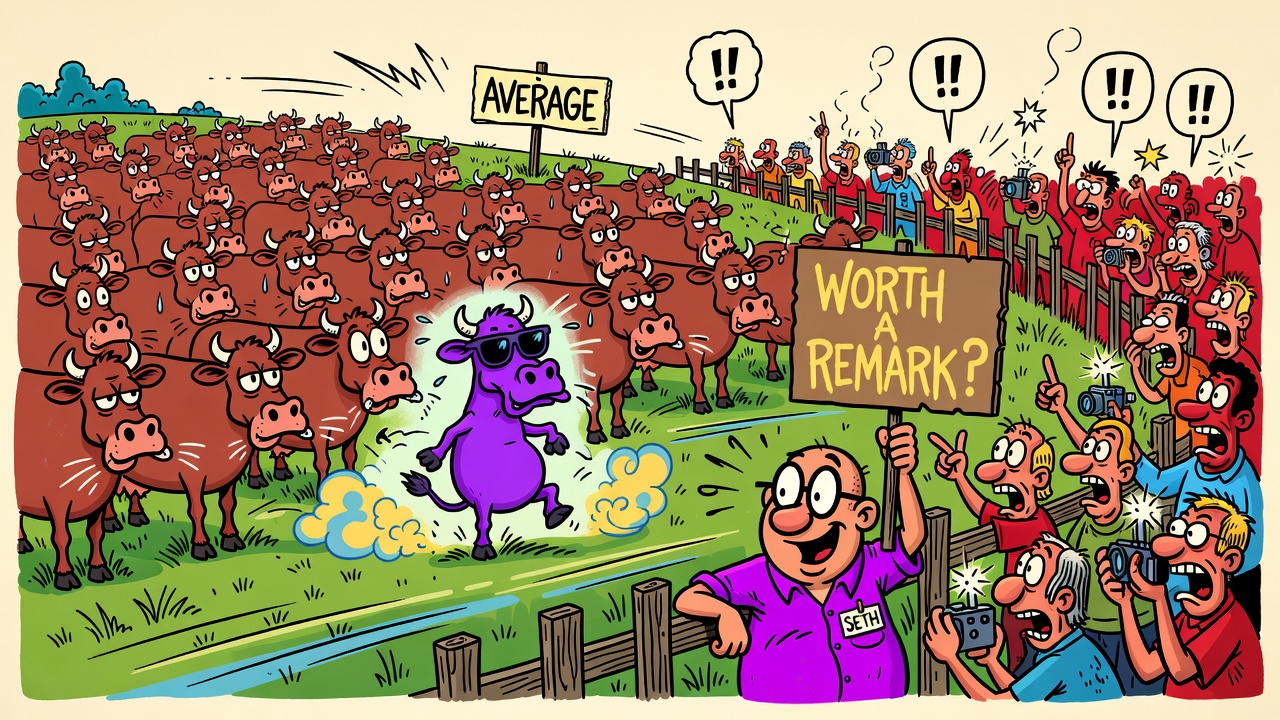
Being remarkable. Purple Cow’s thesis — safe is risky, and the only thing worth building is something worth remarking on — applied to the ordinary week: the product, the audience, the writing itself.
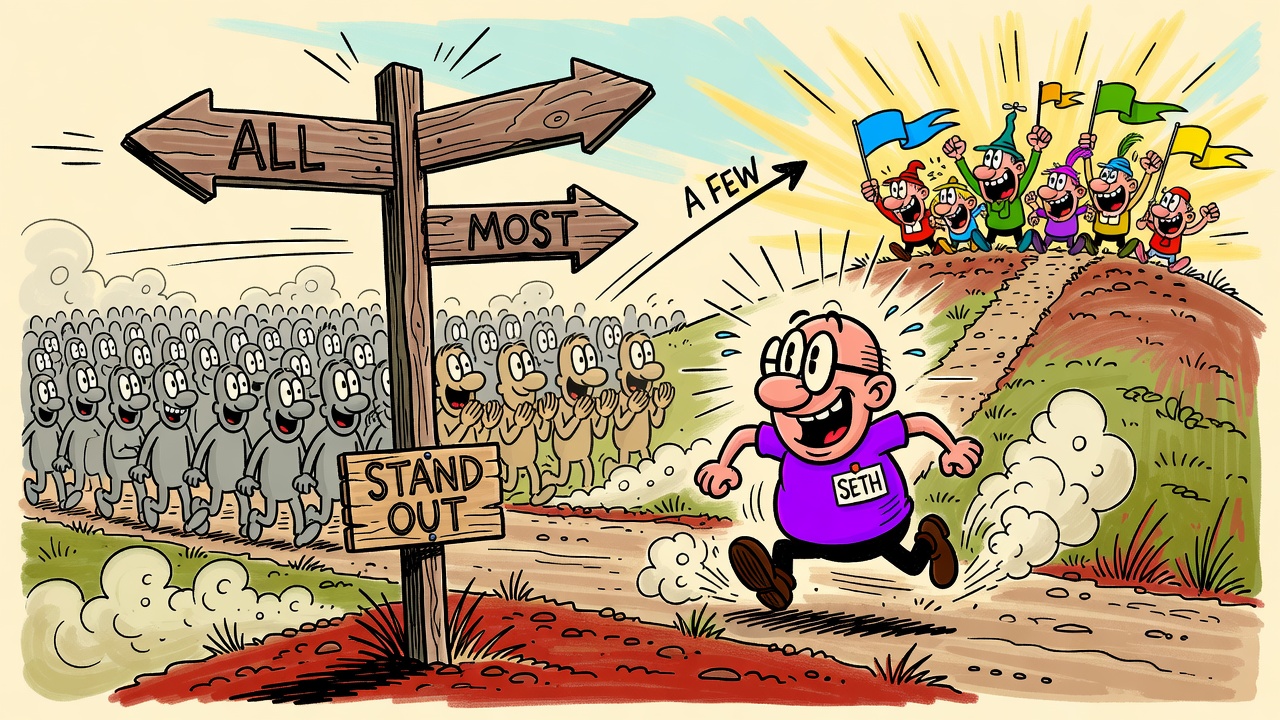
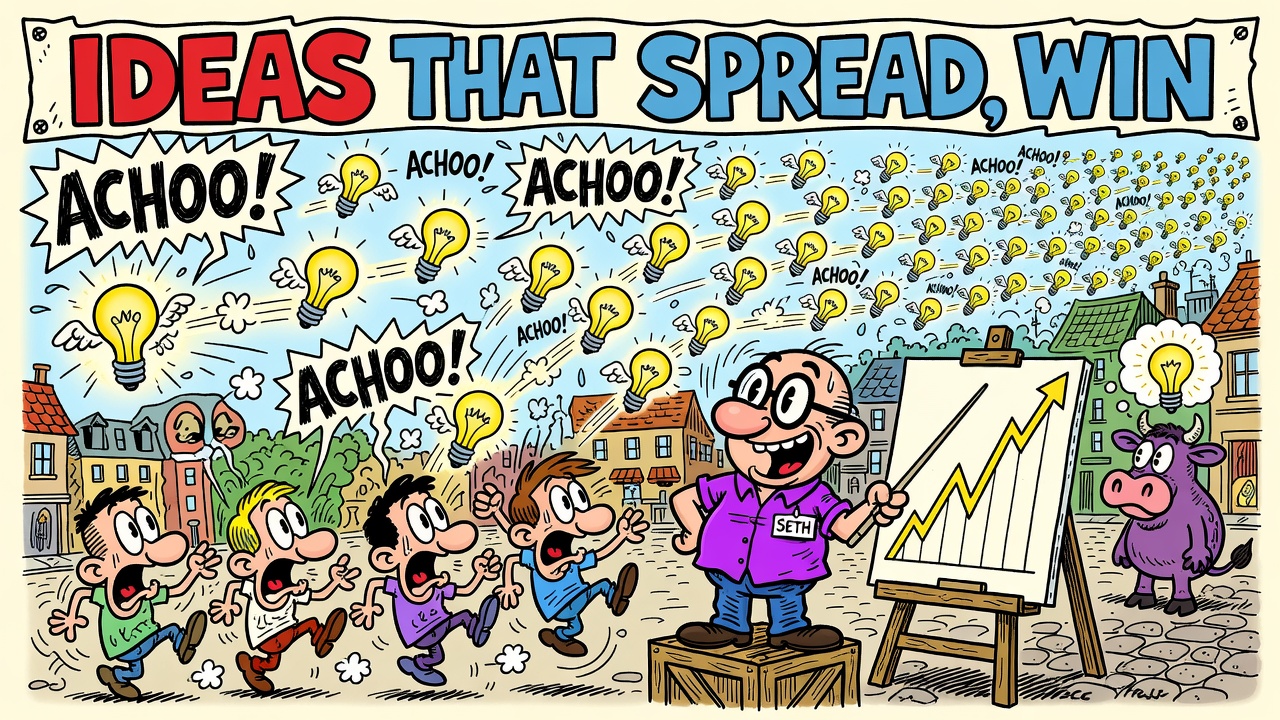
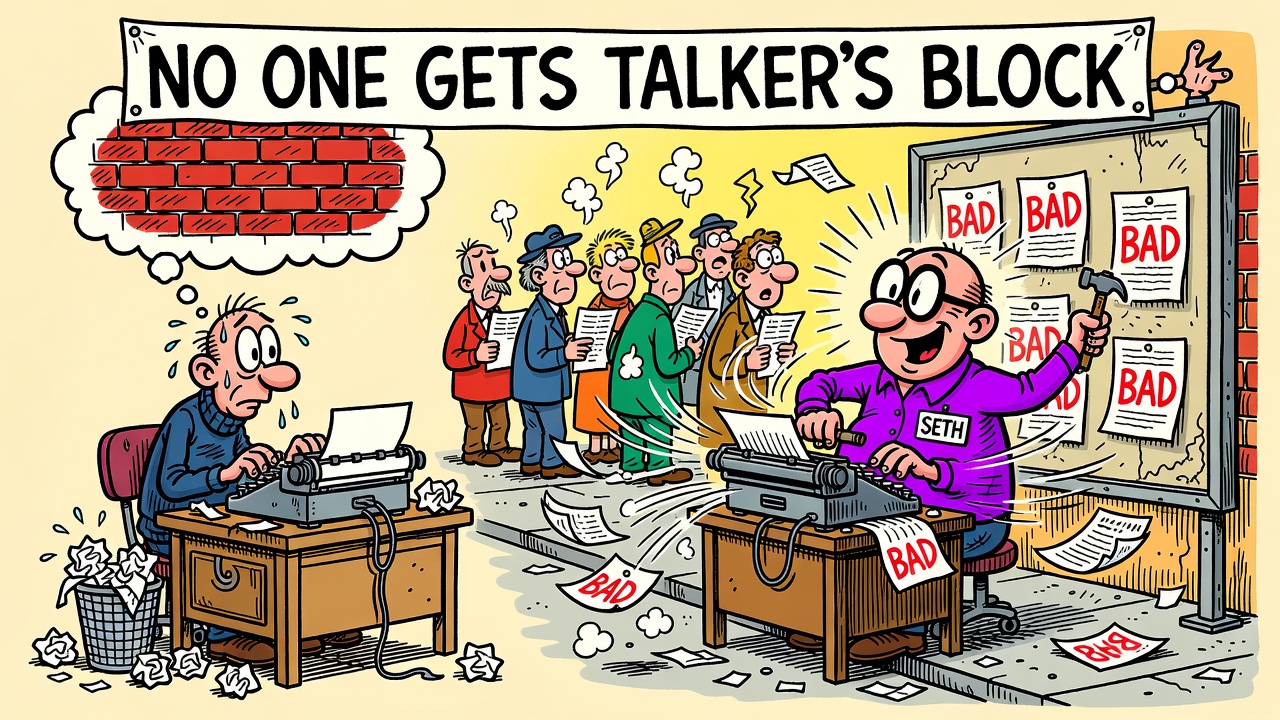
How to Be Remarkable (January 7, 2007.) “Remarkable doesn’t mean remarkable to you. It means remarkable to me. Am I going to make a remark about it? If not, then you’re average, and average is for losers.” The purple cow, defined by the tourists at the fence rather than by the cow.One, a Few, Most or All (May 31, 2007.) Four possible audiences — one, a few, most, all — and four strategies. For a few: “Being exceptional matters most. Stand out, don’t fit in. Shun the non-believers.” That last phrase becomes a Godin refrain — and, a decade on, the “smallest viable audience” of This Is Marketing.Ideas That Spread, Win From “The rapid growth (and destruction) and growth of marketing” (October 16, 2008): viral marketing, remarkable products, word of mouth — “all of these tactics are part of the same strategy: ‘ideas that spread, win.’” And the sentence that joins his two most famous books: “A purple cow is a remarkable story, a story that spreads.”Talker’s Block (September 23, 2011.) “No one ever gets talker’s block.” So: “Just write poorly. Continue to write poorly, in public, until you can write better.” “Write like you talk. Often.” This is the operating manual for the blog itself — one post a day, every day, since well before this book.
SECTION VI
New World Order
Change. Connection. Tactics. The posts where Godin starts naming what comes after the factory — and lands, in the book’s last year, on the phrase he’ll build the next book around: the connection economy.
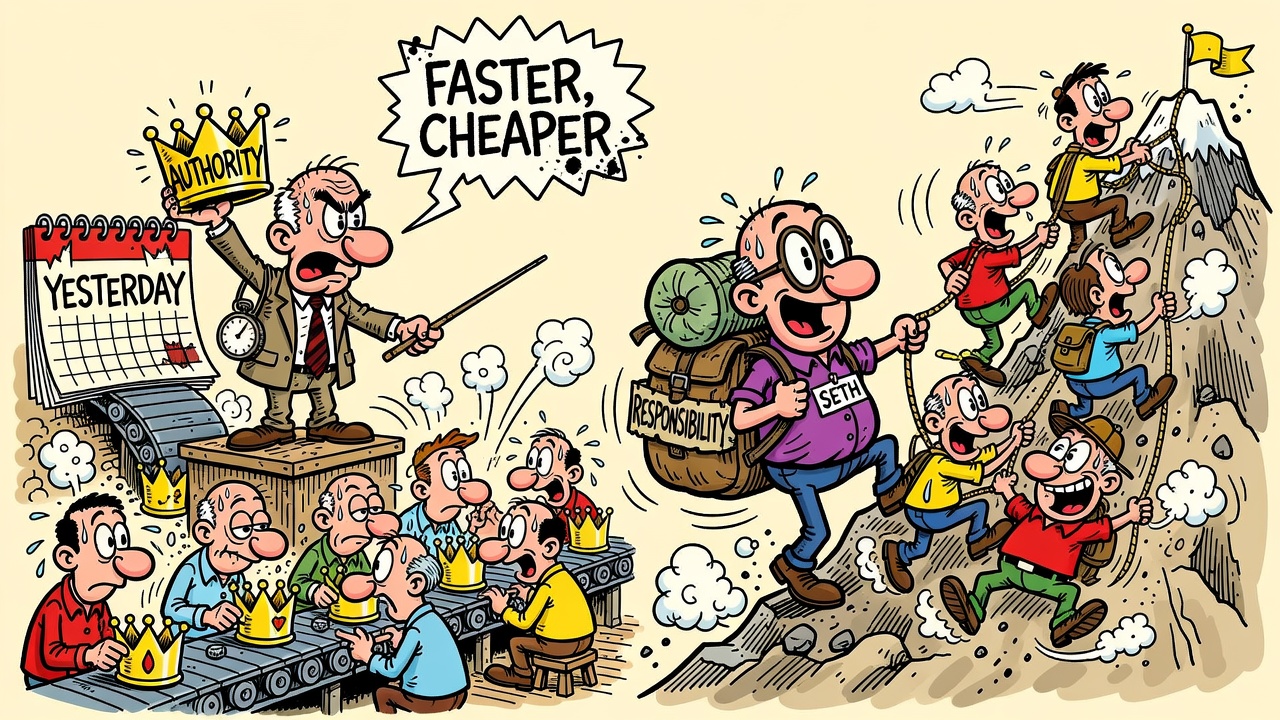
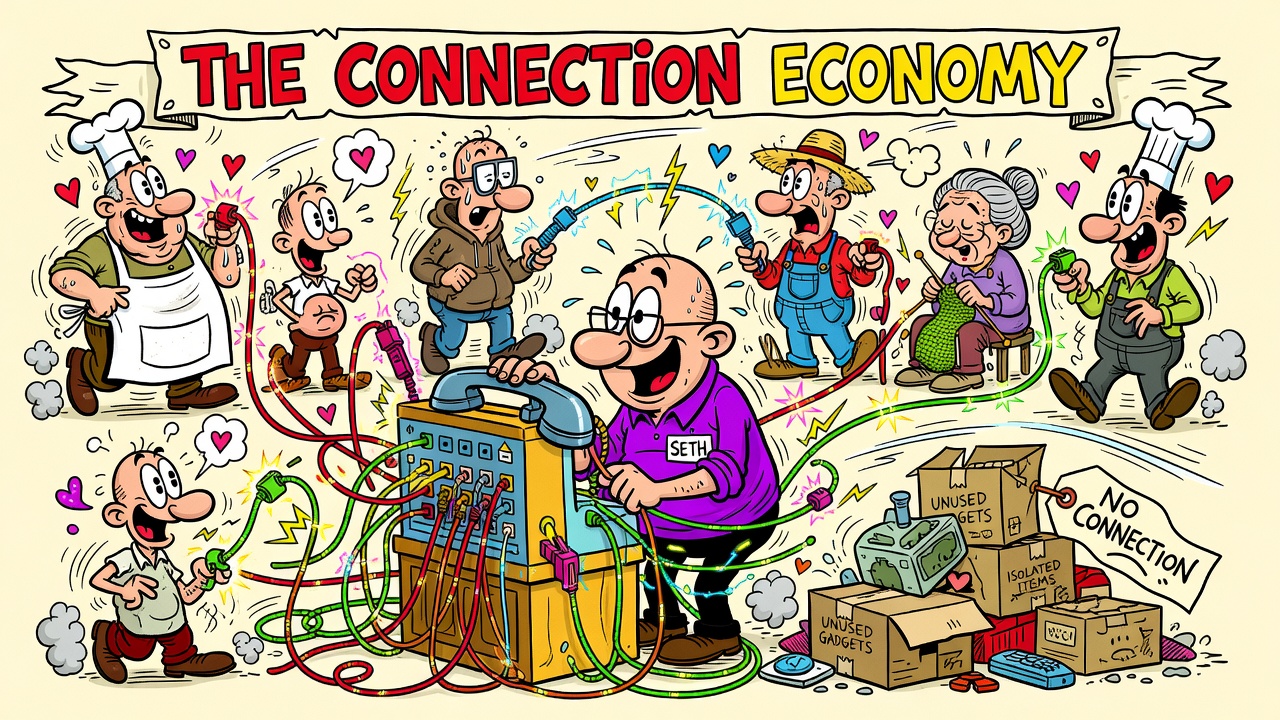
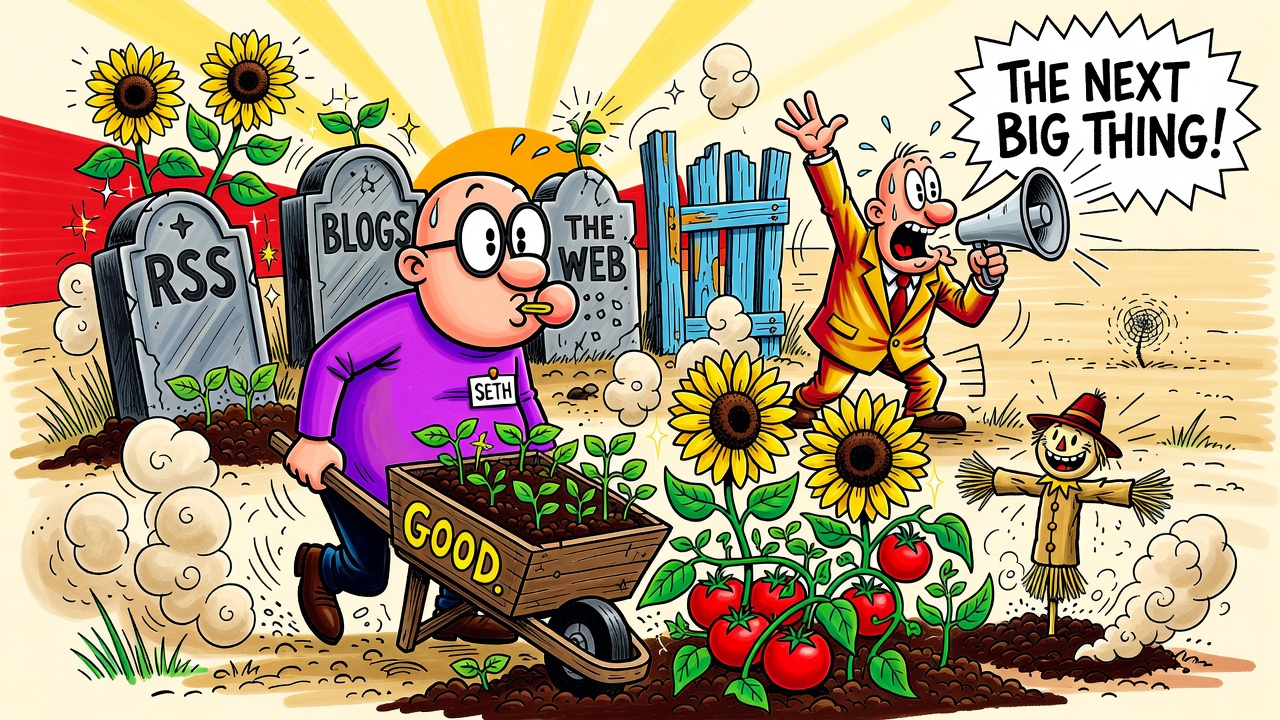
Management vs. Leadership “The difference between management and leadership” (October 22, 2011). “Managers work to get their employees to do what they did yesterday, but a little faster and a little cheaper.” Leaders go somewhere new, with their tribe. “Managers want authority. Leaders take responsibility.”First, Connect (August 30, 2012.) “In the connection economy, there’s a dividing line between two kinds of projects: those that exist to create connections, and those that don’t.” A phrase he’d been using on the blog since February 2012; four months after this post it’s the spine of The Icarus Deception.Bring Me Stuff That’s Dead, Please (March 14, 2011.) “RSS is dead. Blogs are dead. The web is dead. Good.” “Only when an innovation is dead can the real work begin.” The hype-man at the gate is welcome to the next big thing: “I’m far more interested in what you’re doing with the old big thing.”
SECTION VII
The Future Is Arriving
Publishing. Paper. Platforms and gatekeepers. Godin was running the experiment on himself while he wrote these — the Domino Project with Amazon (2010–11), then a Kickstarter for his next book — so the posts about books and libraries and email are field notes, not theory.
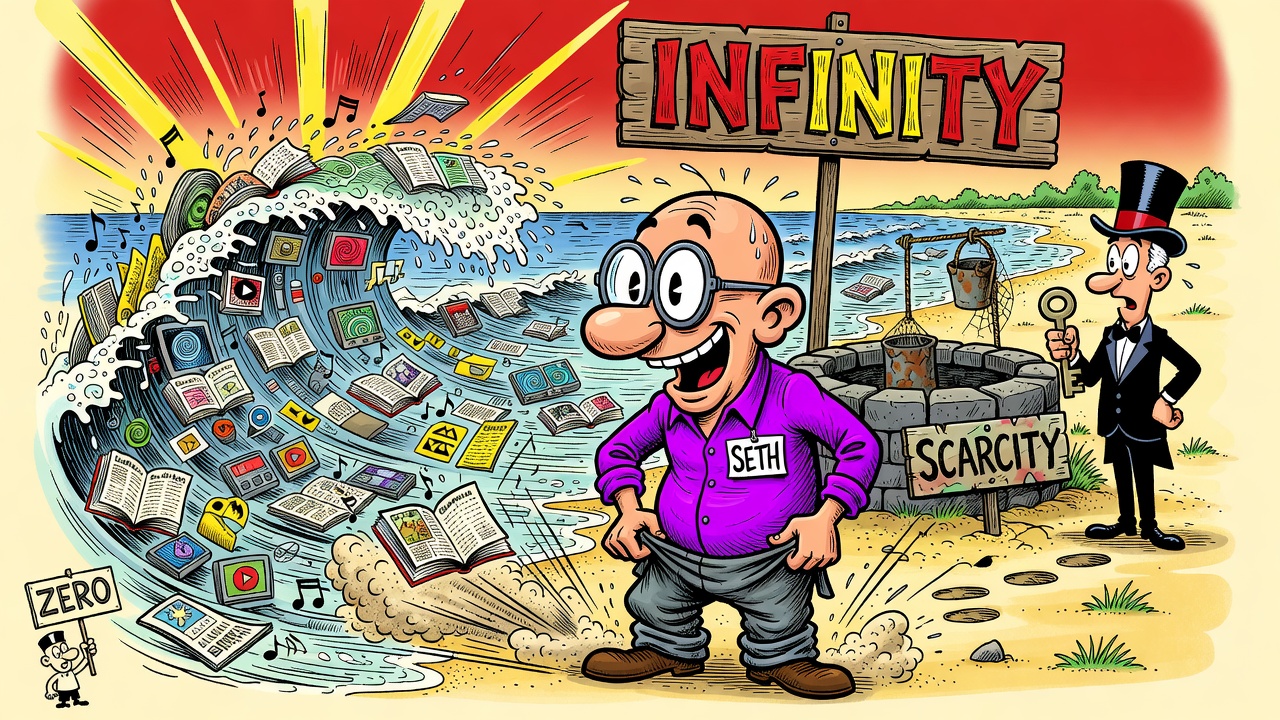
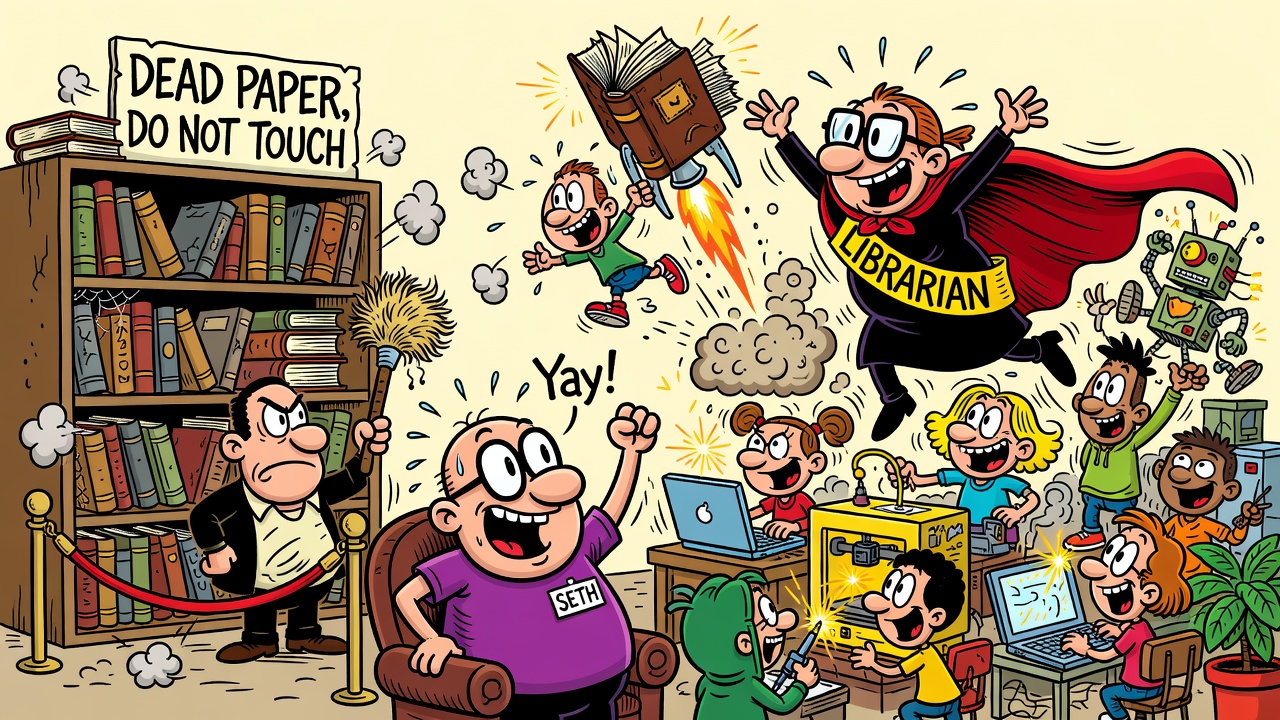
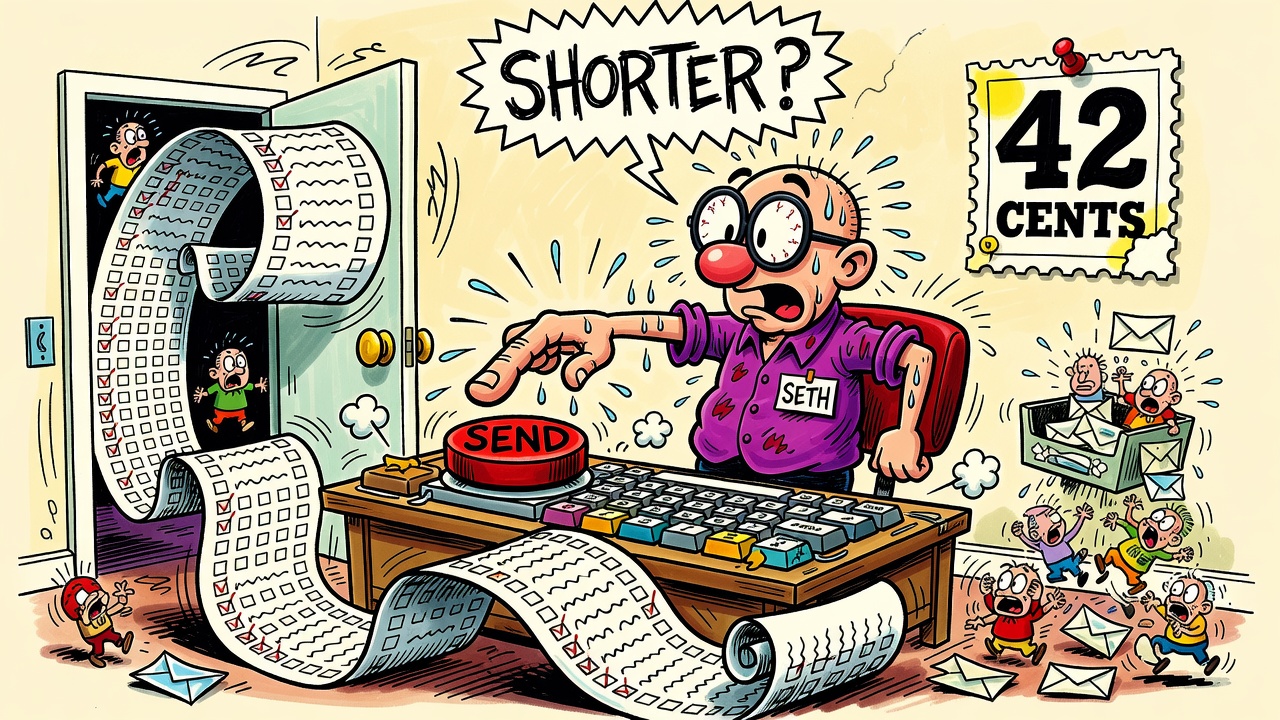
Advice for Authors (August 2, 2006 — nineteen numbered items.) “1. Lower your expectations. The happiest authors are the ones that don’t expect much.” “The best time to start promoting your book is three years before it comes out.” And the one that stings: “a non-fiction book is a souvenir, just a vessel for the ideas themselves.”Infinity “Getting used to infinity” (September 7, 2008): “All of us grew up in a world of content scarcity, and now we live in a world of content infinity.” “Don’t be afraid of infinity. There’s a lot of it going around.” The catch, from “Welcome to infinity” (September 30, 2011): “The corollary of infinity is zero. As in zero people disagreeing with you, questioning you or ignoring you.”The Future of the Library (May 16, 2011.) When every book is a search away, the building isn’t the point and the shelf isn’t the job. “We need librarians more than we ever did. What we don’t need are mere clerks who guard dead paper.”Email Checklist (June 5, 2008.) Thirty-six questions to run down “before you hit send on that next email.” Number 21: “Could this email be shorter?” Number 36: “If I had to pay 42 cents to send this email, would I?” Godin re-ran it in June 2011 as “Email checklist (maybe this time it’ll work!)”.
SECTION VIII
Stop Stealing Dreams
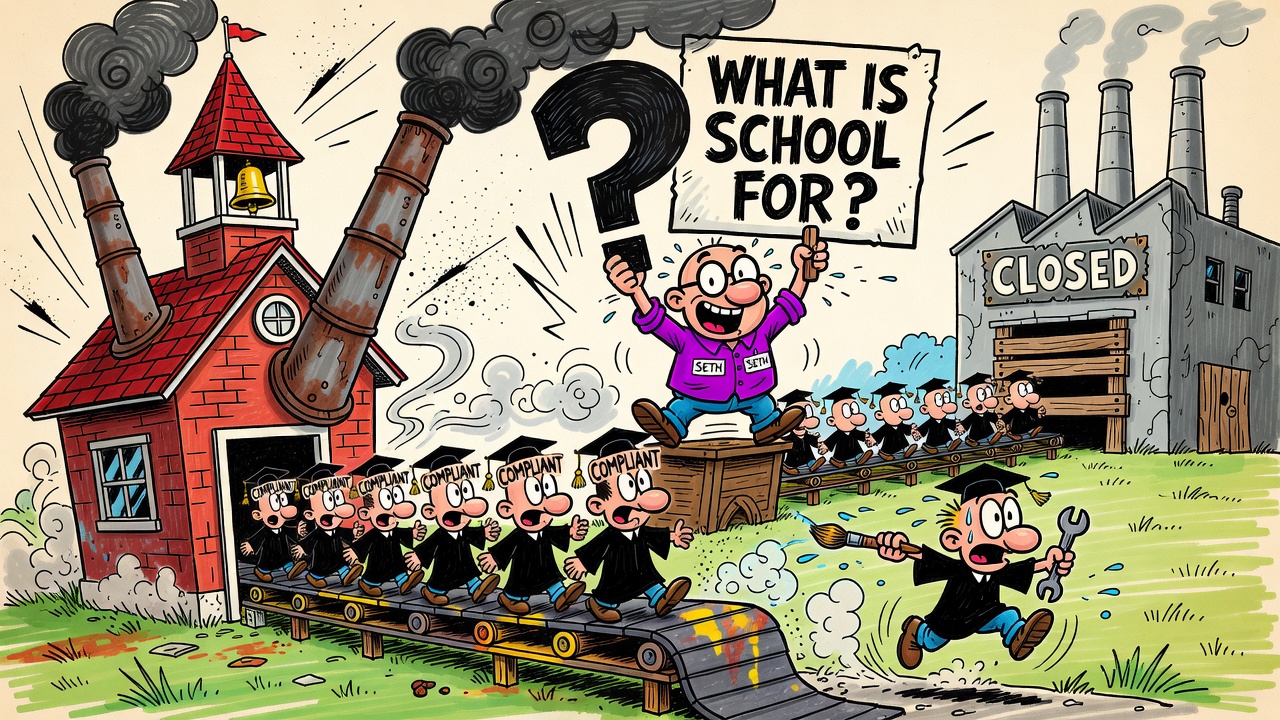
What is school for? The book closes with the 30,000-word manifesto Godin released free in early 2012, bound in as a bonus. It’s the most polemical thing in the collection, and the clearest statement of the idea under all the others: the factory is gone, and the institutions built to feed it haven’t noticed.
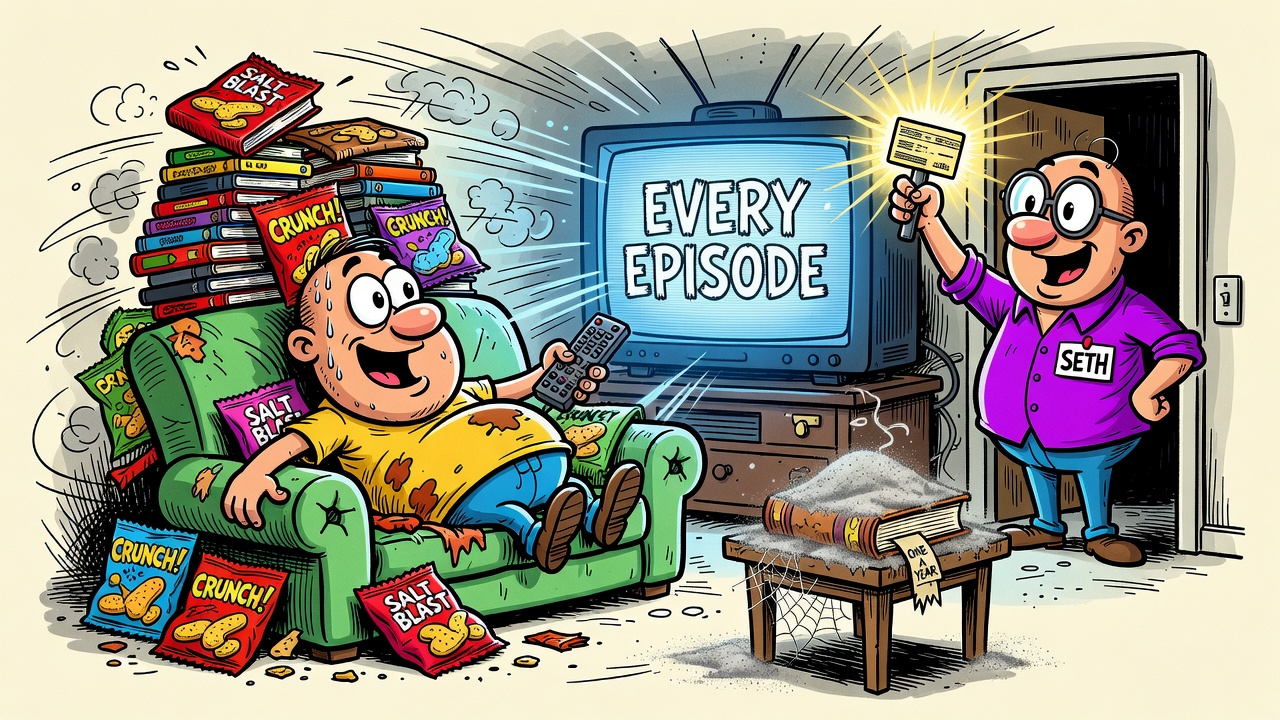
What Is School For?Stop Stealing Dreams (2012). The manifesto’s argument: public school as we know it was built to turn out compliant workers for the factories of the last century — and it still does that job well, for factories that no longer need them. Godin’s alternative is a school that produces people who lead, make, and connect the dots instead of collecting them.Deliberately Uninformed, Relentlessly So (October 20, 2010 — labeled “[a rant]”.) “Many people in the United States purchase one or fewer books every year. Many of those people have seen every single episode of American Idol. There is clearly a correlation here.” In an economy that runs on ideas, Godin argues, choosing not to know is the one choice you can’t afford.
✦ THE REST OF THE TERRITORY ✦
The Duck is one pond. Godin has been writing the same argument since 1999, in twenty-odd books, and the pond sits right at the hinge. Here is the whole map.
THE MAP
A Map of Godin-Land
One territory per theme, books as landmarks with their years, ventures as flags, the blog as the river running through all of it. Solid road: the path through the books. Dashed road: still being written. The map is a hand-drawn-style SVG built to grow — every landmark is a labeled group, so the next book gets added by copying the nearest one.
Click the map to open it full-size. Years are first-edition years; where sources disagree by a year (Ideavirus 2000/2001, Meatball Sundae 2007/2008, the Duck itself Dec 2012/2013) the earlier one is used.
A LOOSE FRAMEWORK
How to Read Godin Without Getting Lost
One argument, a quarter century and counting
The industrial economy — mass markets, average products, interruption advertising, compliant workers, and the bargain that obedience would keep you safe — is over. What replaces it runs on permission (attention that was given, not taken), remarkability (things worth talking about), tribes (small groups led, not managed), and individuals willing to ship their art to the few who care. Every book is this argument aimed at a different reader: the marketer, the employee, the leader, the creator, the citizen.
Godin says as much himself, backwards. His 2018 definition of his own field splices a sentence from 1999 onto one from 2018: marketers make change happen “for the smallest viable audience, and by delivering anticipated, personal, and relevant messages that people actually want to get.” The second half is the Permission Marketing definition, nearly word for word. The arc loops.
Five eras — and where the Duck sits
0 · 1986–1998
Packager & entrepreneur
A book-packaging shop started with $20,000 and (by his count) 900 rejections; then Yoyodyne, the “ethical email marketing” company sold to Yahoo! in 1998.
Business Rules of Thumb, the Bootstrapper’s Bible
1 · 1999–2007
Marketing in the attention economy
Attention is scarce and belongs to the reader. Earn it, build something remarkable, tell a true story, let it spread.
Permission Marketing, Ideavirus, Purple Cow, Free Prize Inside, All Marketers Are Liars, Small Is the New Big, Meatball Sundae — and The Dip, the hinge: the first book addressed to the individual’s choices rather than the marketer’s.
2 · 2008–2012 · YOU ARE HERE
The end of the factory
Lead a tribe. Become indispensable. Ship despite the lizard. Pick yourself. Mass is a myth. The Duck collects the blog from exactly these years, which is why its center of gravity is shipping and fear, not cows.
Tribes, Linchpin, Poke the Box, We Are All Weird, Stop Stealing Dreams, The Icarus Deception, V Is for Vulnerable, the Duck
3 · 2014–2020
The practice
From books to workshops: the altMBA, the Marketing Seminar, the Akimbo podcast. The ideas get a method — trust the process, serve the smallest viable audience, ship generously.
What To Do When It’s Your Turn, This Is Marketing, The Practice
4 · 2021–2026
Systems, significance, civic work
The toolkit turned on public problems and on organizations themselves: see the system, choose the game, play the long game, treat people as the point rather than the resource.
The Carbon Almanac (300 volunteers; credited to the network, Godin as editor), The Song of Significance, This Is Strategy, The Knot
The four moves (in almost every post)
Name it. Coin a term and the problem becomes visible: purple cow, sneezer, the dip, linchpin, sheepwalking, the lizard brain. “Step one is to give the problem a name. Done.”
Flip it. Invert the obvious until it’s a headline: safe is risky; all marketers are liars; bring me stuff that’s dead; the world’s worst boss is you.
Draw the line. A two-box choice you have to stand on one side of: permission or interruption, the dip or the cul-de-sac, hard work or long work, manager or leader, risk or fear.
Say go. End with a verb. Ship. Lead. Start. Pick yourself. The posts are provocations, not proofs — read them for the reframe, not the evidence.
The recurring themes
Theme
In one line
Key terms
Where
Permission & attention
Attention is scarce and belongs to the reader; earn it with messages people want.
permission marketing, interruption marketing
Permission Marketing (1999); the daily blog; restated in This Is Marketing (2018)
Remarkability
If it isn’t worth remarking on, it’s invisible. Safe is risky.
purple cow, otaku, free prize, edgecraft
Purple Cow (2003), Free Prize Inside (2004)
Ideas that spread
Ideas move person to person; design for the carriers, not the broadcast.
ideavirus, sneezers, “ideas that spread, win”
Unleashing the Ideavirus (2000), TED 2003
Stories & worldviews
People buy the story that fits what they already believe.
worldview, authentic story, “people like us do things like this”
All Marketers Are Liars (2005), This Is Marketing (2018)
Tribes & leadership
Anyone can now lead a group connected to an idea and to each other; leading is the scarce thing.
tribe, heretic, sheepwalking, leader vs. manager
Tribes (2008), TED 2009
The end of the factory
The bargain — obey and be safe — is broken; value comes from connection and trust.
the factory, cogs, compliance, connection economy
Linchpin (2010), Stop Stealing Dreams (2012), Icarus (2012), Song of Significance (2023)
Art & emotional labor
Indispensable people give their work as a gift and do the hard, human part.
linchpin, emotional labor, art, gift
Linchpin (2010), V Is for Vulnerable (2012), The Practice (2020)
The resistance & shipping
Fear stops people from starting and finishing; no one will pick you, so go.
lizard brain, thrashing, ship, poke the box, pick yourself
Linchpin (2010), Poke the Box (2011), the Duck (2012), Your Turn (2014)
Strategic quitting
Be the best in the world at something narrow; quit the cul-de-sacs early.
the dip, cul-de-sac, the cliff
The Dip (2007); echoed in This Is Strategy (2024)
Weird vs. mass
Mass is a myth of the TV age; serve the few who care enough to spread it.
weird, smallest viable audience
Small Is the New Big (2006), We Are All Weird (2011), This Is Marketing (2018)
Generosity & enrollment
Change happens when you create tension and invite people in, not when you coerce.
enrollment, tension, “better is possible”
This Is Marketing (2018), The Practice (2020), the Carbon Almanac (2022)
Systems, games & time
See the system you’re in, pick a game you can win, plant for a later harvest.
zooming, systems, games, time, empathy
Survival Is Not Enough (2002), This Is Strategy (2024), The Knot (2026)
Significance & dignity
Humans are the point of the work, not a resource for it.
significance, “Mozart, not Muzak,” real skills
Song of Significance (2023), the altMBA (2015–24)
The civic turn
The same toolkit pointed at school, climate, and philanthropy, through volunteers instead of products.
“what is school for?”, “it’s not too late”, positive auction
Stop Stealing Dreams (2012), The Carbon Almanac (2022), GOODBIDS (2024)
The tensions worth noticing
Liars vs. true stories. The title All Marketers Are Liars is itself the marketing; Godin’s own intro says marketers “are just storytellers,” and later printings carry the words All Marketers Tell Stories on the cover.
Attention vs. generosity. The early books are about getting noticed; the late ones say marketing is a generous act. He now reads Purple Cow through the later lens: being remarkable as a form of service, not a stunt.
Quit vs. persist.The Dip says winners quit the right things fast; The Practice says never quit the practice. The reconciliation — quit projects, not the practice — is ours, not his.
Mass vs. weird. His two biggest ventures, Yoyodyne and Squidoo, were scale plays. Squidoo peaked in late 2012, a year after We Are All Weird declared the myth of mass, then lost most of its traffic to Google’s spam crackdowns and was sold to HubPages in 2014.
Aphorism vs. evidence. The style is the point and the weakness. Kirkus on Icarus: “Enjoyable, if not particularly enlightening, take on the new economy.” Read for the reframe; bring your own data.
The numbers drift. Book counts (18? 20? 21?), languages (35? 38? nearly 40?), words on the blog (two million? three? five?) vary by source and by year. The map uses what can be checked.
If you only read five
This Is Marketing (2018) — the synthesis of eras 1 and 2, in order.
Linchpin (2010) — the one he calls his most important, and the book the Duck was written around.
The Dip (2007) — an afternoon, and the hinge between the marketer and the maker.
Purple Cow (2003) — the idea everything else assumes.
Whatcha Gonna Do with That Duck? (2012) — for dipping into; or just read the blog, which is the same thing, free, and still arriving every morning.