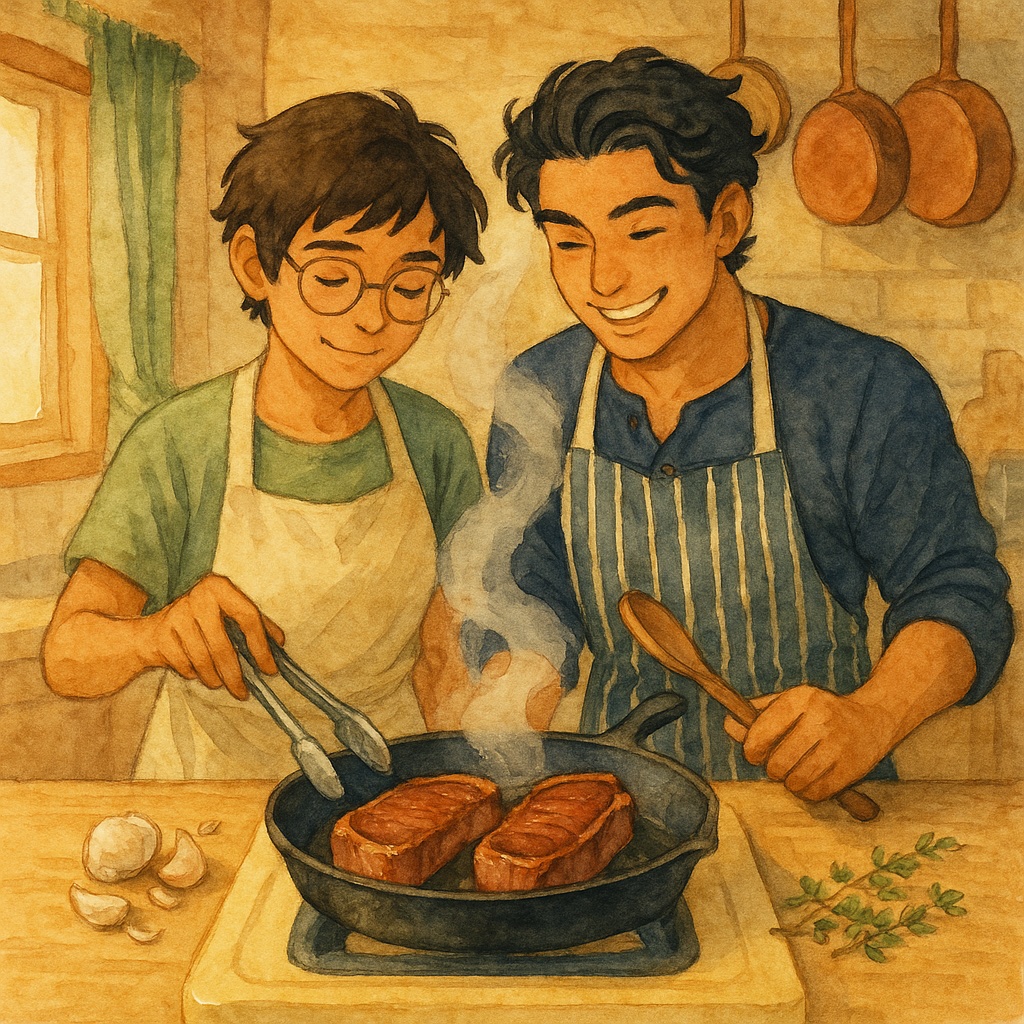
The Maillard Affair
a short illustrated tutorial on the perfect New York strip
Cold Open
The kitchen smelled like Sunday before anything had hit the heat.
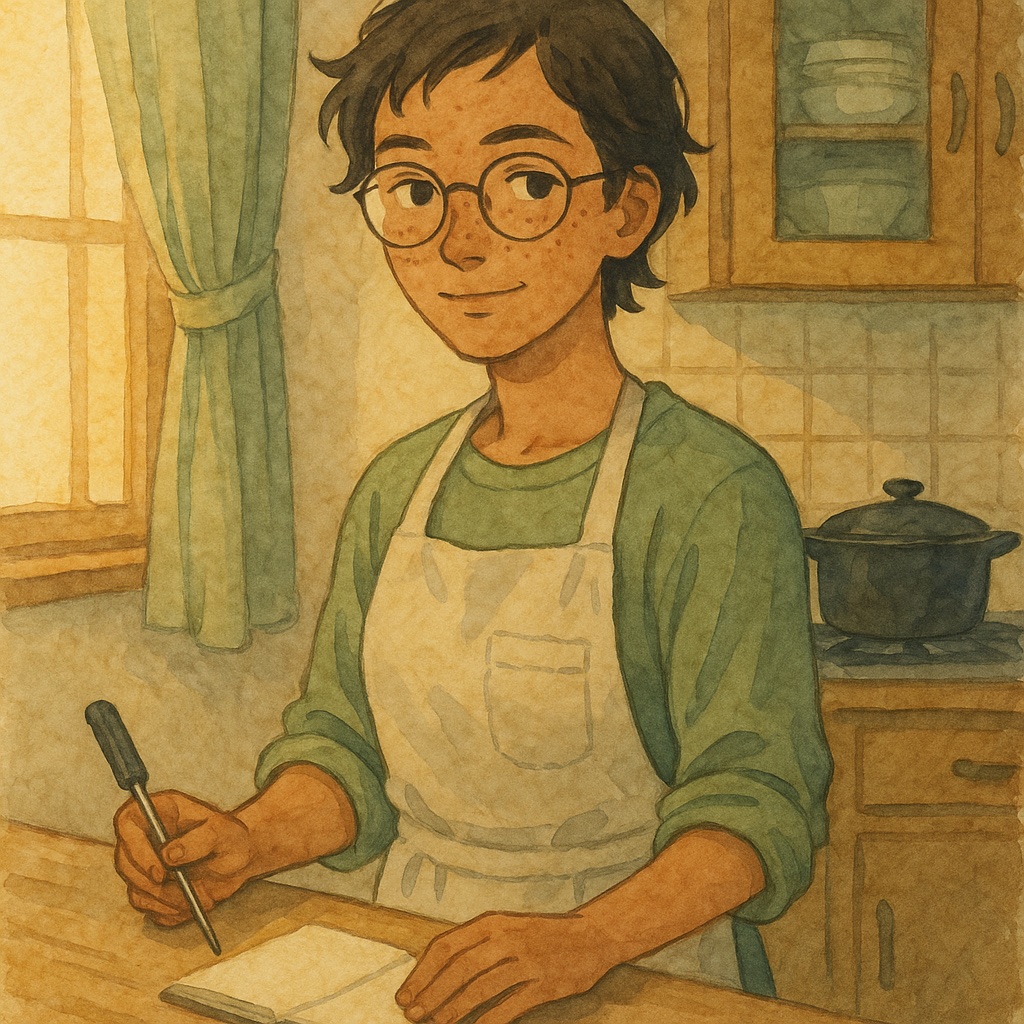
Mara unwrapped her steak the way some people open a textbook. Butcher paper folded back along the crease. Steak placed center on the cutting board. Pencil tapped twice against the wood like a metronome finding its tempo.
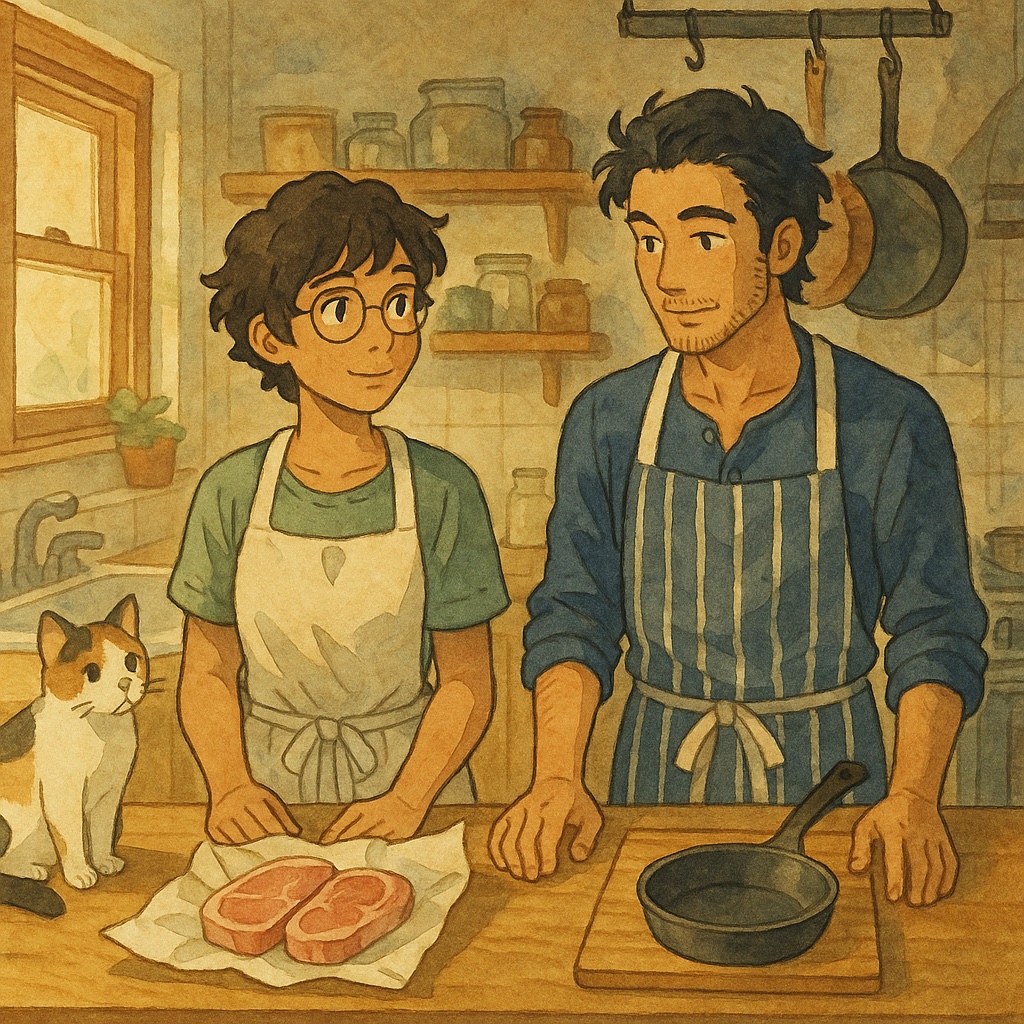
"One and a half inches," she said. "Beautiful marbling. Fat cap on the side, intact. That is a good cut."
"Mar, you do this every time."
"I do this every time because every time it works."
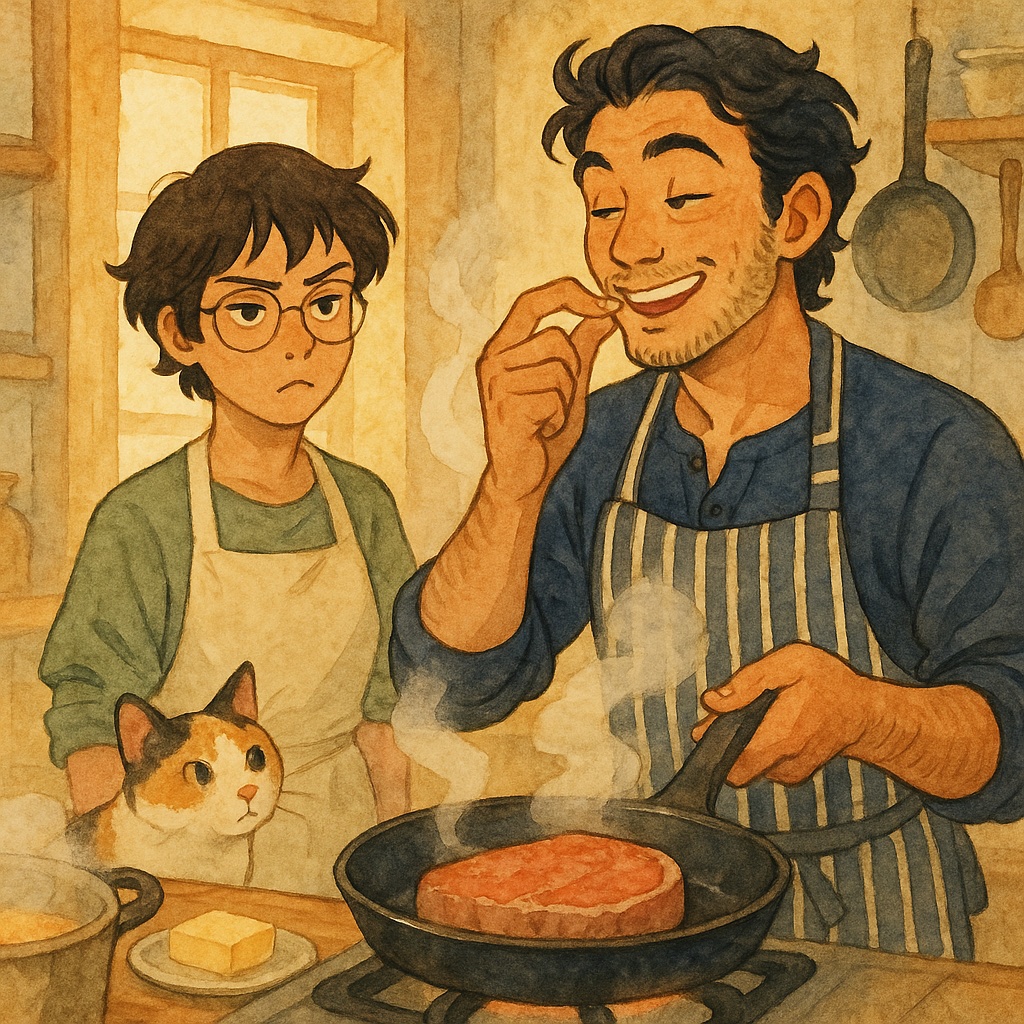
Theo unwrapped his steak the way some people unwrap a present. The paper tore. The steak landed with a wet slap that made him grin. He picked it up with both hands like he was holding a small confused cat.
"Hi friend," he said to the steak. "We're going to have a very good evening together."
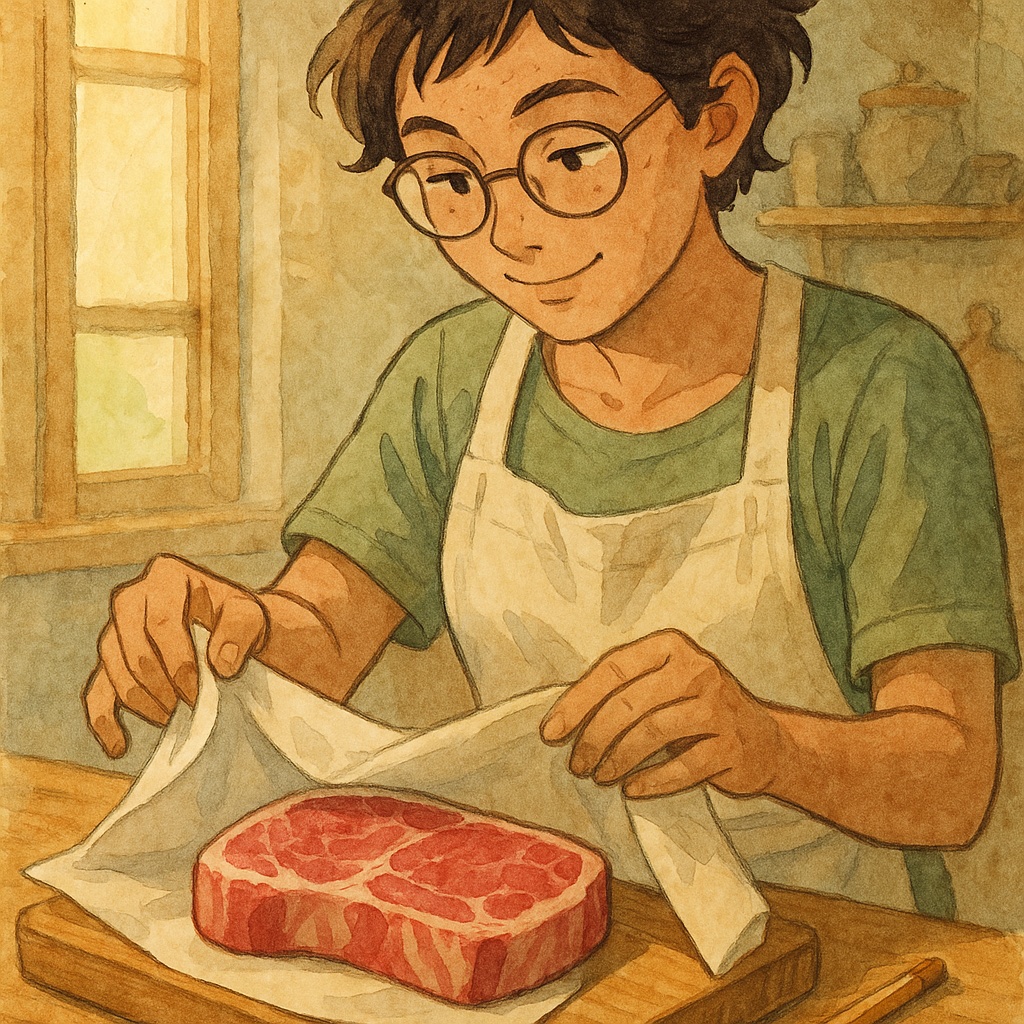
Mara did not look up from her notebook. She was already writing something.
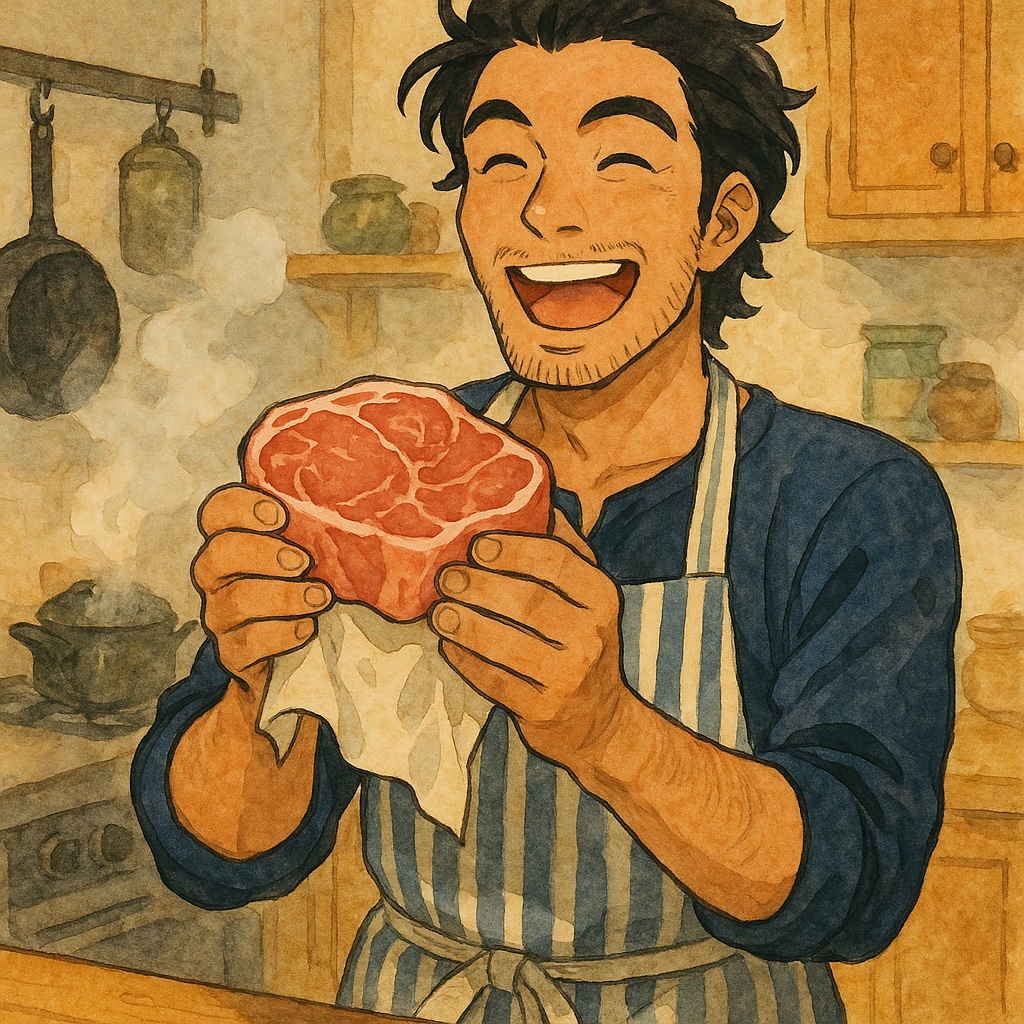
"What are you writing."
"Your time of death."
"Rude."
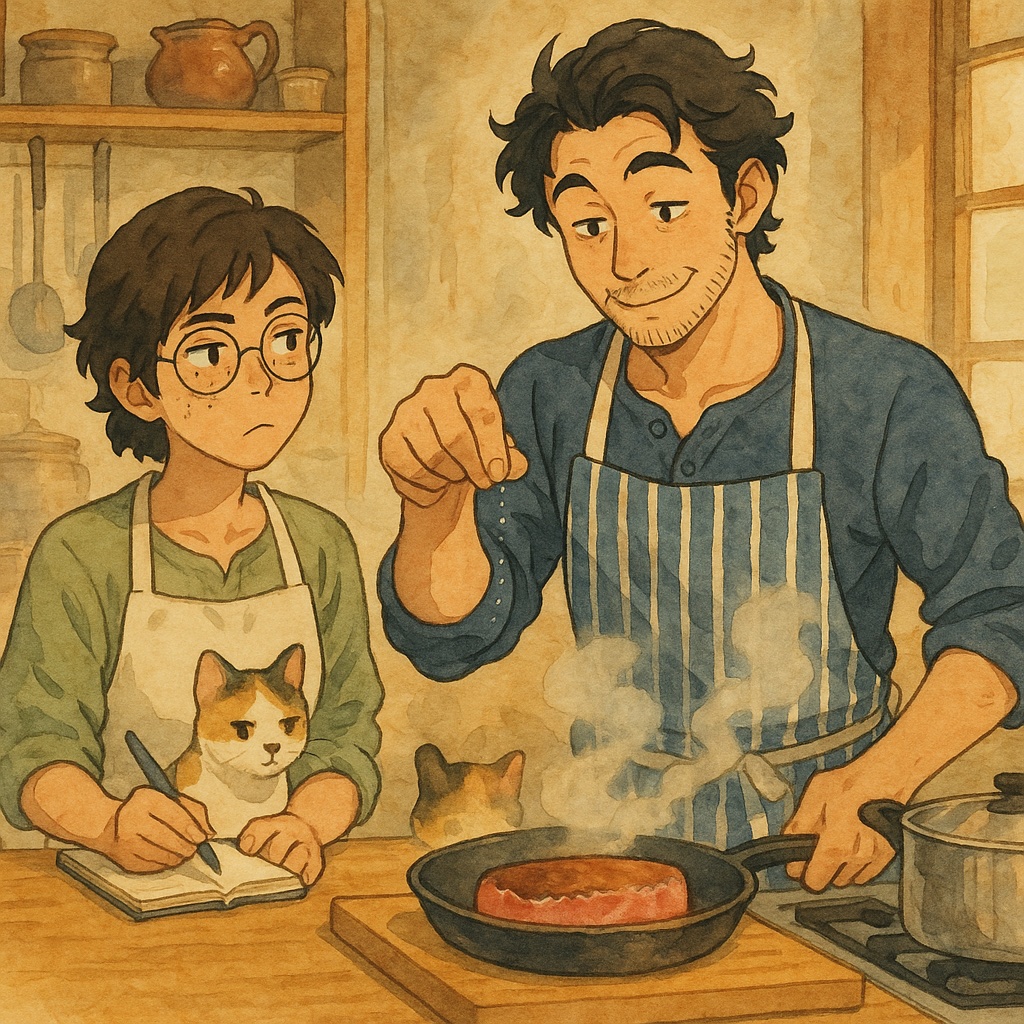
She tapped the pencil against the page. "I'm doing reverse sear. You're doing forward sear. Whoever's steak has the more even pink does the dishes."
"Loser does dishes."
"Loser does dishes."
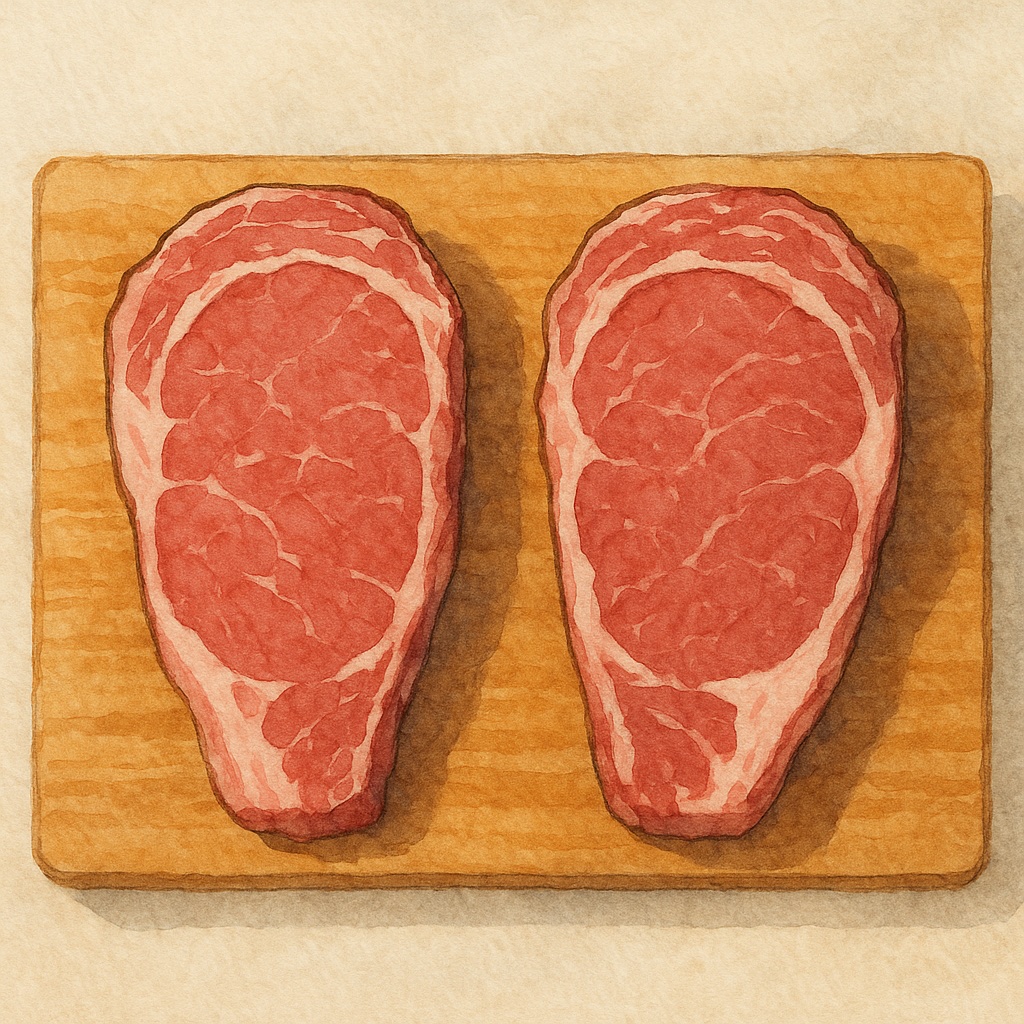
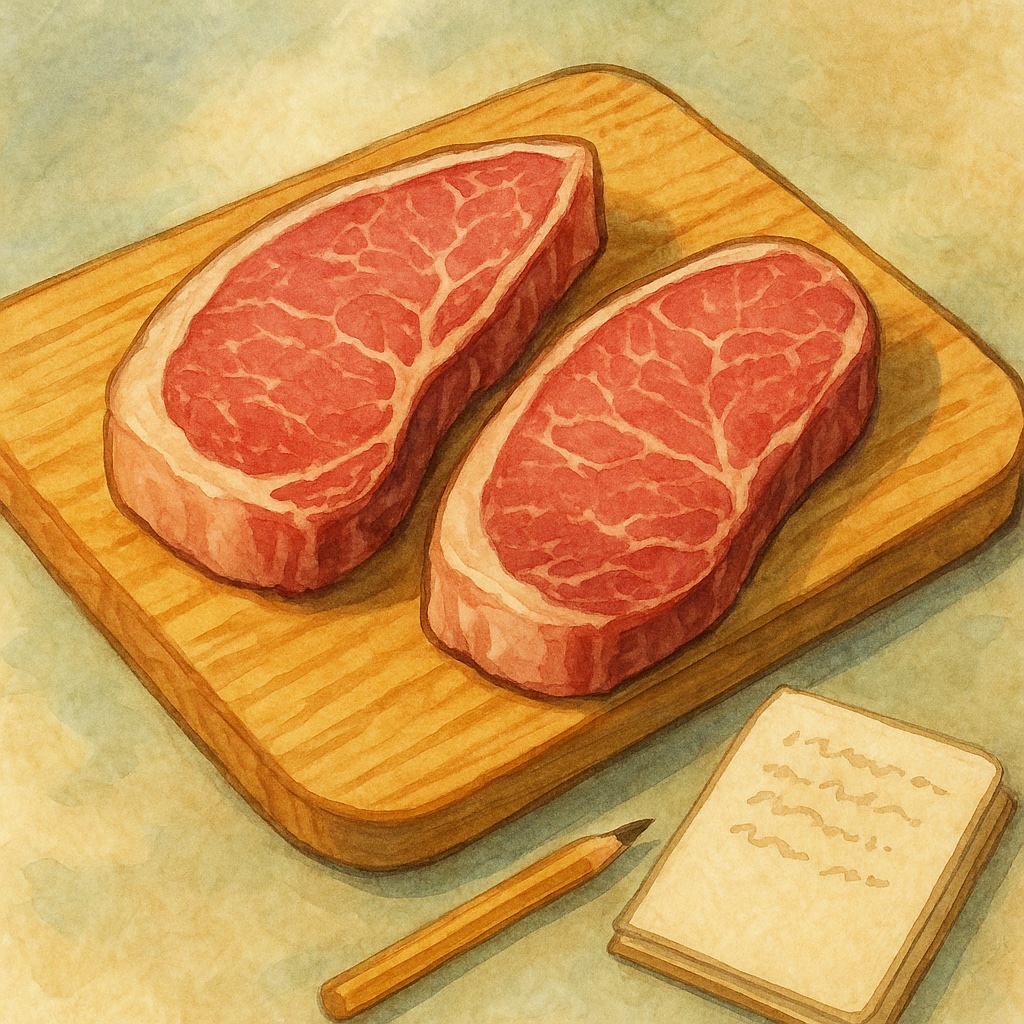
He set his steak gently on its own corner of the board, side by side with hers. They were nearly identical — two thick rectangles of deep cool red threaded with little white rivers of fat. From above, on the warm wood, they looked like a paired set, two pages from the same atlas.
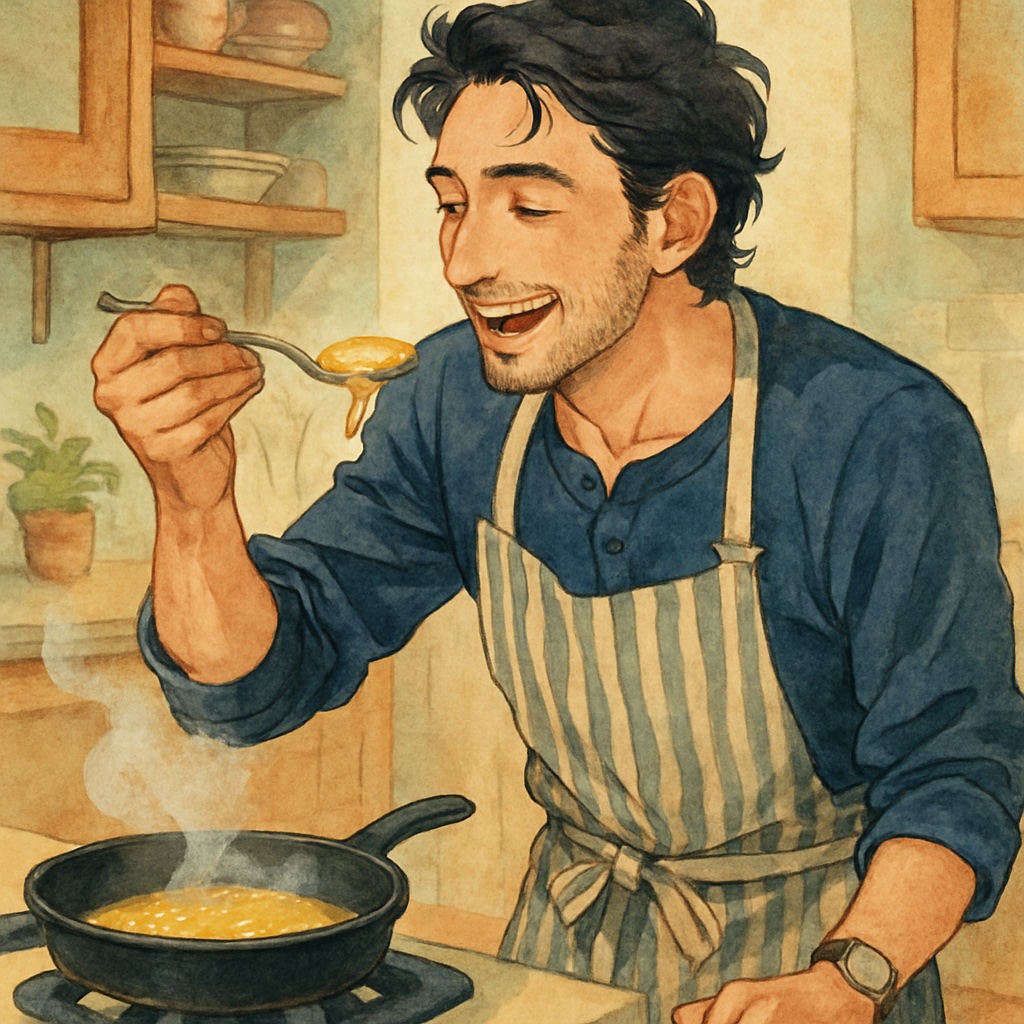
"Okay," Theo said. He pulled the stick of butter out of the fridge and gestured at the kitchen with it like a wand. "What do we need."
"Salt. Big flakes. Butter — already in your hand. Garlic. Thyme. Neutral oil. Cast iron. Two probes. A wire rack."
"A glass of wine."
"A glass of wine."
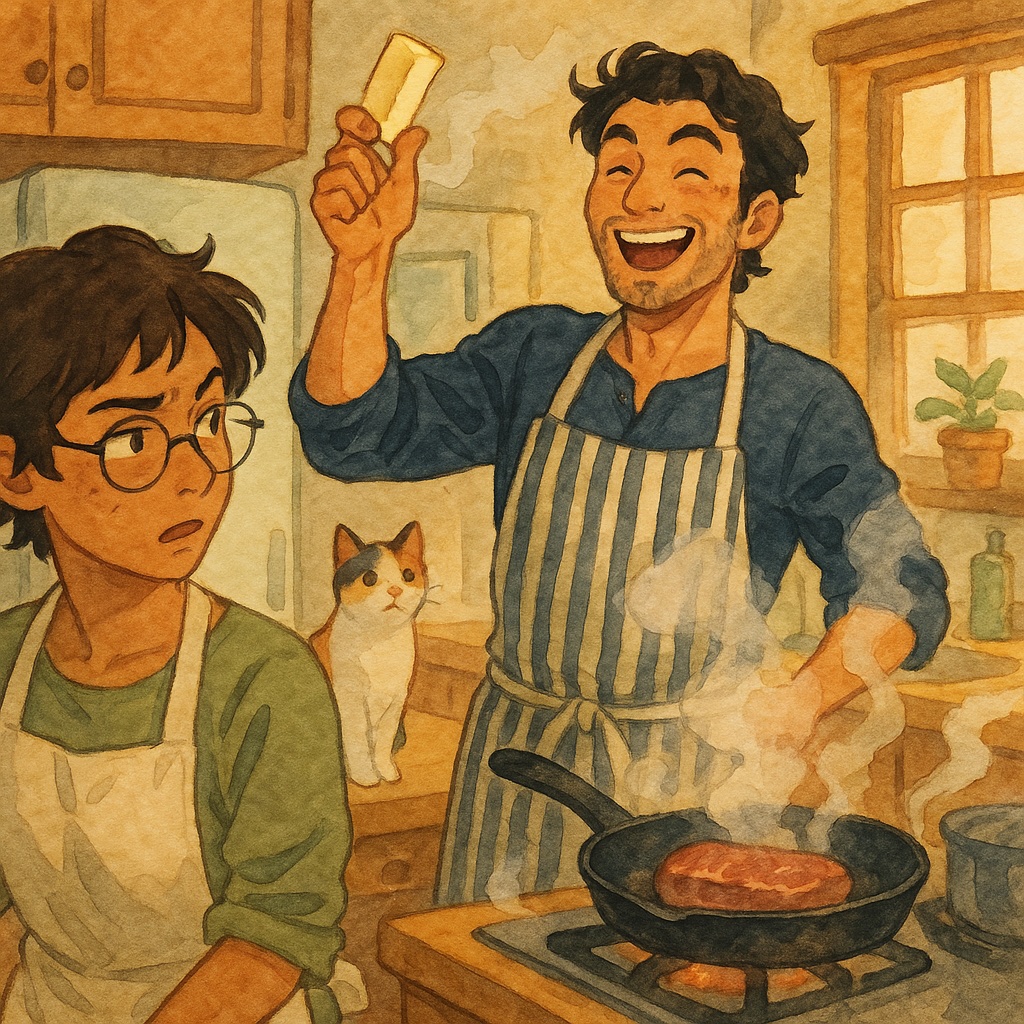
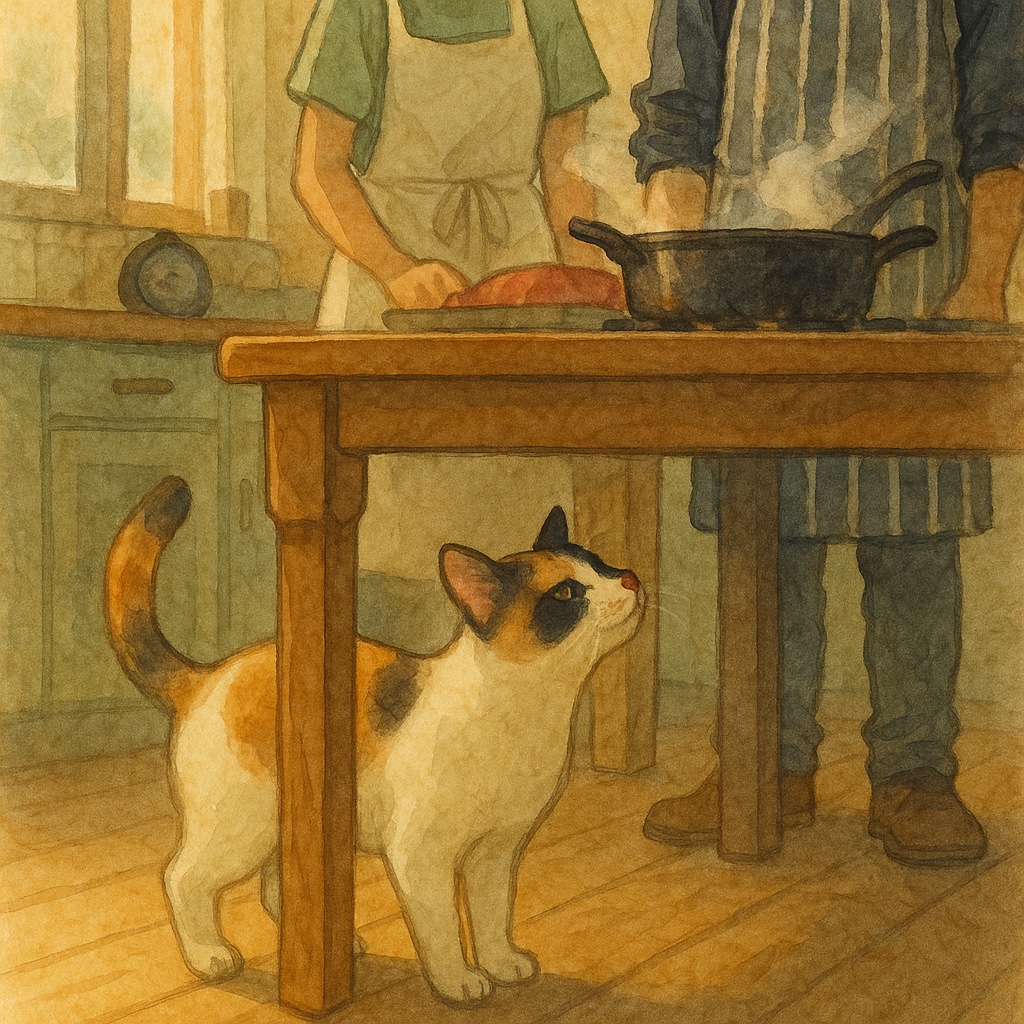
The window above the sink was full of late afternoon. Honeyed sunlight lay flat on the counter and the wood floor and the rim of the copper pan rack above their heads. The cat — small, opinionated, named Brisket — strolled in, sniffed at the table leg, decided nothing was happening yet, and strolled back out.
Mara was still looking at her steak the way pilots look at their checklists.
"You know what this is," she said.
"Dinner."
"It's Maillard. It's not browning. It's not caramelizing — that's sugar. Maillard is amino acids and reducing sugars rearranging themselves into hundreds of new flavor compounds at the surface of the meat. It starts around a hundred and forty degrees Celsius. It needs a dry surface. It needs contact. It needs heat that doesn't quit when you put something cold on it."
"Mara."
"Yes."
"You said Maillard like it was the name of a man you were in love with."
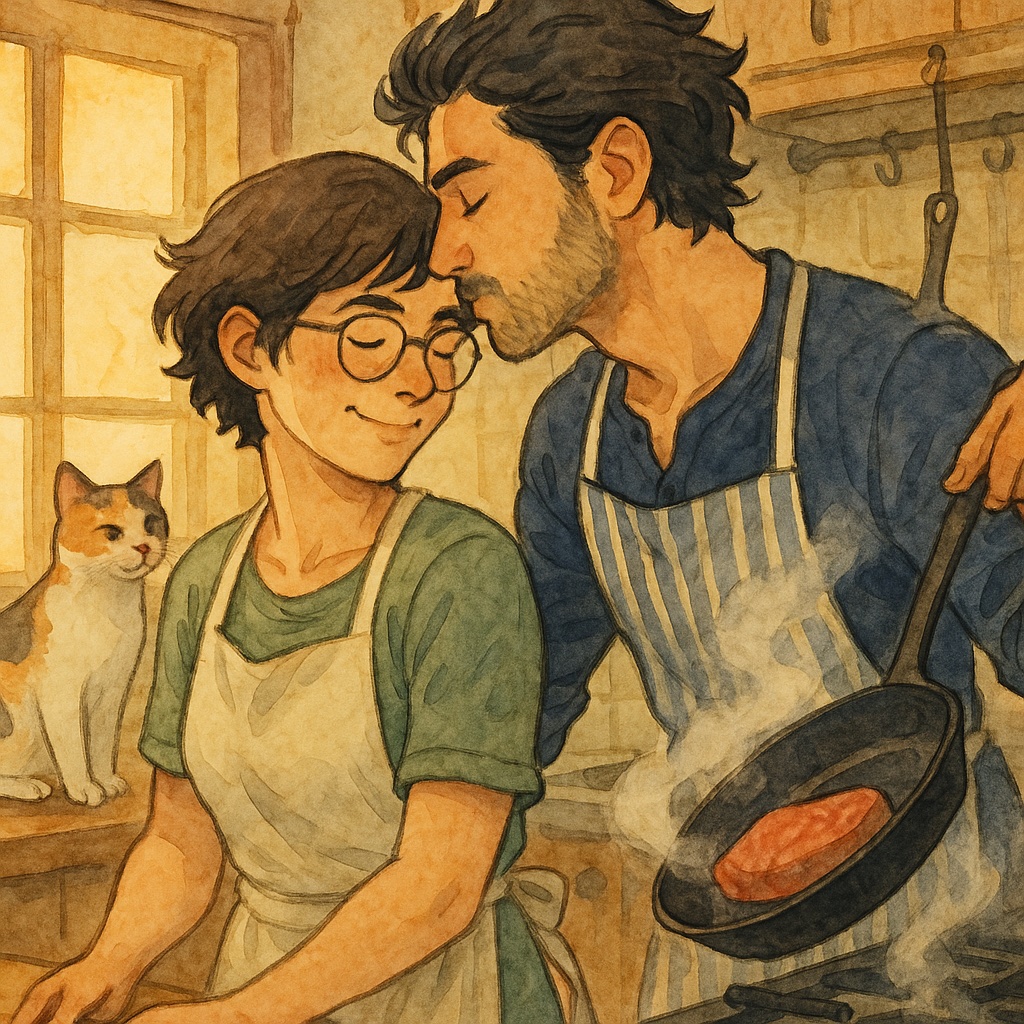
She blinked at him. "I am a little in love with Maillard."
"Move over Maillard," Theo said. He kissed the top of her head on the way past her toward the stove. "Heat. Salt. Fat. Rest. Slice. Eat. We have a steak to ruin or save, and only one of us can be right."
"Both of us can be right."
"Then both of us can do the dishes."
She laughed. The pencil went behind her ear. The cast iron came down off the hook and onto the burner with a soft heavy thunk that was the actual cold open of the evening.
Outside the window, the light kept going.
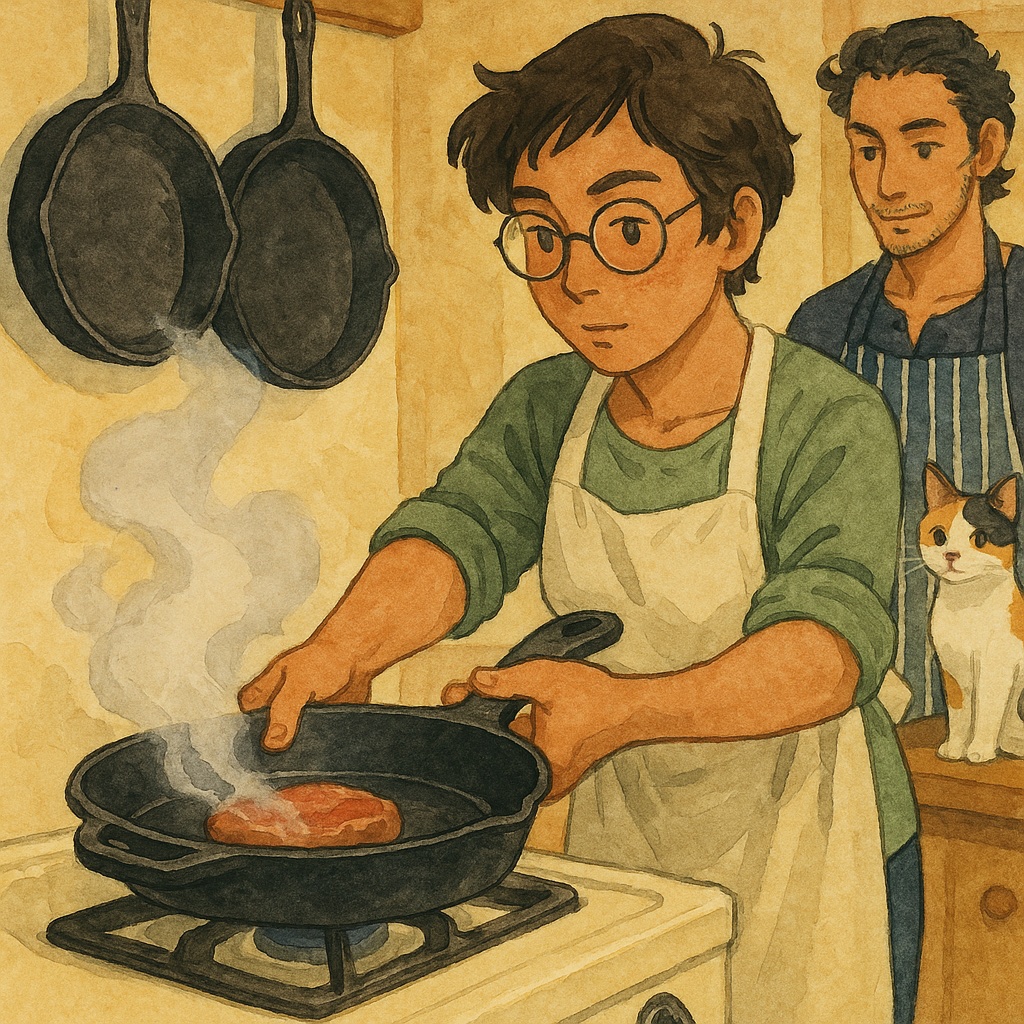
Inside, two steaks waited on the wood, and Mara wrote the time at the top of her page so they'd know later, exactly, how long it had taken from raw to the moment they sat down across from each other.
Reading the Steak
"Okay. Reading the steak. Sit," Mara said.
"I'm standing."
"Sit metaphorically."
"Metaphorically seated."
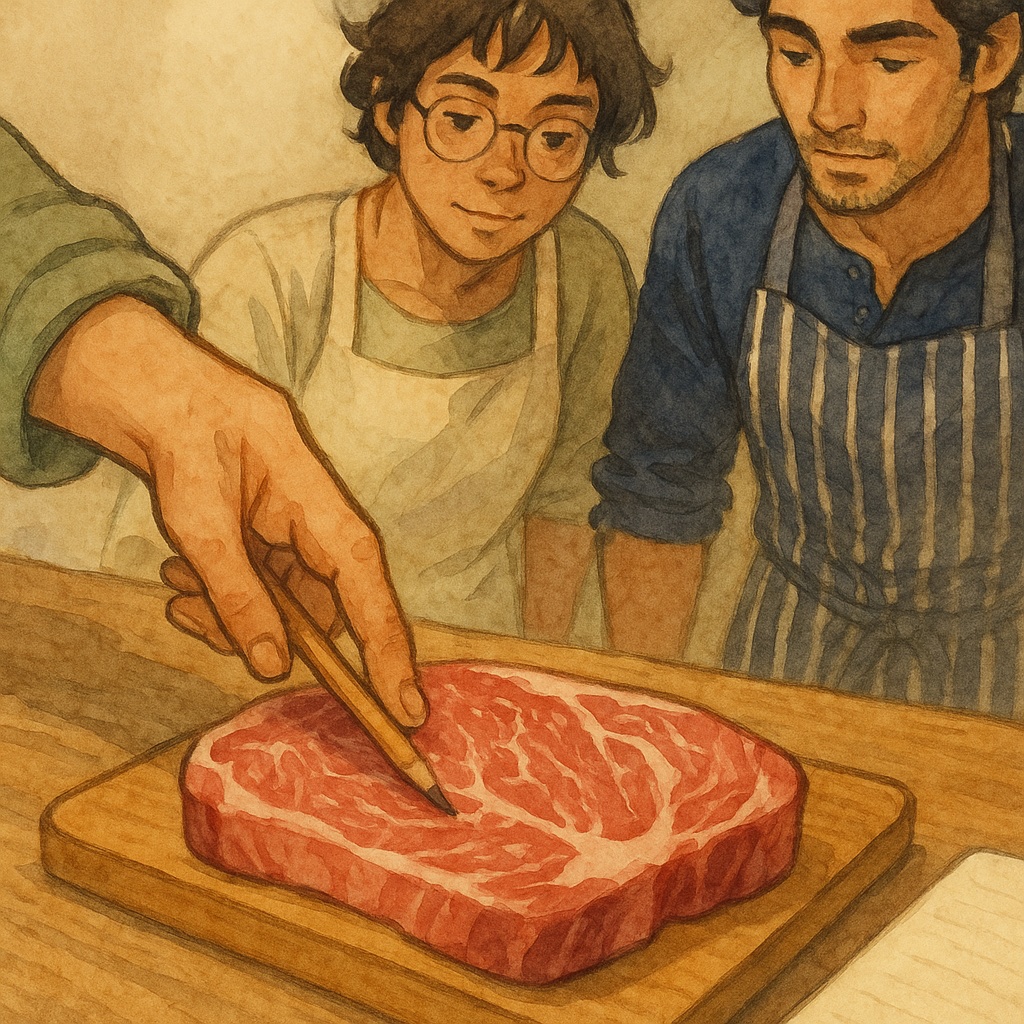
She turned both steaks to face the window light. "Three things you're looking for at the counter, in this order. Cut, thickness, marbling."
"Cut, thickness, marbling. Got it."
"Cut: this is a New York strip. Short loin. Tender, beefy, holds shape when you slice. The big cousin is the ribeye — more fat, more flavor, but also more chaos. The strip is the grown-up cut."
"You like it because it's responsible."
"I like it because it's consistent."
She pointed her pencil at his steak. "Thickness. You want one and a quarter to one and three quarter inches. Thinner than that, you have no margin — the inside cooks past medium-rare before the crust even forms. Thicker than that, the inside is so far from the surface that you basically have to reverse sear, or you'll burn the outside trying to get the middle warm."
"Mine's an inch and a half."
"Mine's an inch and five-eighths."
"You measured."
"I measured."
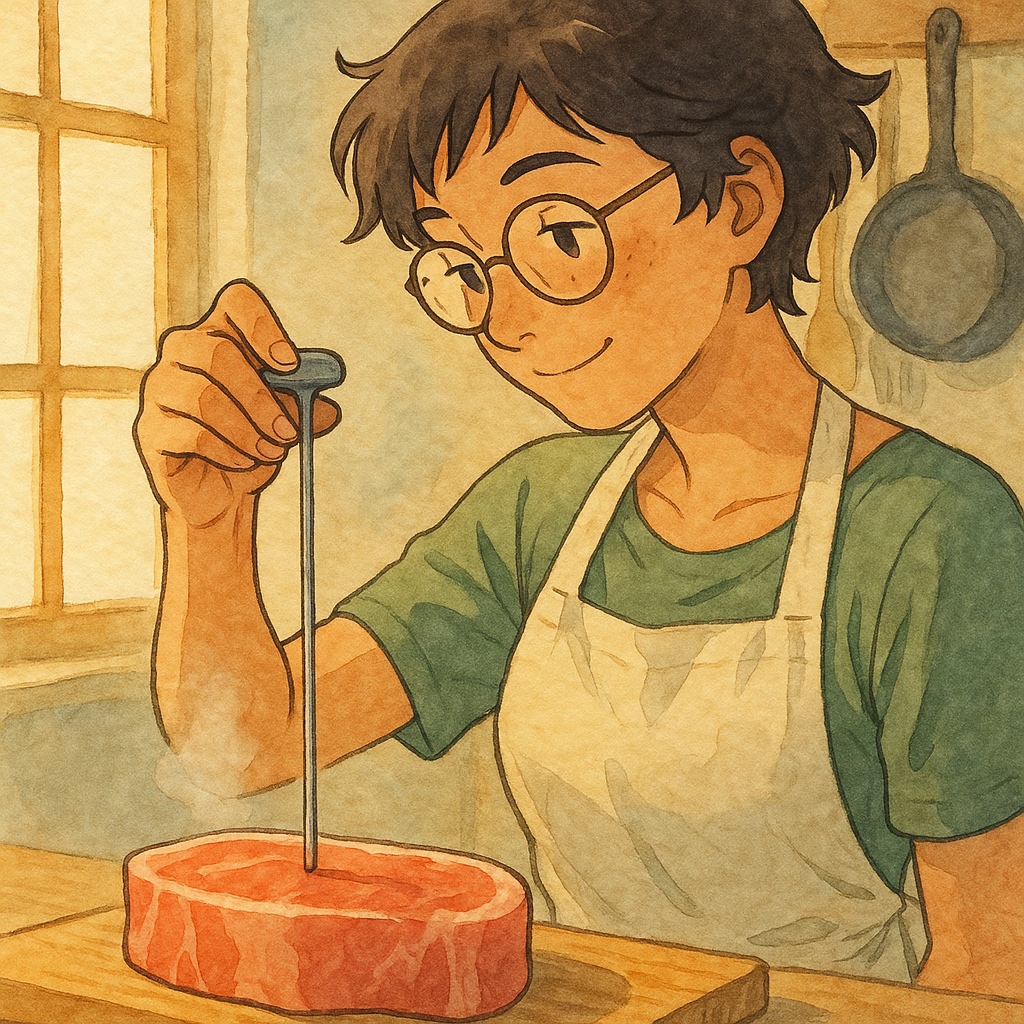
Theo nudged his shoulder against hers. "I love a measurer."
She kept going. "Marbling. The little white veins running through the red. Those are intramuscular fat. They melt during the cook and lubricate everything. No marbling: lean and chewy. Too much: the fat doesn't all render and you get squishy patches. We're looking for fine, even veins — like a topographic map of a small river system."
"That is the most romantic thing you've ever said about meat."
"Thank you."
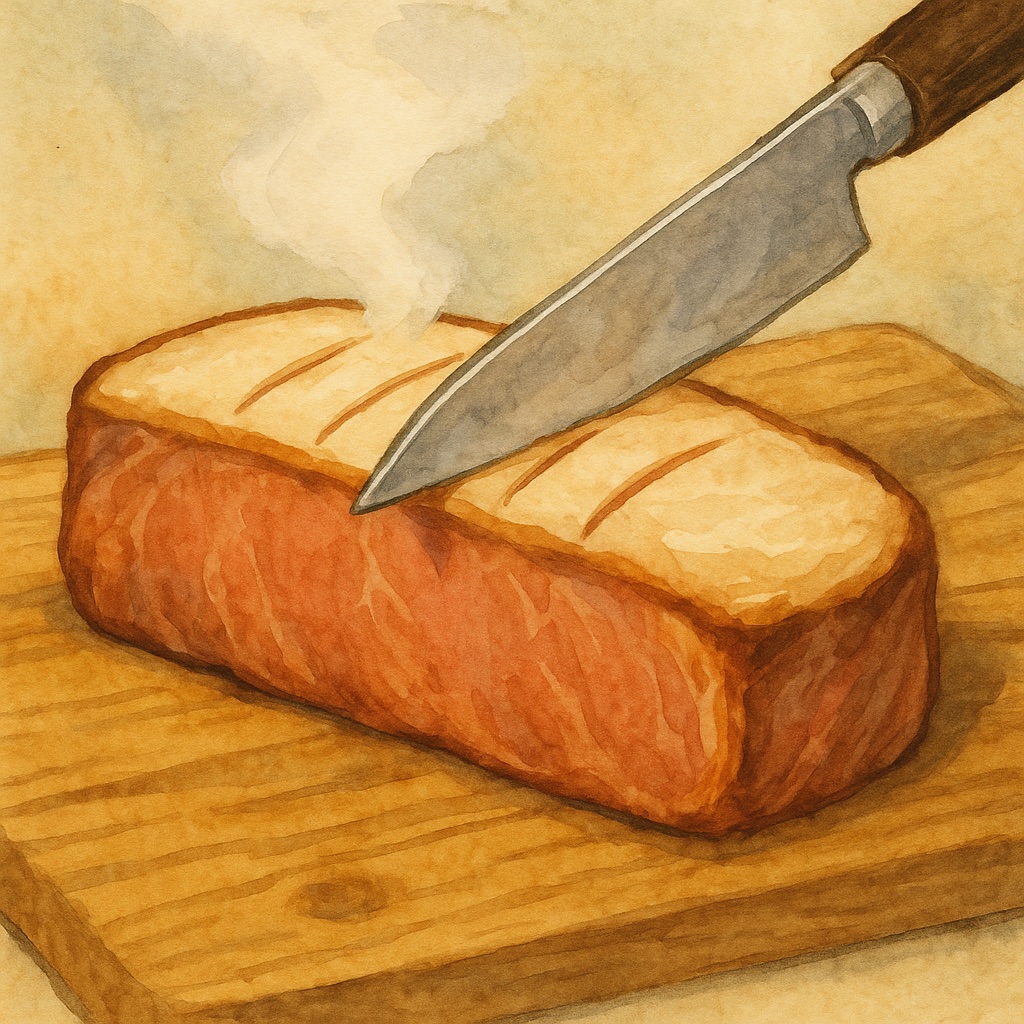
She turned her steak on its side and tapped the strip of fat running along the long edge. "Fat cap. Keep it. Don't trim it. We score it lightly — three or four shallow cuts perpendicular to the edge — so it doesn't shrink and curl the steak into a U-shape when it sears. The fat renders into the pan and bastes the meat from the bottom edge up."
"And I should never trim the fat off."
"You should never trim the fat off. The fat is the whole point."
She slid the pencil behind her ear and pulled the two steaks back to center. They sat on the wood, pinked surfaces beading with a few tiny drops of moisture.
"One more thing. Both of these need to sit at room temperature for thirty to forty-five minutes before they go anywhere near heat. The smaller the temperature difference between the inside and the outside, the more evenly it cooks. A cold-from-the-fridge steak gives you a gray cooked ring around a cold raw center. A room-temp steak gives you that pink edge to edge thing you're trying to win the dishes on."
"Forty-five minutes."
"Forty-five minutes."
He looked at his watch. "So we're not cooking."
"Not yet. We're reading."
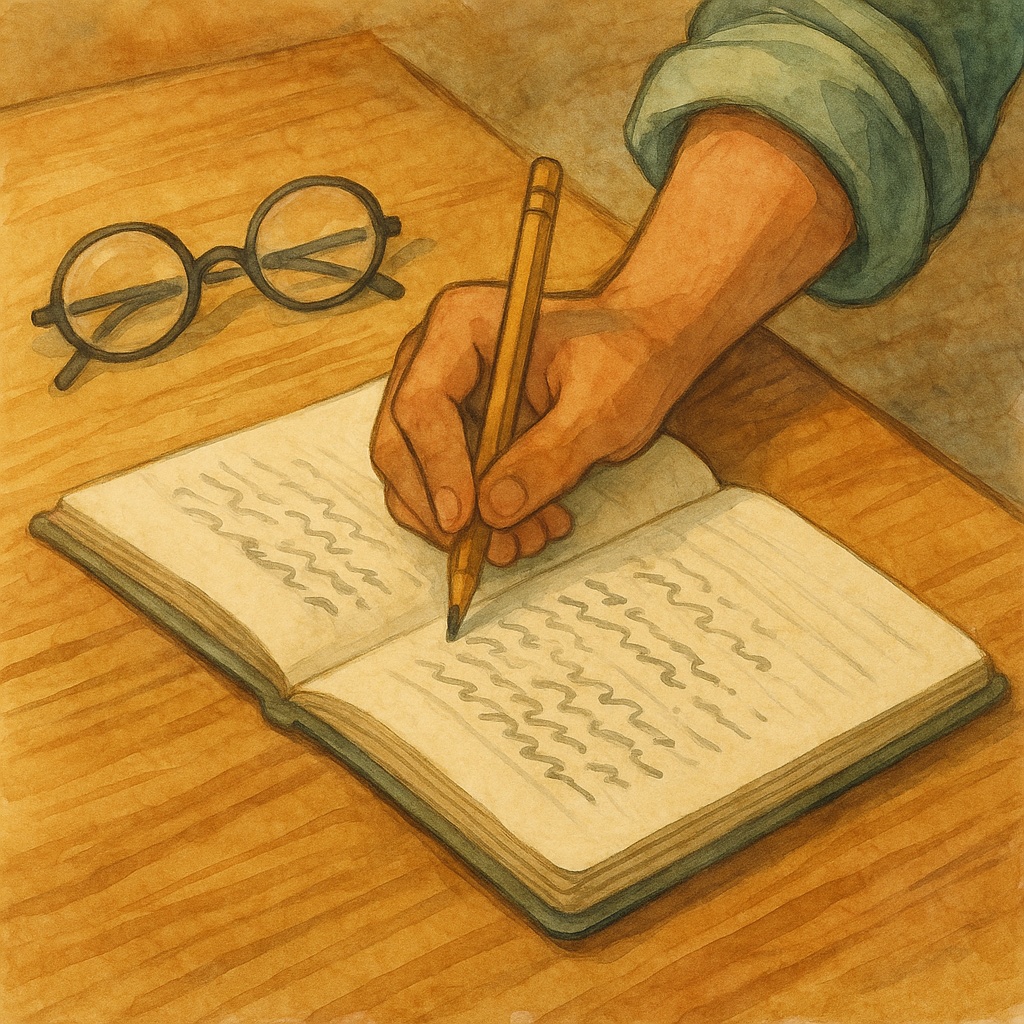
"You know what's funny is normally when you tell me to slow down I do not listen, but for steak, somehow."
"For steak somehow."
He picked the corner of fat off his steak's fat cap and chewed it raw, just the rim.
"Theo."
"What. The fat cap's the whole point."
She closed her eyes for a long second and then opened them and wrote a small note in her notebook that he couldn't see. He was pretty sure it was the word Theo with an exclamation point. He decided he was okay with this.
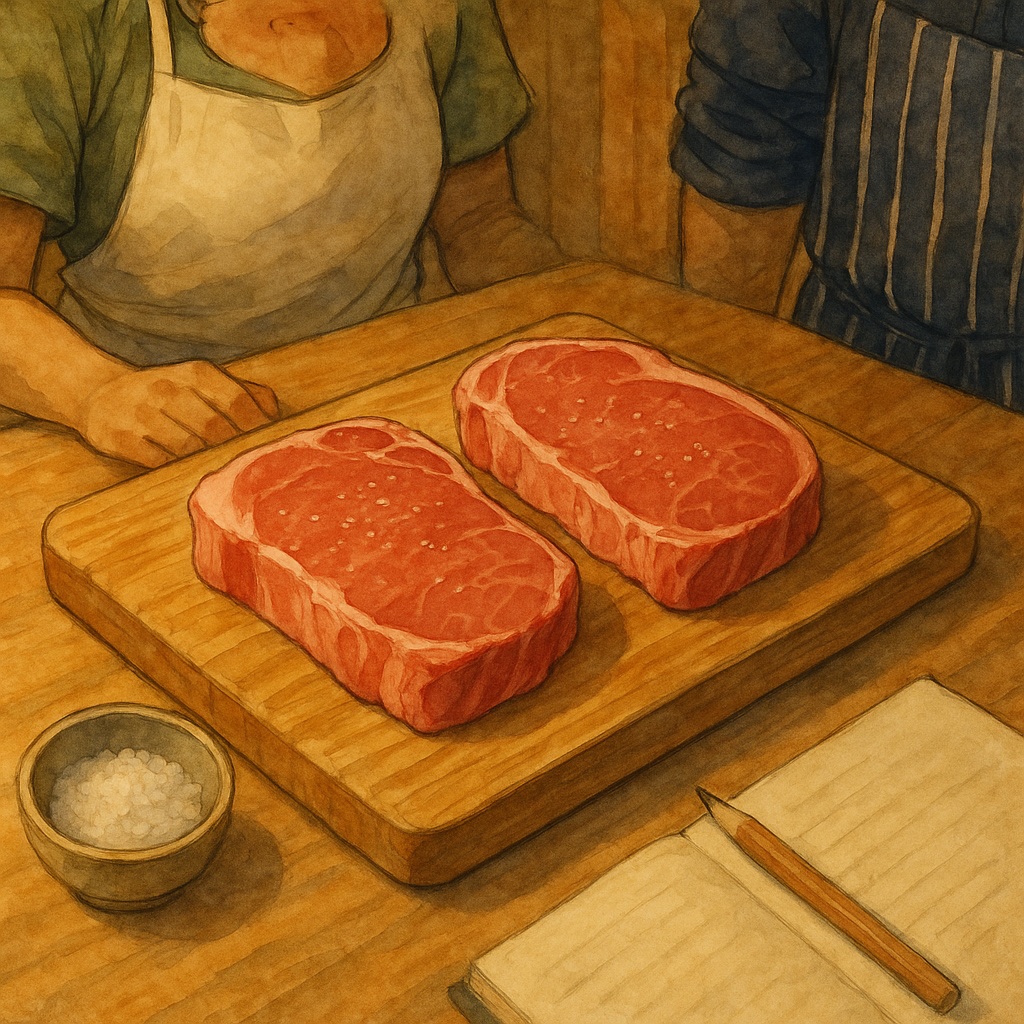
The two steaks sat between them, doing nothing, doing the most important thing.
Salting Theory
The salt cellar lived between the stove and the window. It was a small handmade ceramic bowl, glazed in the kind of cream-and-blue that looked like a sky someone had painted from memory. Mara reached past Theo for it and brushed his elbow with hers on the way back.
"Salt," she said.
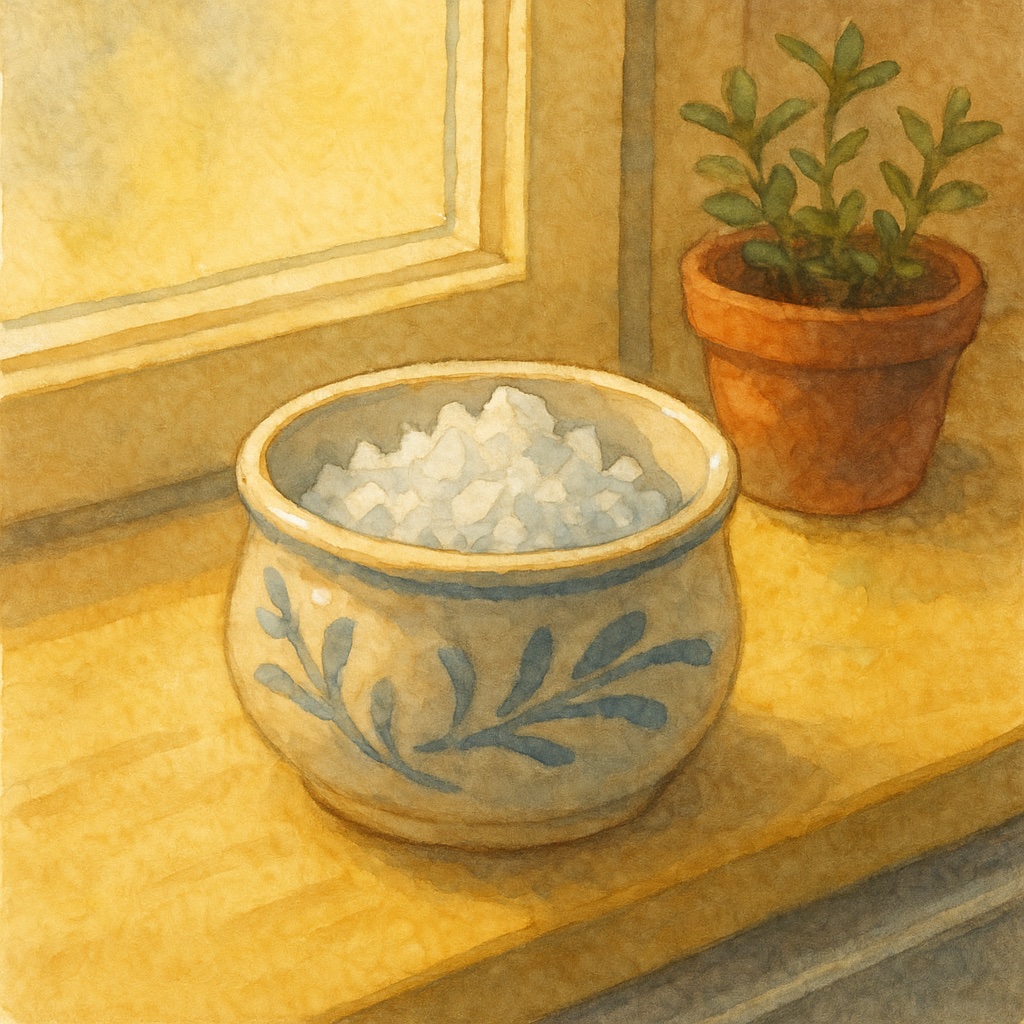
"Salt," he agreed.
"More than you think."
"More than I think."
"More than that."
He had been pouring a polite little sprinkle. He doubled it. She nodded once.
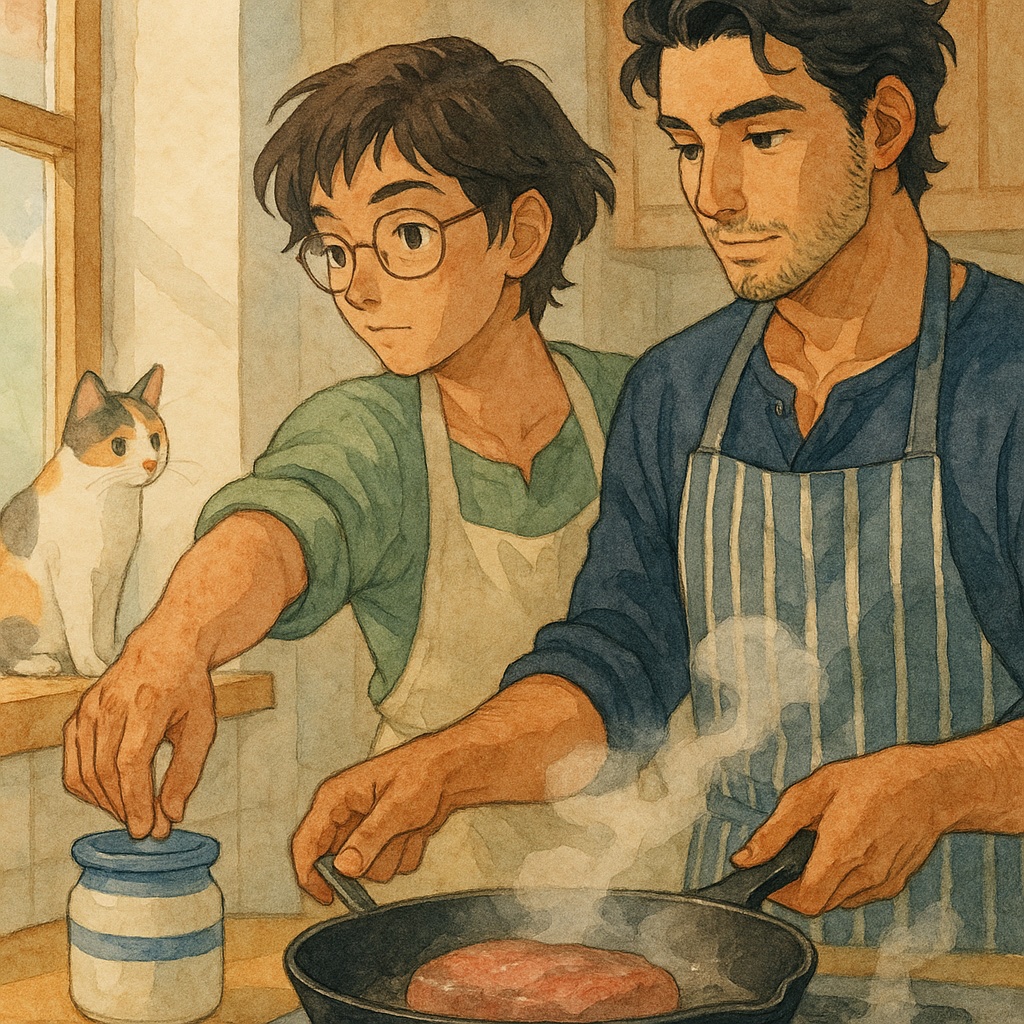
"Big flake kosher or sea salt. Not table salt — too fine, it dissolves and over-salts before you can see it. The big crystals draw moisture out, dissolve into it, and then get drawn back in with the moisture as the surface re-equilibrates. That brine seasons the inside, not just the skin."
"The salt goes in. Then it goes out. Then it goes back in."
"More or less. And in the meantime the surface dries — which is what we want. Dry surface equals fast Maillard. Wet surface equals steam, which is the enemy."
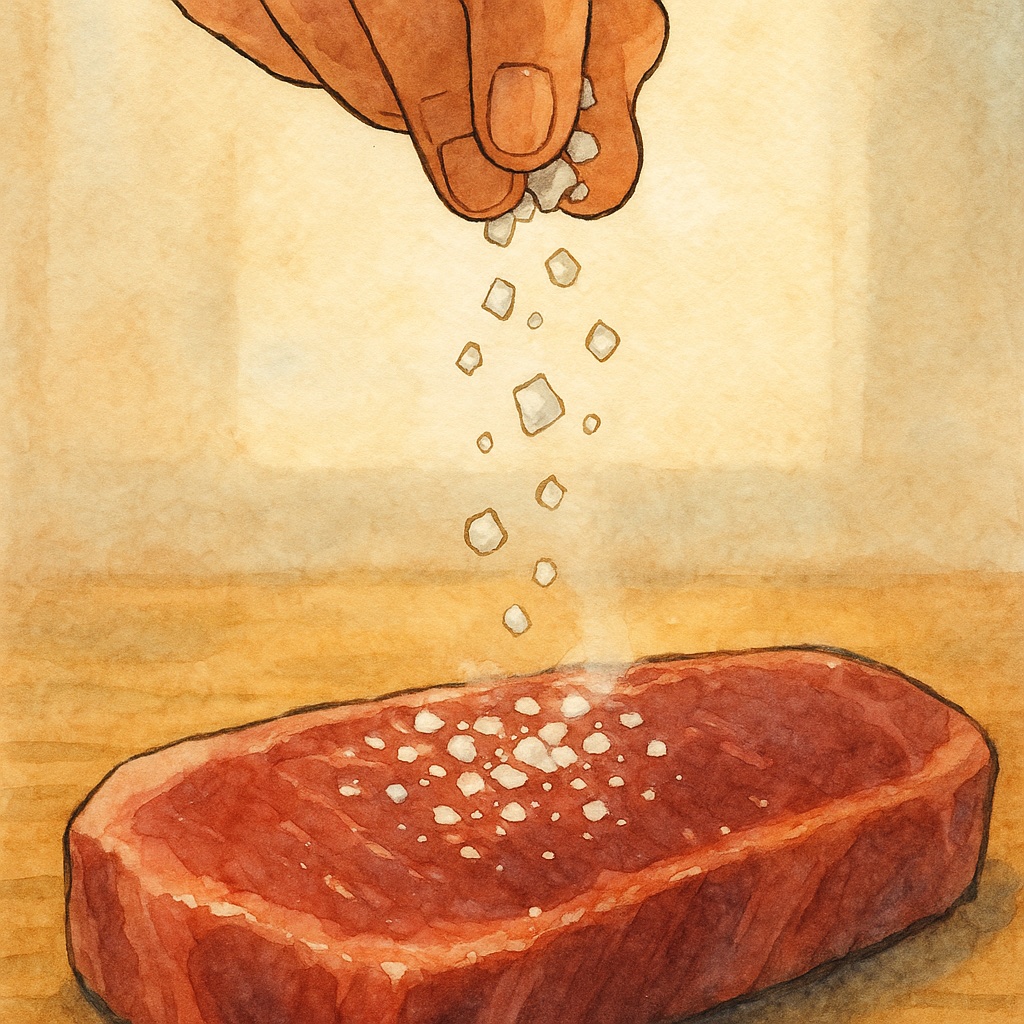
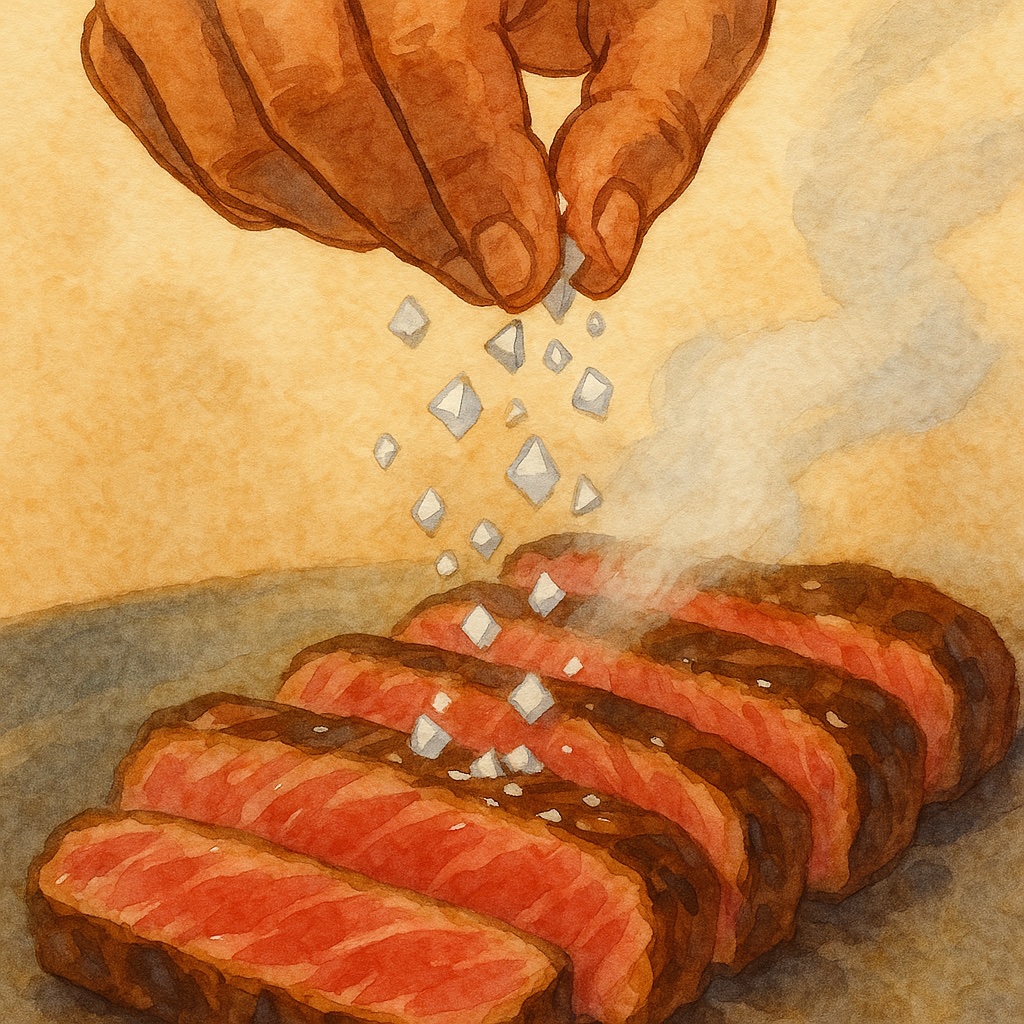
She lifted her steak and salted both flat sides from a height — enough drop for the crystals to scatter evenly, not so much that they bounced off — then the long edges, then she set it back down on the wire rack. She did it ritually, like a small prayer.
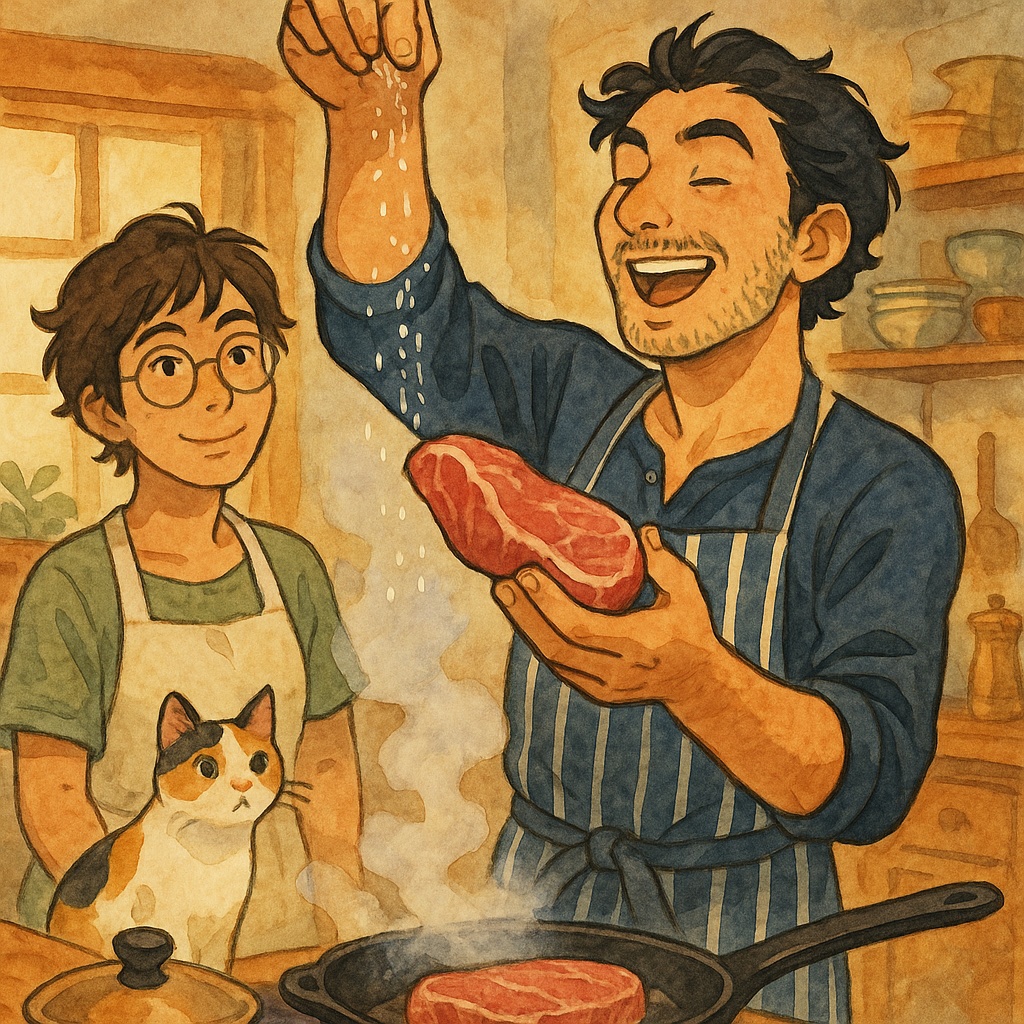
Theo lifted his steak above his head and salted it from arm's length like a TV chef.
"Theo."
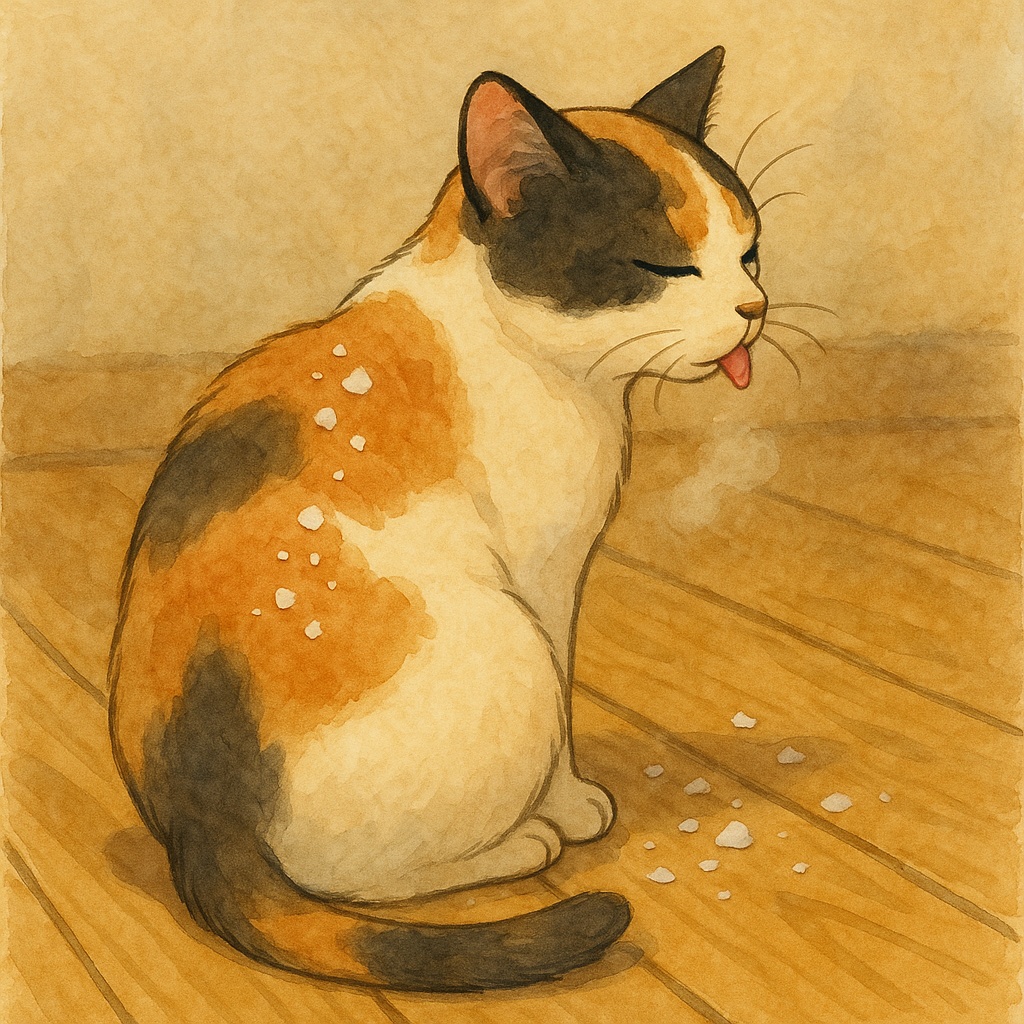
A flake landed on Brisket, who had reappeared. Brisket sat down with deep insulted dignity and licked the salt off her own back.
"She is seasoned now," Theo said.
"She is furious now."
He lowered the salt. He resalted his steak from a sensible height. He looked sheepish. He looked extremely cute.
"How long does this sit?" he said.
"Forty-five minutes minimum. An hour is better. If you have all day, do it the day before — uncovered on a rack in the fridge. The surface dries out beautifully overnight. People don't believe me until they try it."
"What you don't want is fifteen minutes."
"What you don't want is fifteen minutes. That's the worst window — long enough that the salt has pulled moisture out but not long enough for the moisture to go back in. You get a wet, salty surface. The pan will spit, the crust will steam, your whole effort goes sideways."
"So zero to ten minutes is fine —"
"— because the salt hasn't done anything yet, yes. You're basically seasoning a dry steak right before the pan."
"And forty-five-plus."
"And forty-five-plus."
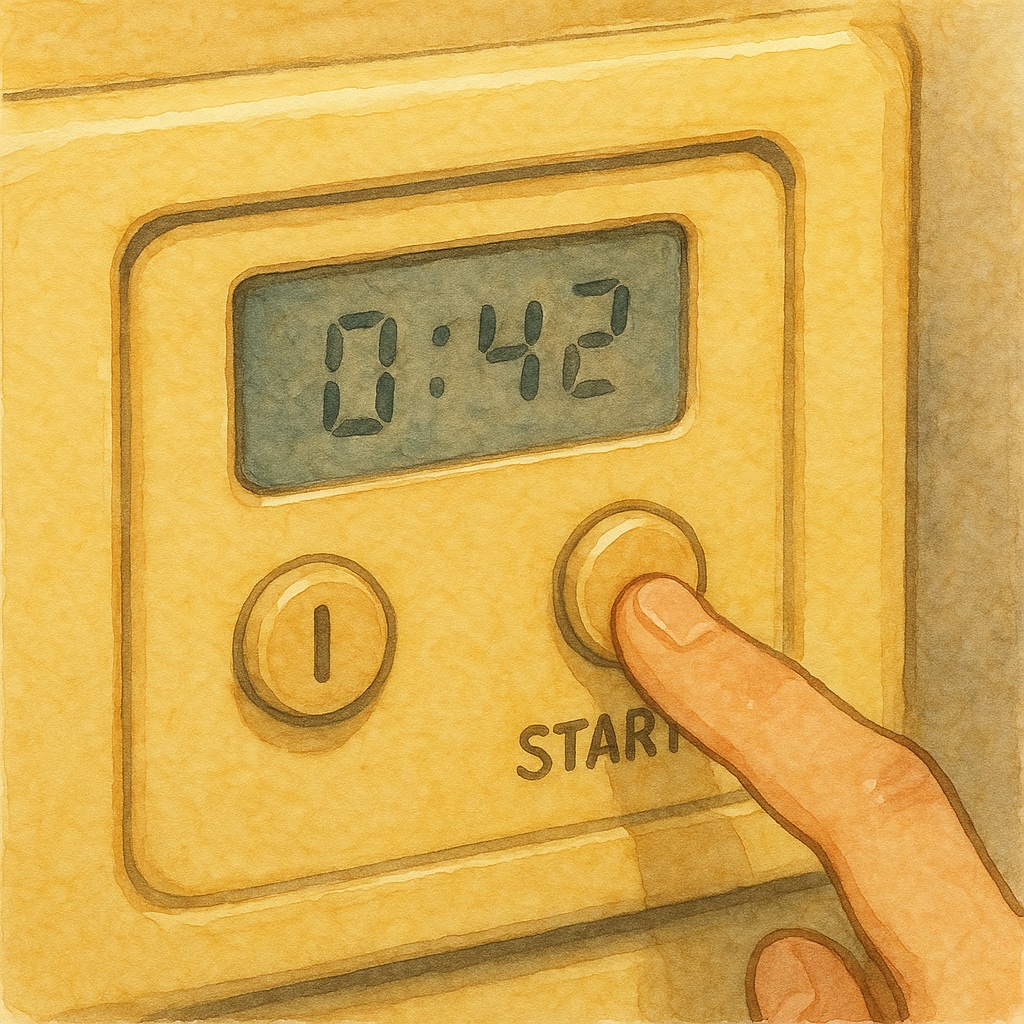
She set the timer on the oven for forty-five minutes. The little digital numbers ticked once and started running down.
"And the pepper?"
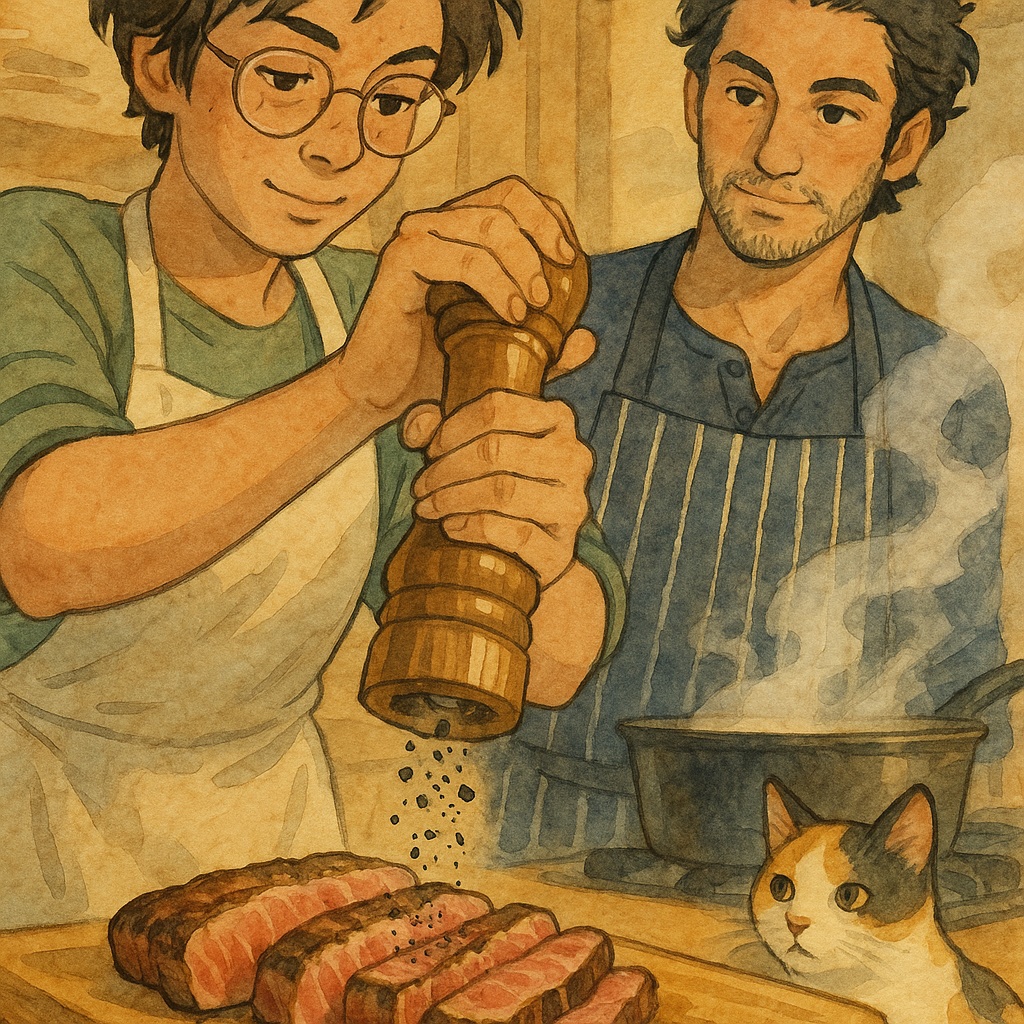
"After. Always after. Peppercorns burn at the heat we're going to use, and burned pepper tastes like a campfire someone forgot to put out. Pepper is a finishing seasoning. Salt is a building seasoning. They sit on different shelves in your head."
"Salt builds. Pepper finishes."
"Salt builds. Pepper finishes."
He repeated it under his breath like a small mantra while he washed his hands. She caught herself smiling at the back of his head and looked away before he could see it.
"What now?" he said.
"Now we read."
"Read what?"
"The pan."
She lifted the cast iron off the hook above the stove. It was heavier than it looked — they always are — and the slow careful way she set it onto the burner was the same slow careful way she did everything that mattered. He liked her best when she was being careful. He also liked her best when she was being chaotic. He had not yet figured out how those two things could both be true.
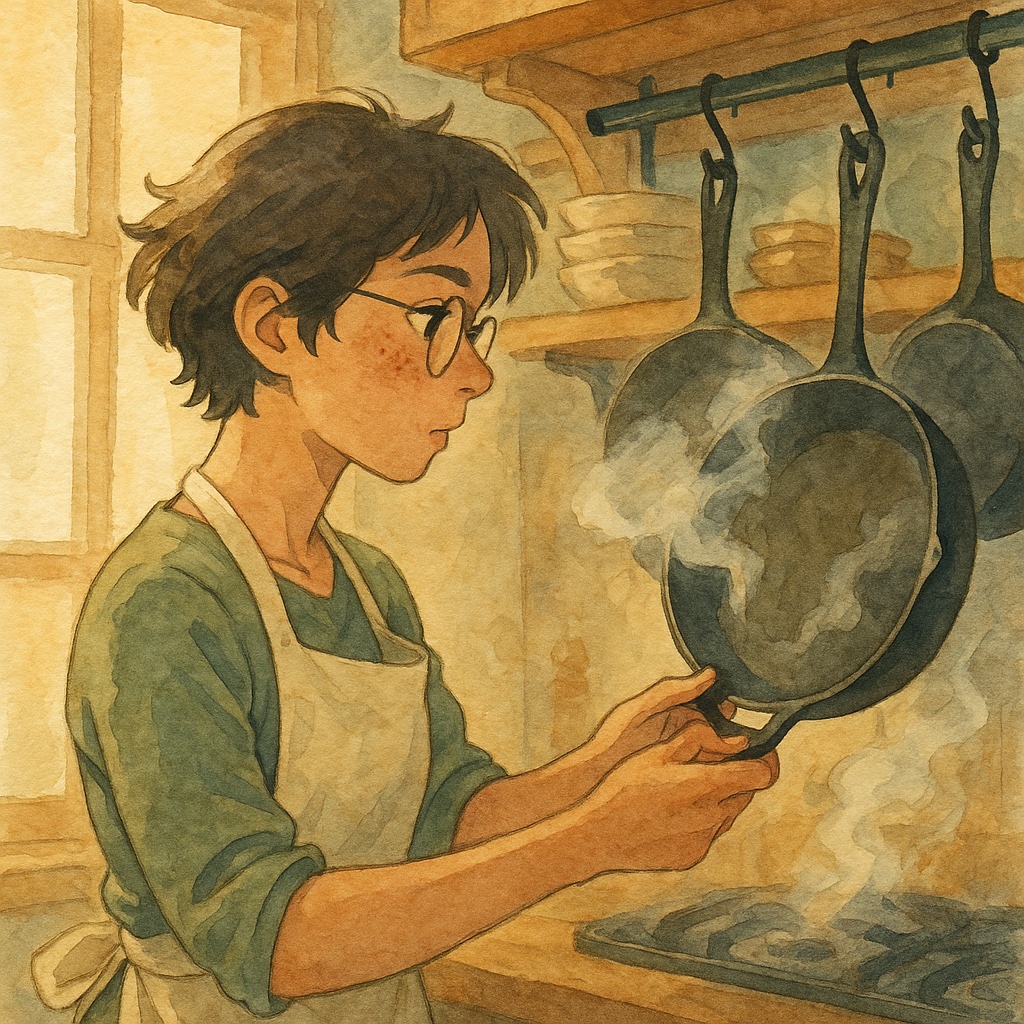
Outside, the salt did its quiet work on the meat. Inside the cast iron, the silence was about to end.
Pan & Heat
"Cast iron," Mara said, "is the most patient material in your kitchen."
"That's a compliment, right?"
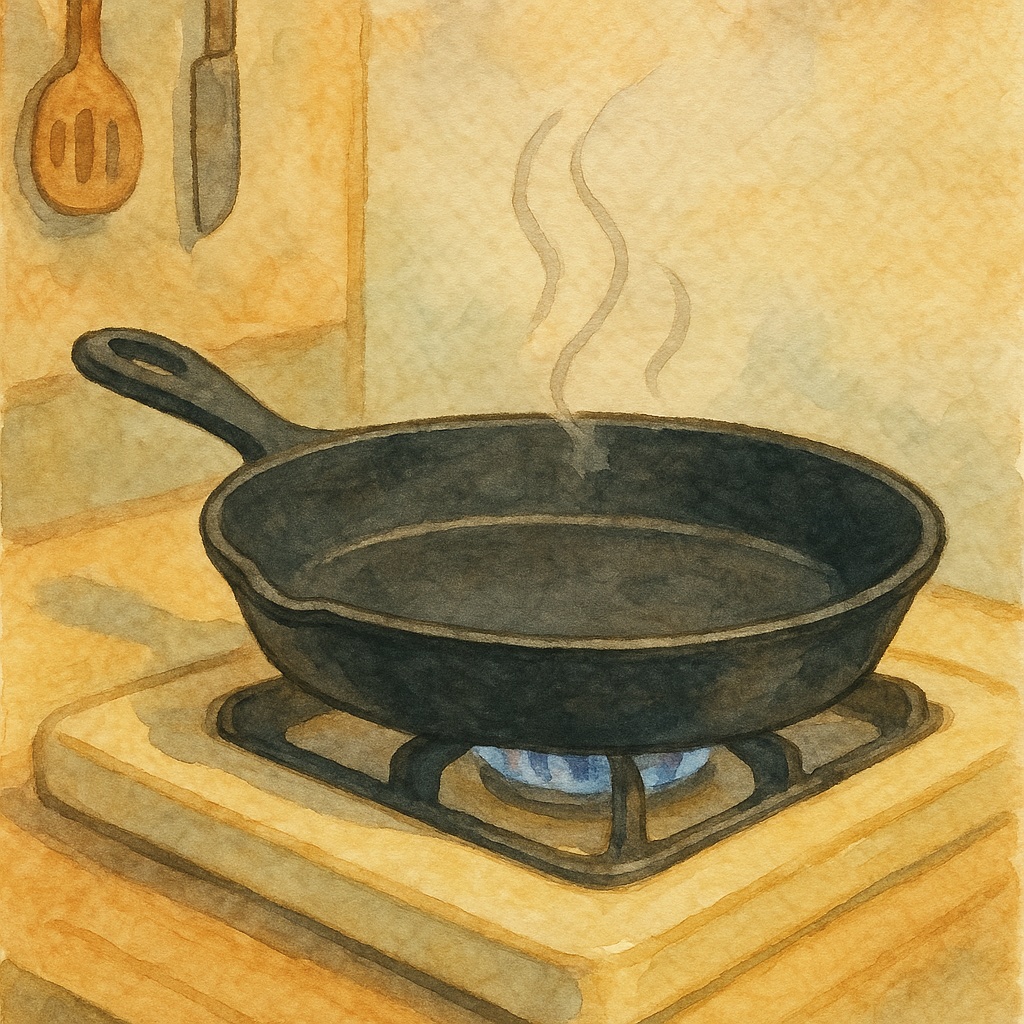
"It is a huge compliment. Patient means it stores heat. It takes a while to warm up — fifteen, twenty minutes if you're being thorough — and when it does, it holds onto that heat with both hands. When you drop a cold steak into a hot cast iron pan, the pan barely flinches. It just keeps giving heat."
"Whereas?"
"Whereas a thin pan crashes the second cold meat hits it. The temperature drops a hundred degrees in two seconds. You're trying to crust a steak with a pan that's gone tepid. You don't get crust. You get a sad gray sear and you blame the steak. Don't blame the steak."
"I have blamed steaks."
"I know you have."
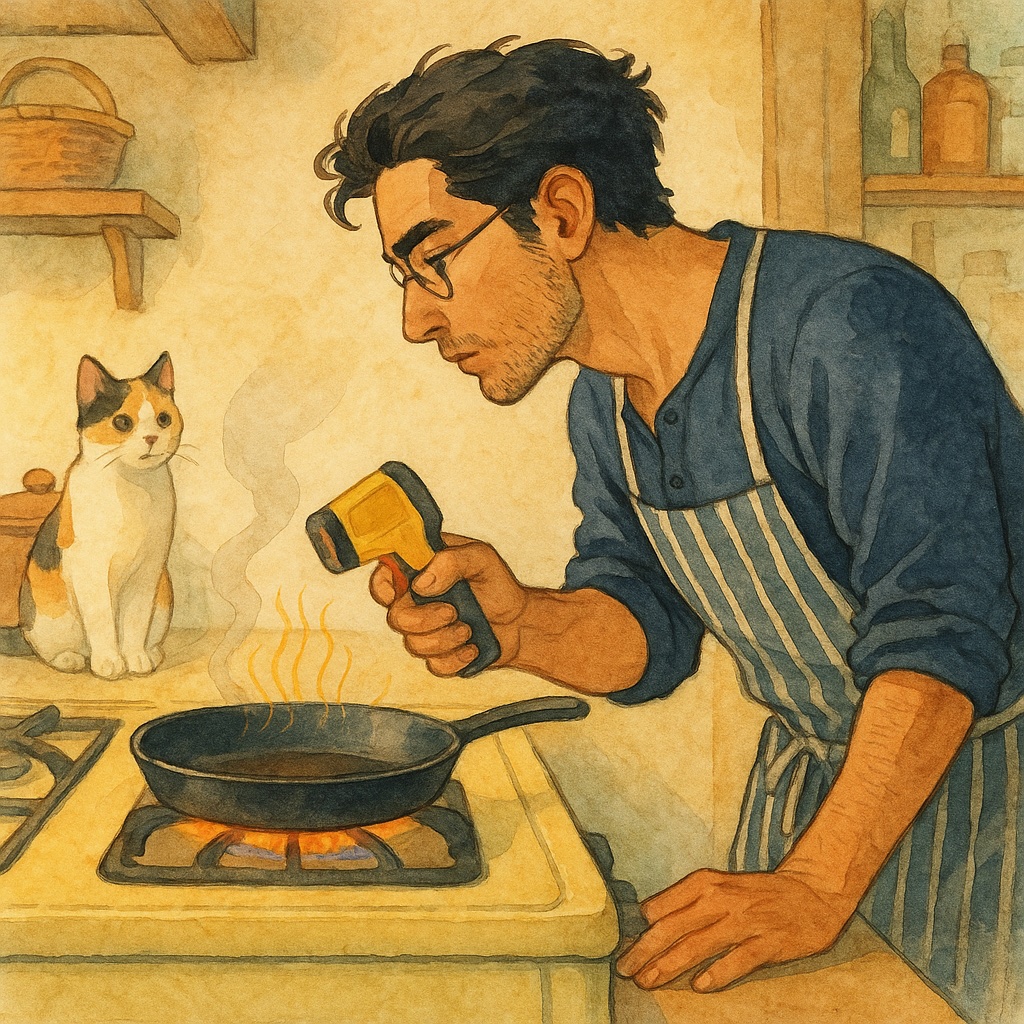
She lit the burner under her own pan — high — and put the smallest possible drop of water on the surface to test it.
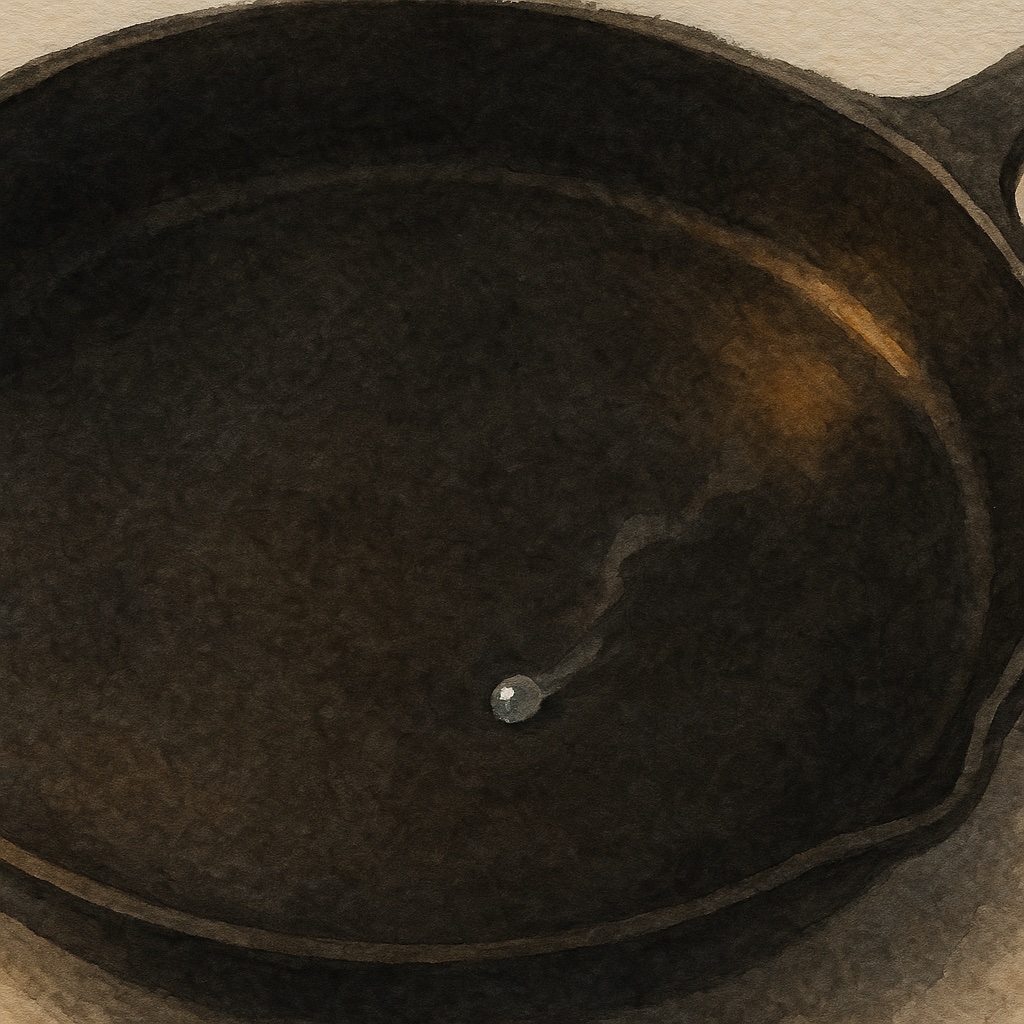
The water hit the iron. It did not sizzle. It did not pool. It hesitated for one second, balled up into a tiny silver bead, skittered across the surface like a marble on a tilted table, and was gone in two seconds.
"Leidenfrost effect," she said happily. "Means the surface is over two hundred Celsius. We're in business."
"Mara. Do you call all your favorite physics by their full names."
"Maillard, Leidenfrost, and Frédéric Foucault."
"Three boyfriends."
"Three gentlemen friends."
He put both hands flat on his cheeks. "Continue."
"Smoke point. The temperature at which an oil starts to break down and produce visible smoke. You want an oil with a smoke point well above your pan temperature, or you'll be cooking in burned oil — which tastes burned and smells worse. Avocado oil: around two hundred and seventy Celsius. Grapeseed: about two-fifty. Refined canola: about two-forty. All of those are fine for this."
"And butter?"
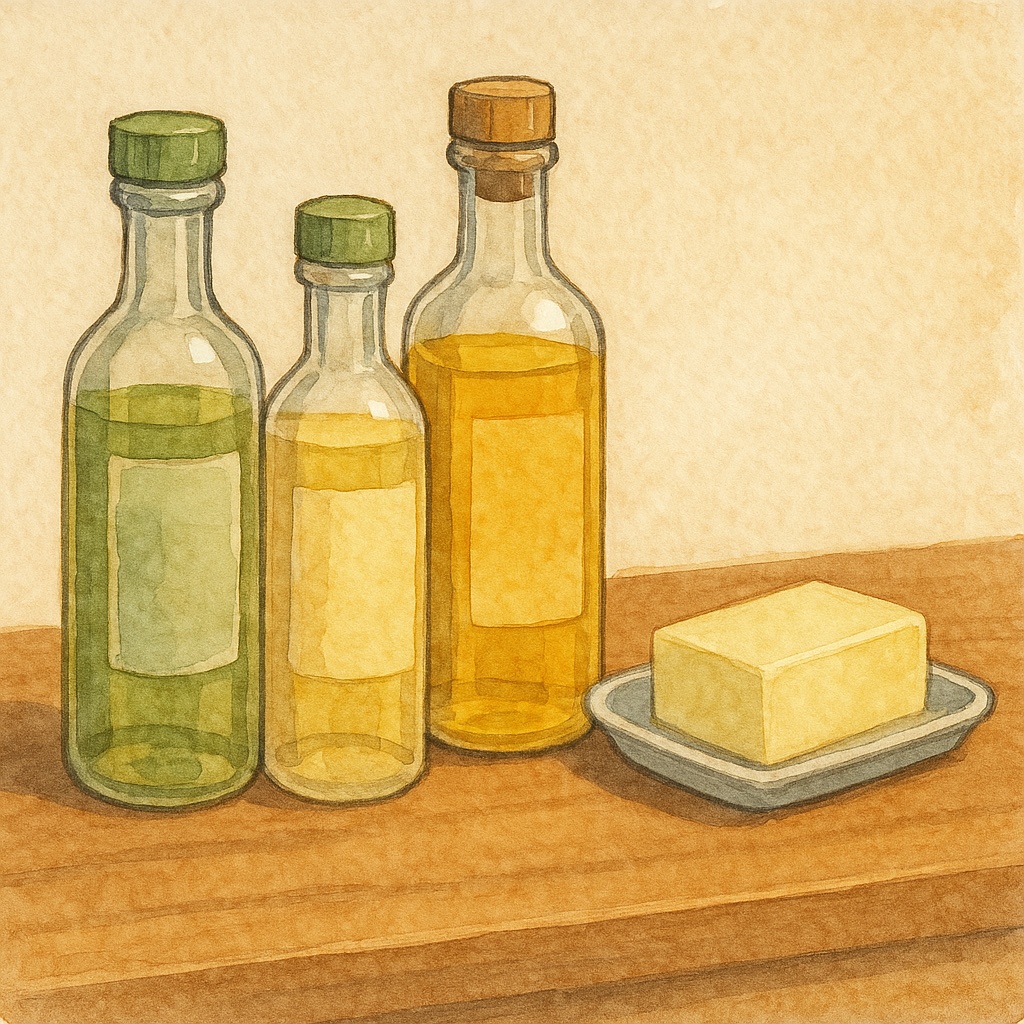
"Butter smokes around one seventy-five. That's too low. If you put butter in a sear-hot pan, it burns. The milk solids char. The whole thing turns acrid and black before you even put the steak in."
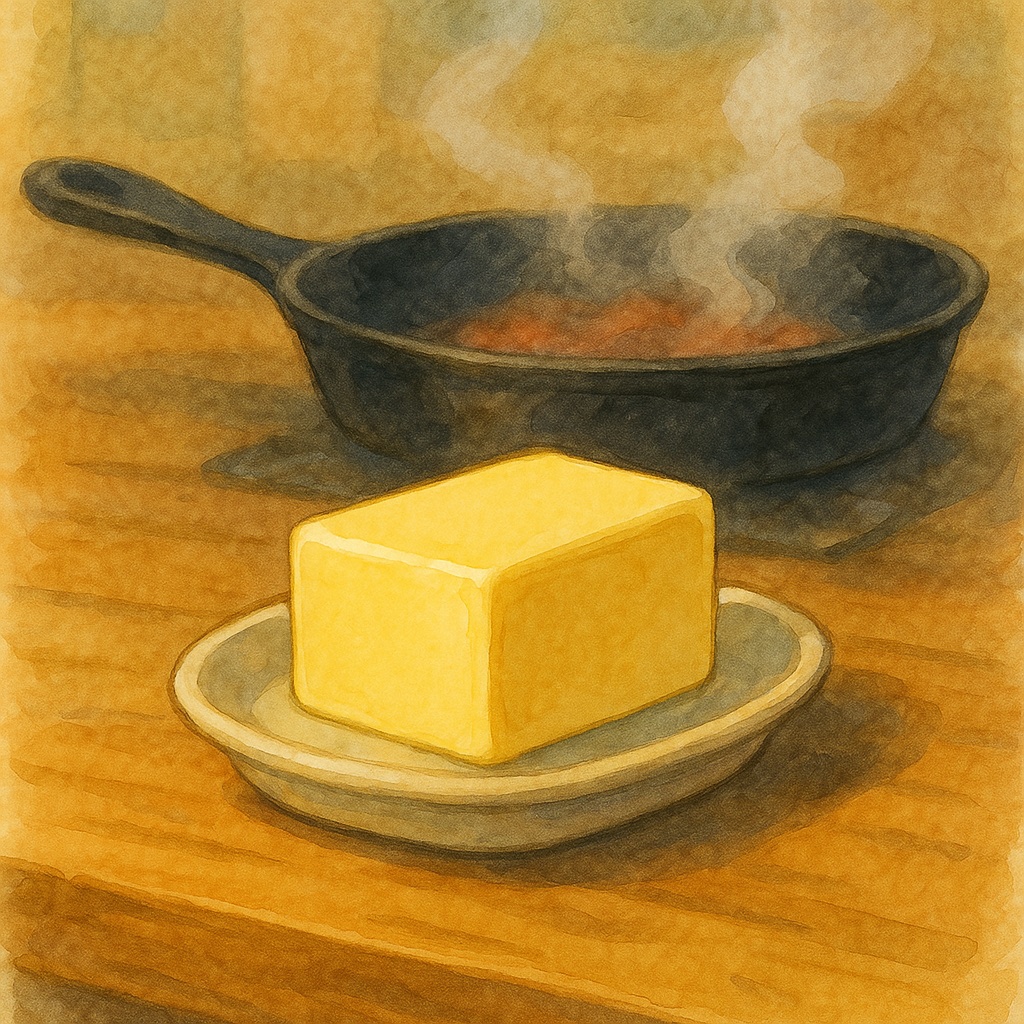
"So no butter at the start."
"No butter at the start. Butter is a finisher. Butter goes in after the crust is built — Chapter Six material. Pretend I didn't say it."
"What did you say."
"Nothing yet."
He liked that joke a lot. He laughed loud enough that Brisket stood up to see what was happening.
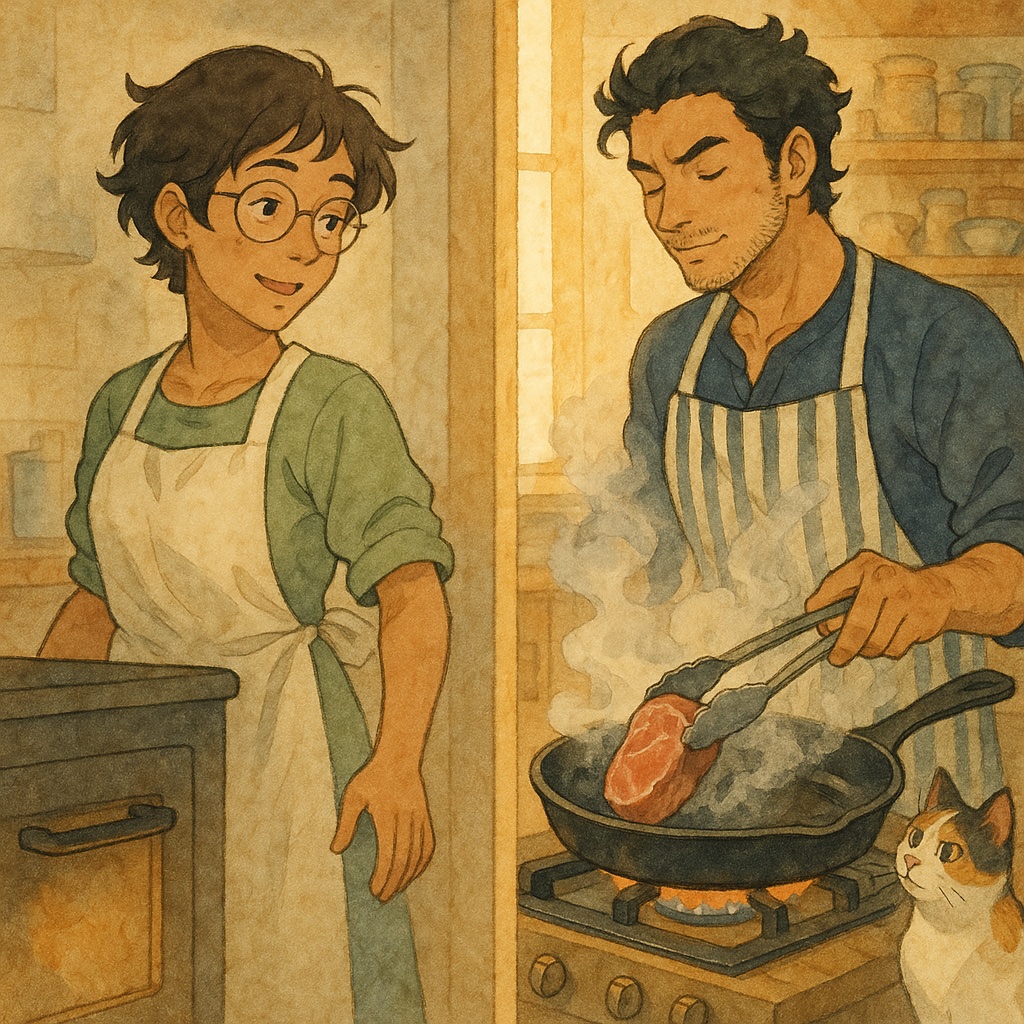
Mara turned to the oven. "Okay. Here's where we split."
"Forward and reverse."
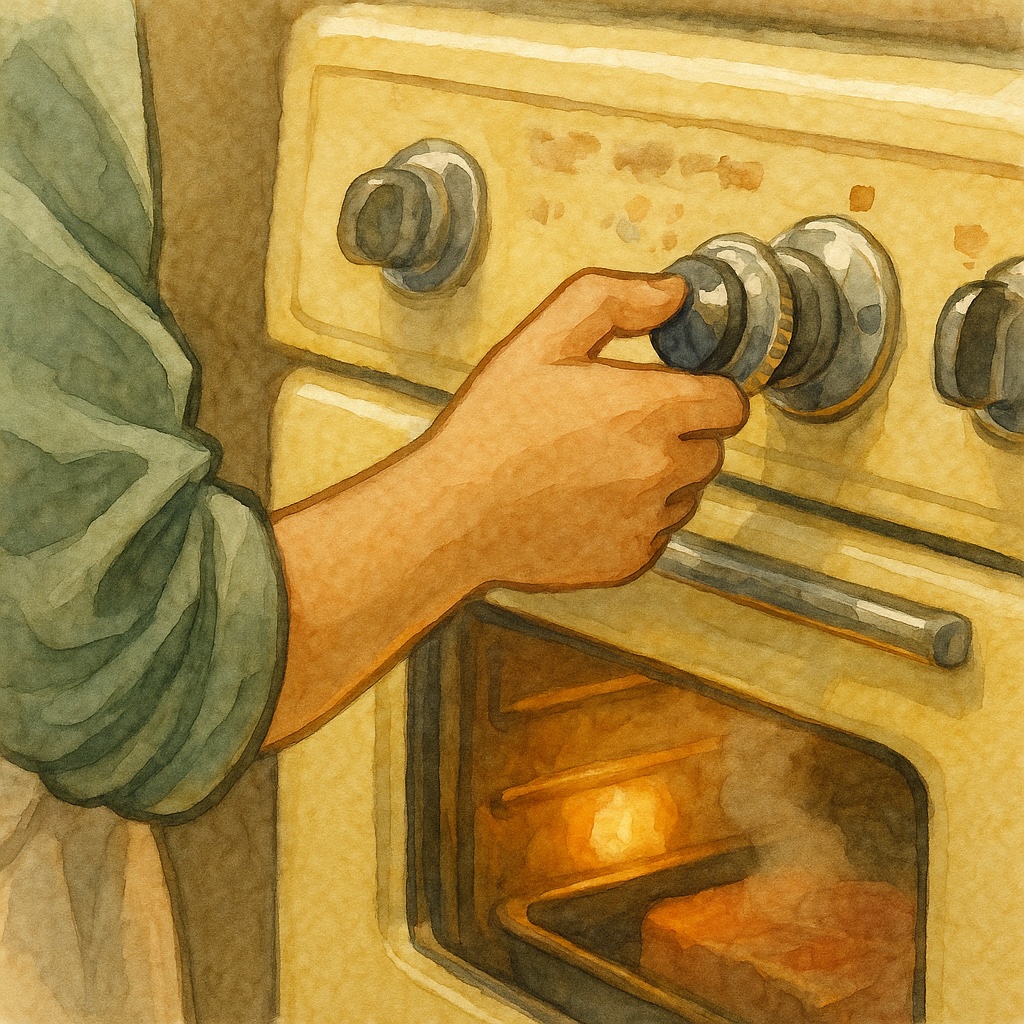
"Forward and reverse. Your pan is screaming. Mine is going to scream in about four minutes, but first my oven is going to whisper."
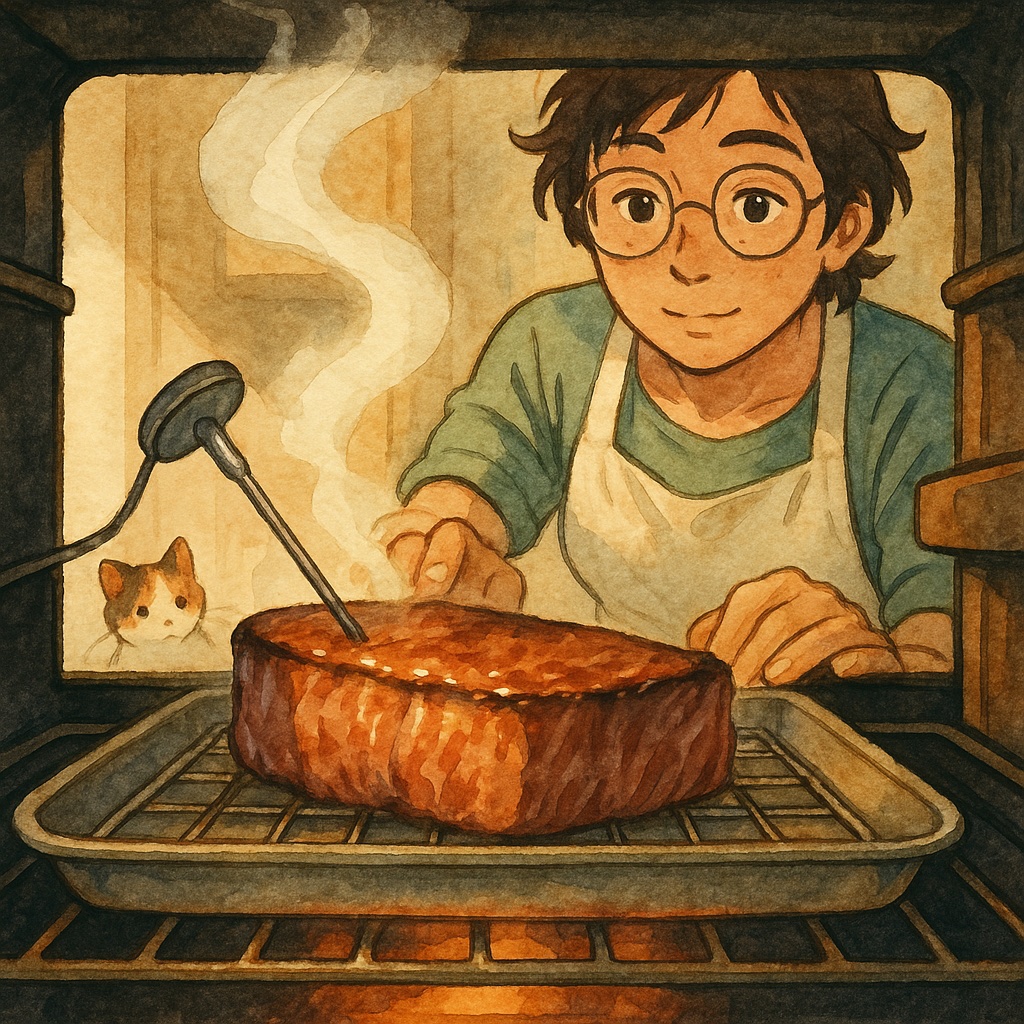
She bent and turned the oven dial: 120 Celsius. 250 Fahrenheit. Low. The light inside clicked on. She set her steak — patted dry one more time on every surface with paper towel, salt crystals mostly absorbed by now, surface looking matte, almost suede — onto a wire rack over a sheet pan. She put a probe thermometer in through the side, into the dead centre, away from the fat cap.
"Reverse sear plan: the oven brings the inside up to forty-nine Celsius — a hundred and twenty Fahrenheit — slowly. About thirty to forty minutes for a thick steak. Edge to edge, even pink, no gray ring. Then I'll pat it bone-dry again and slam it into the pan for about forty-five seconds a side, just to build the crust. The interior is already done; the pan's only job is the surface."
"And mine."
"And yours. Forward sear plan: rip pan first. Steak goes in cold-ish — well, room temp — and we build crust while the inside cooks. Faster overall. Smokier. The interior is a little less even — there'll be a slightly thicker zone of more-done meat under the crust — but on a one-and-a-half-inch steak that's small. You'll be eating in like four minutes."
"And I get to flip and baste."
"And you get to flip and baste."
She stood up from the oven, dusted her hands together, gave him a look over the top of her glasses.
"Two roads. Same Maillard. Same crust. Different timing."
"Race you to the rest stage," he said.
"It is not a race."
"It is absolutely a race."
She didn't argue with that because she knew it was. She just turned the oven light off and closed the door very gently like she was tucking the steak in.
Inside the oven, the small slow patient warming began.
Outside the oven, his pan was getting ready to scream.
The Sear
"Last check," Mara said.
"Pan."
"Screaming."
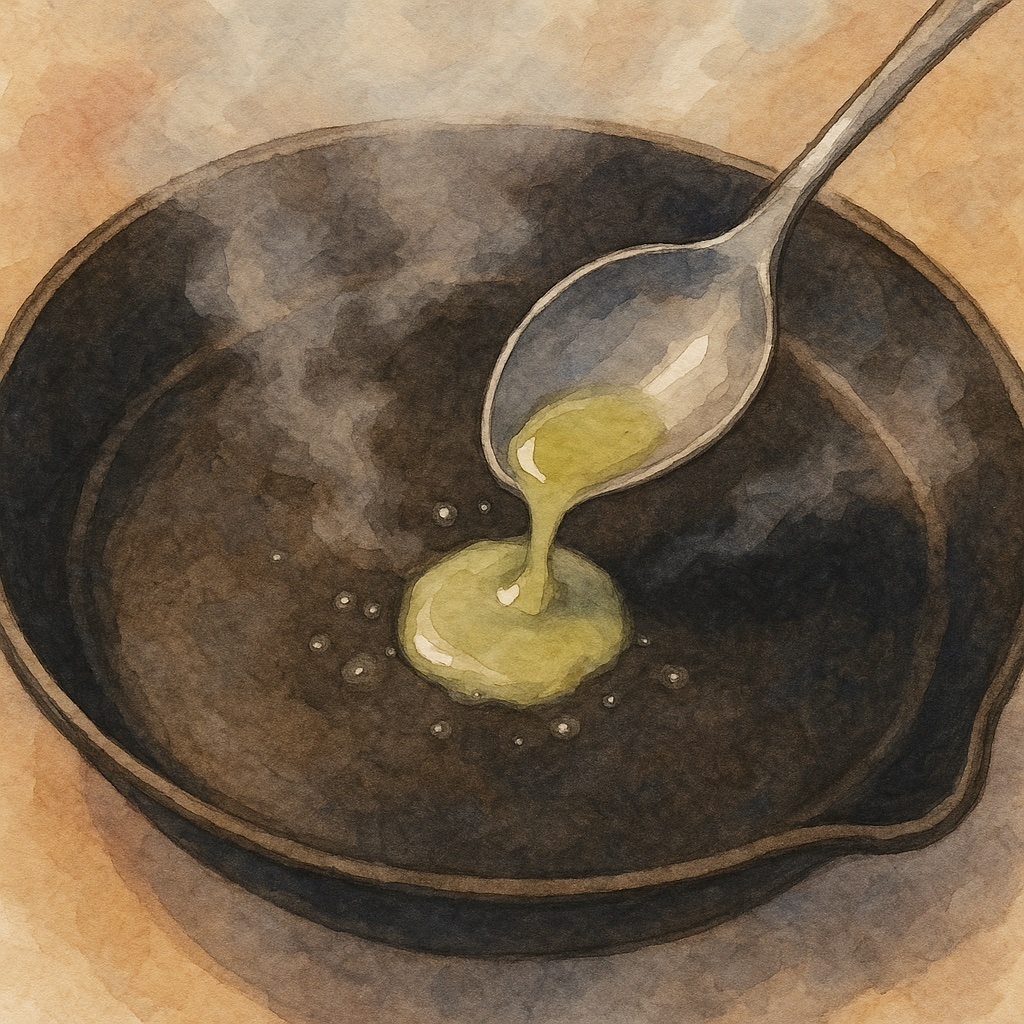
"Oil."
"In."
A teaspoon — a little more — of avocado oil into the pan. It hit the iron and the surface rippled like a small sea, the oil thinning instantly and skating across the surface, almost transparent.
"Steak."
"Patted."
"Surface."
"Dry as bone."
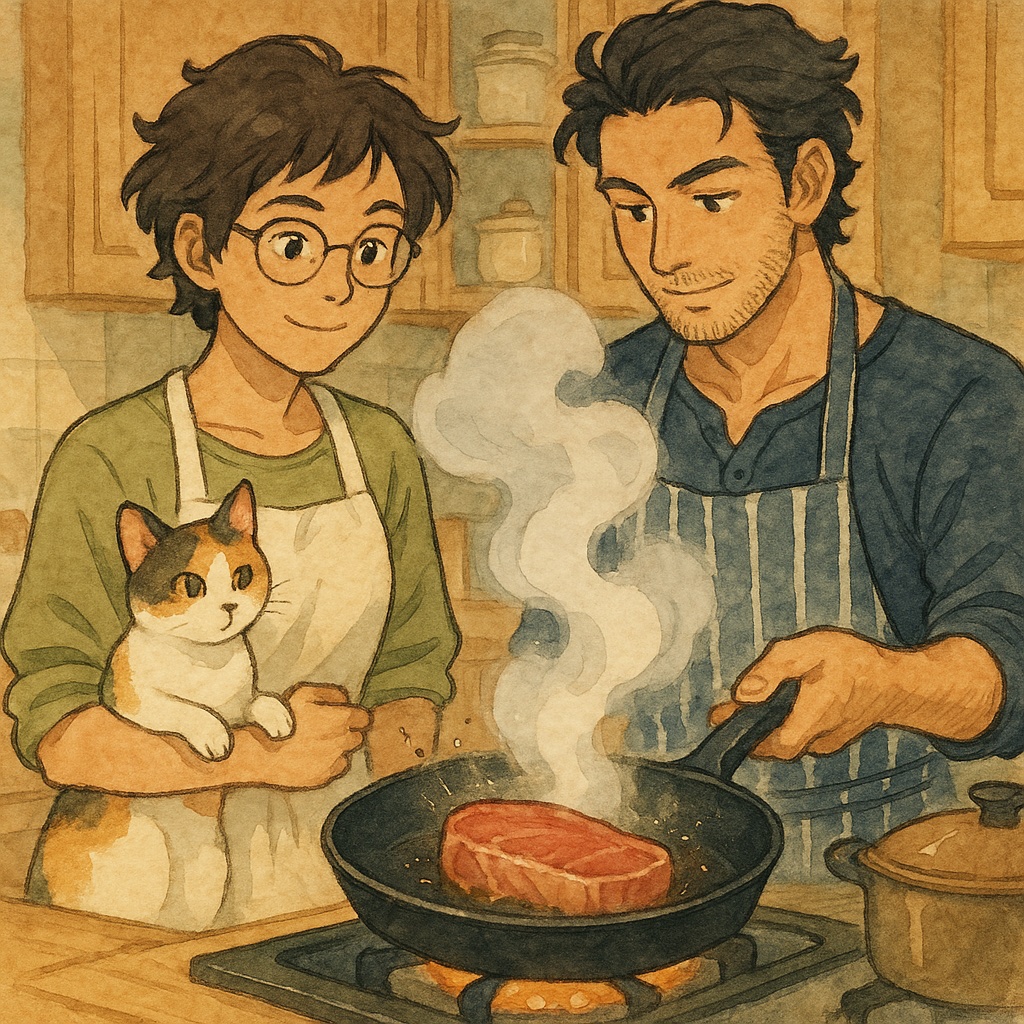
"Hands."
"Away from the pan. Toward me."
"Theo."
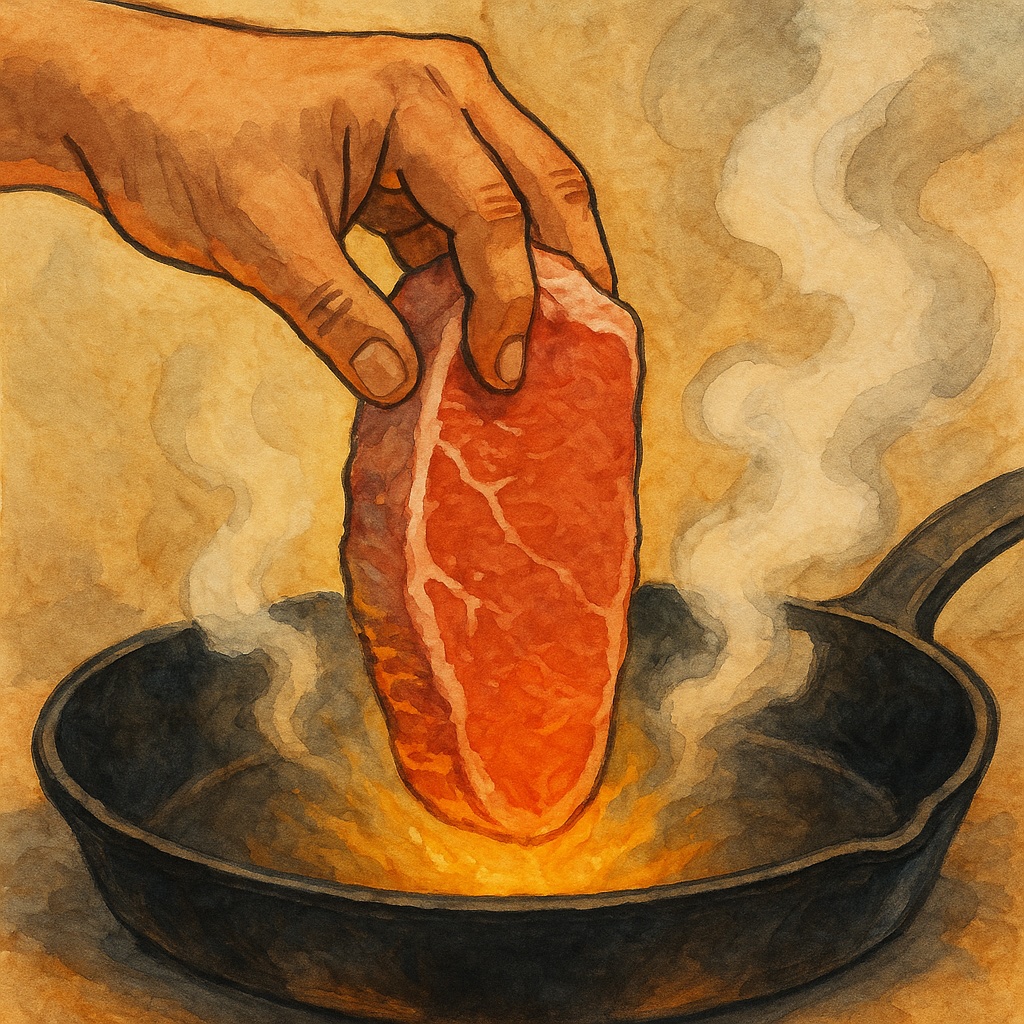
He laughed and got back into position. He held his steak by its long edge, between thumb and forefingers, the fat cap pointed down toward the pan. He hovered it just above the surface. He looked at her once like he was about to do something either heroic or stupid, and she nodded, and the steak went in.
It went in the way she'd told him — away from himself, not toward, so the spit and splatter went away. The room exploded into sound. A long aggressive hisssss that was not so much a hiss as a small flat panicked roar.
"Don't move it!" Mara called over the noise.
"Not moving it!"
"Don't poke it!"
"Not poking it!"
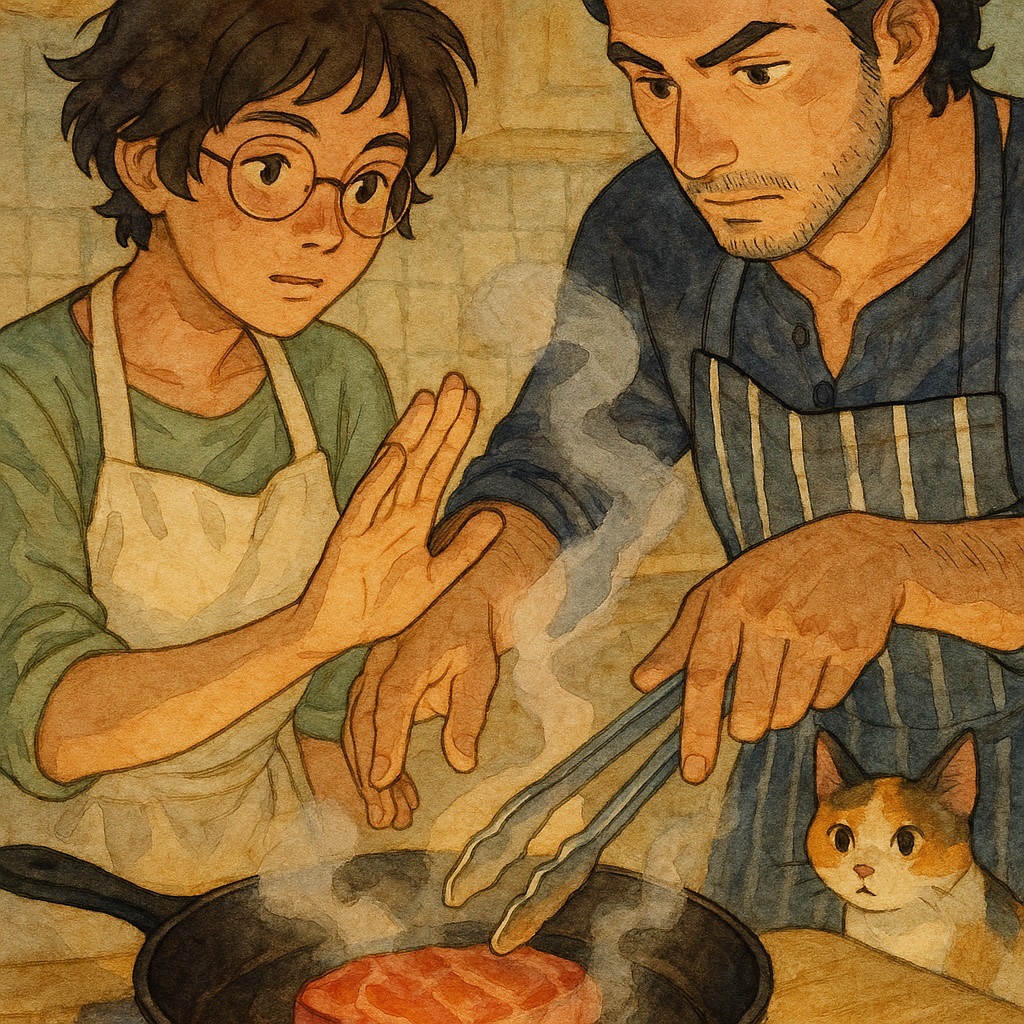
"Don't peek at it!"
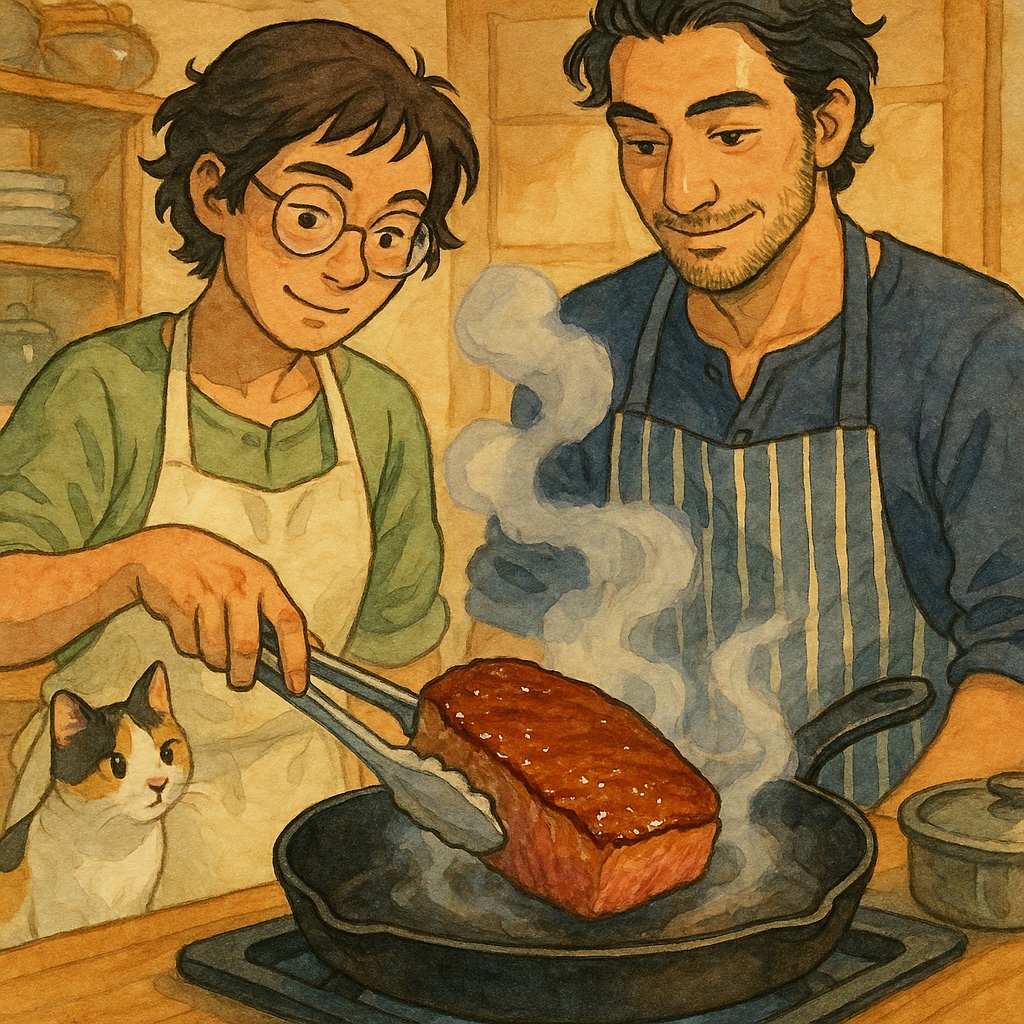
"I'm not even looking at it!"
He was looking right at it. They both were. They couldn't help it. The smoke started — first a single thin column near the fat cap, then a thicker curl from the body of the steak, pale gray-violet, rising up into the copper pan rack and shading the whole kitchen with the smell of cooking beef.
This is the hands-off rule, she would say later. The thing you most want to do — pick the steak up, peek at the underside, jiggle the pan, slide it around — is the exact thing that breaks the contact between the meat and the iron, and contact is where the crust comes from. You move the steak, you break the seal, you lose your crust. Don't move the steak. Don't touch the steak.
She watched the clock on the wall.
At 60 seconds — the edges of the steak were starting to turn cooked-grey-tan on the underside, just visible where the meat had pulled in slightly from the heat.
At 75 seconds — the smoke thickened, the smell deepened, a few amber droplets of rendered fat were now pooling at the edge of the pan.
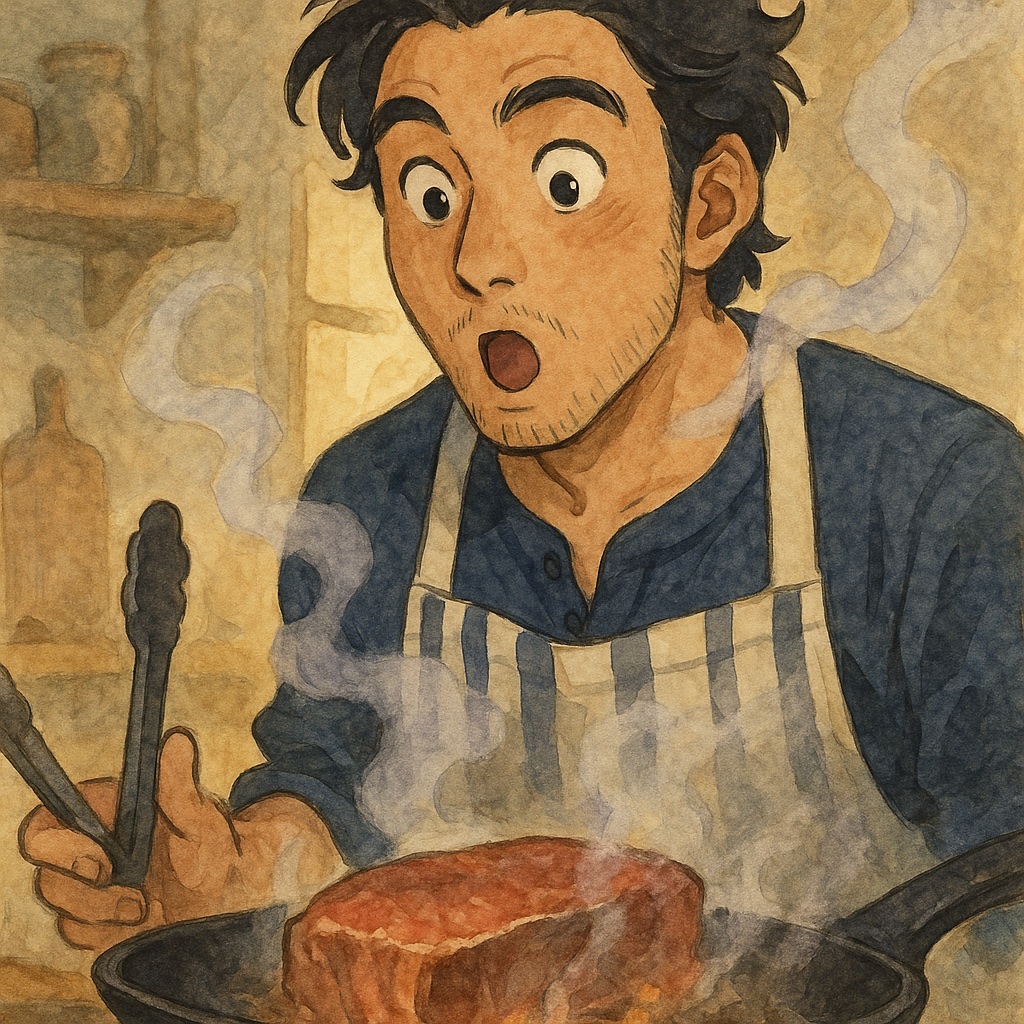
At 90 seconds — she said flip.
He flipped. The tongs got under, lifted, turned. The underside came up gorgeous — deep deep mahogany-bronze, the colour of a violin, the colour of a chestnut, the colour of bread crust that has just barely not burned. He made a small oh sound that was so genuine it embarrassed him.
"Oh."
"Oh."
He set it down on its new side. Another hiss. Another curl of smoke.
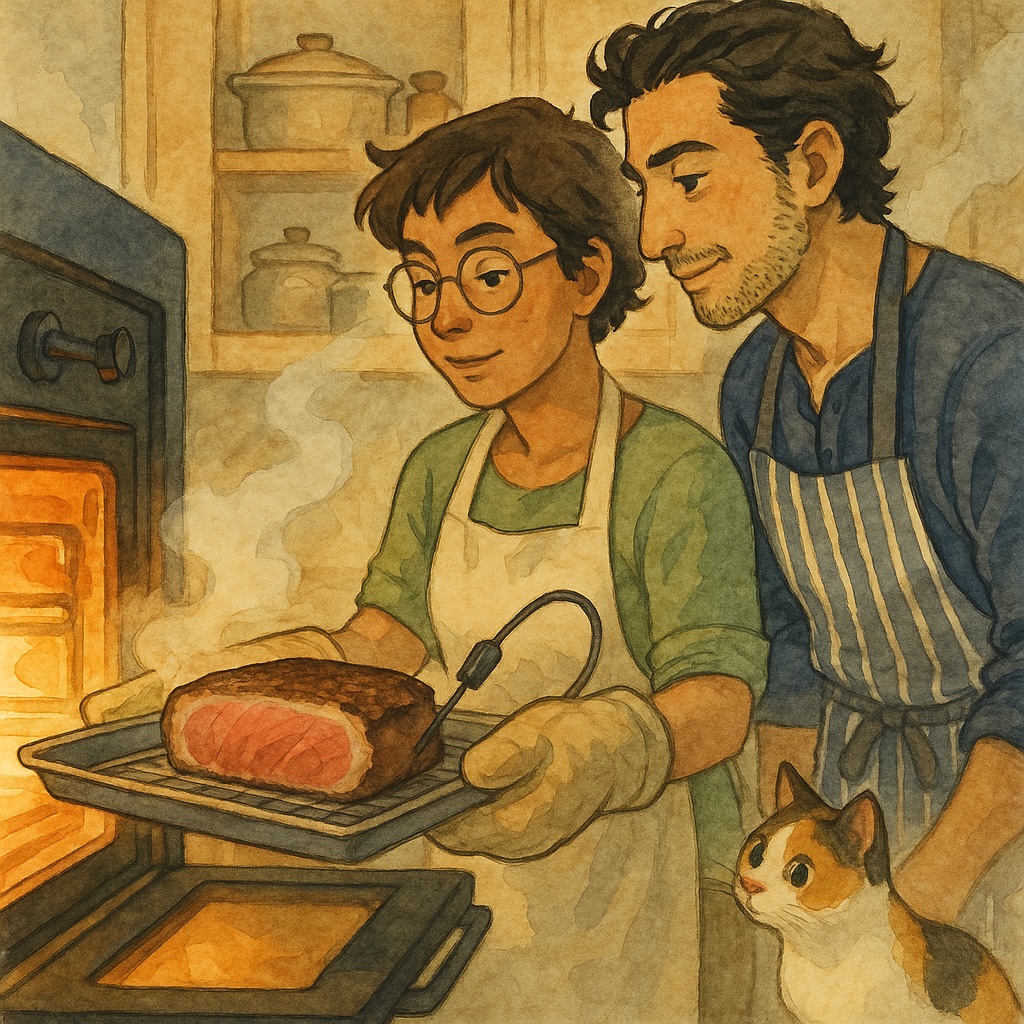
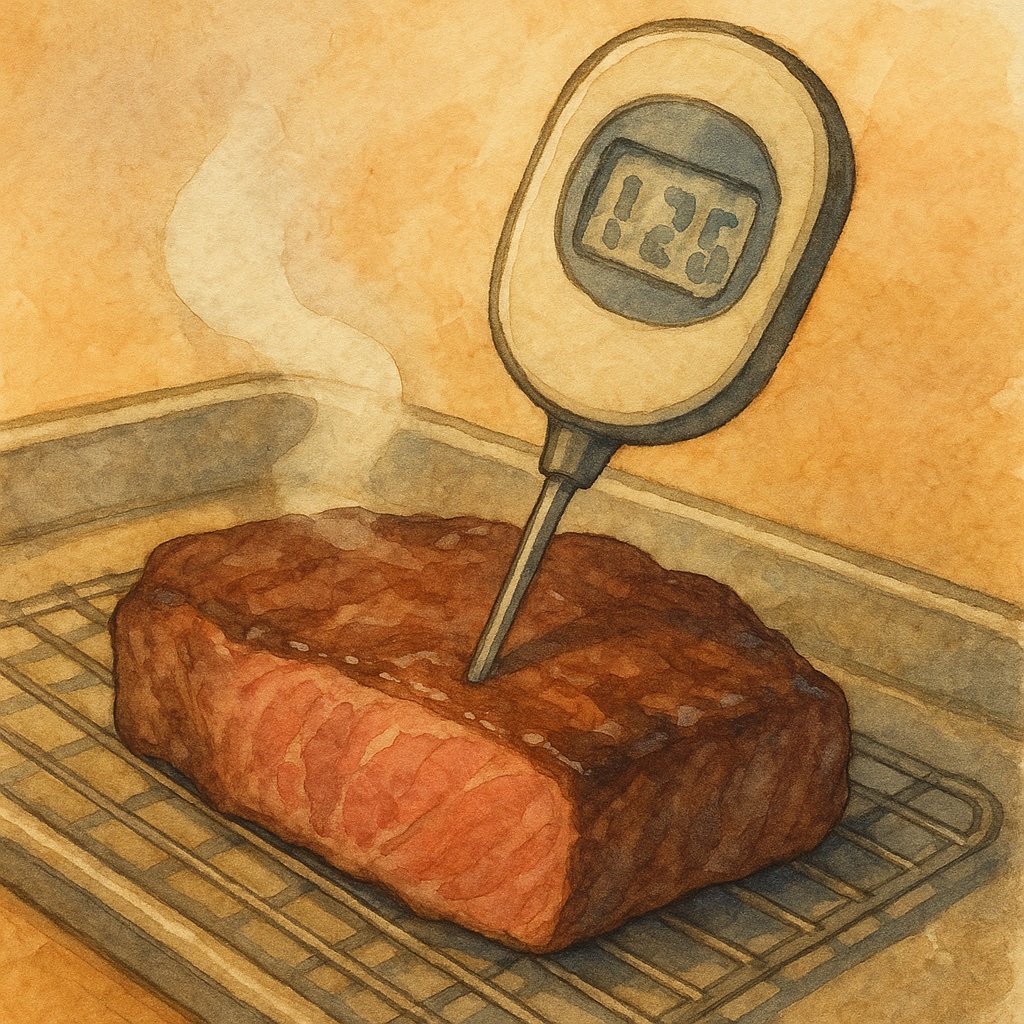
Meanwhile her timer chimed. Forty minutes had passed. The oven door opened. She lifted her own steak — gorgeously pink-red all the way across now, edge to edge, no gray ring anywhere, lifted out on the wire rack — and the probe read 49 Celsius. 120 Fahrenheit. Exactly. She nodded once with quiet satisfaction.
"Pat dry."
She patted hers dry on a paper towel.
"Now I sear."
She bumped him gently with her hip. He slid his pan over to the next burner. Hers slid into its place — already ripping-hot, her own cast iron, a slightly smaller pan she'd had since college. A pin of oil into it. A huge hiss. The steak went in.
Forty-five seconds on one side.
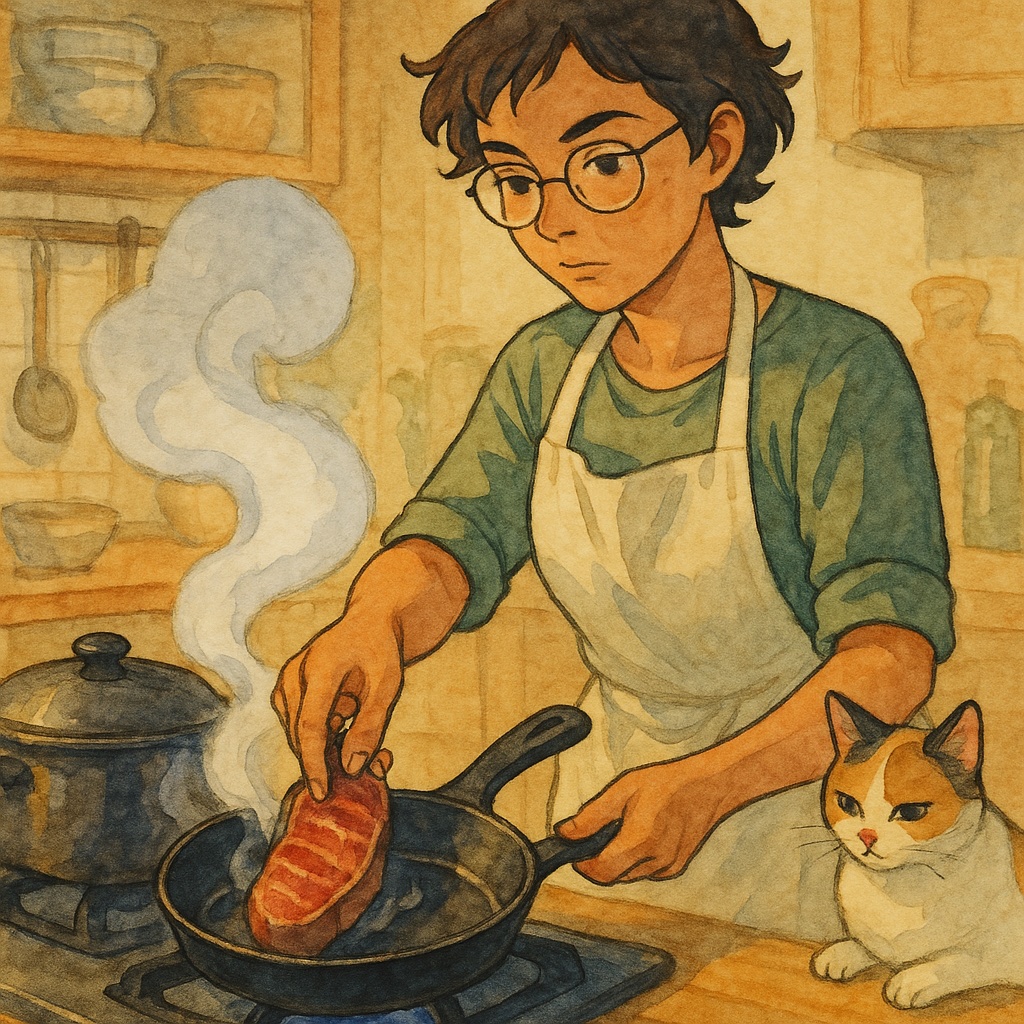
Forty-five seconds on the other.
She did not say don't move it. She just stood very still with her tongs at the ready and her shoulder against his, watching the colour build on her steak as fast as it had built on his.
When she flipped, the underside came up the exact same mahogany.
"Hi," he whispered to her steak.
"Hi," she whispered to his.
The kitchen was a held breath inside a roar of sound. The crusts came together over the two pans like two pages of the same book.
"Good," she said.
"Very good," he said.
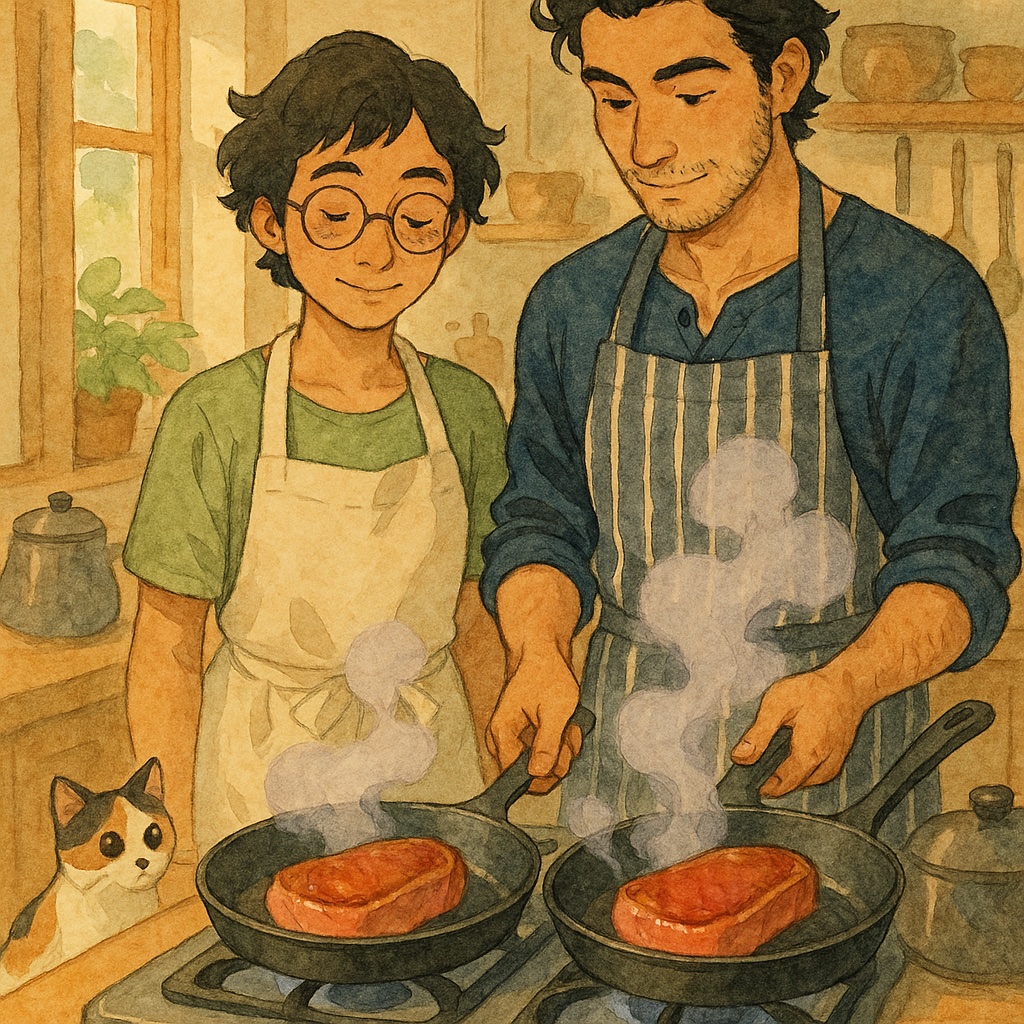
They were both very serious about this now. The chapter was nearly over and the steaks weren't even resting yet.
But the crusts were built.
Butter, Garlic, Thyme
"Now," Mara said, "the love language."
"The what."
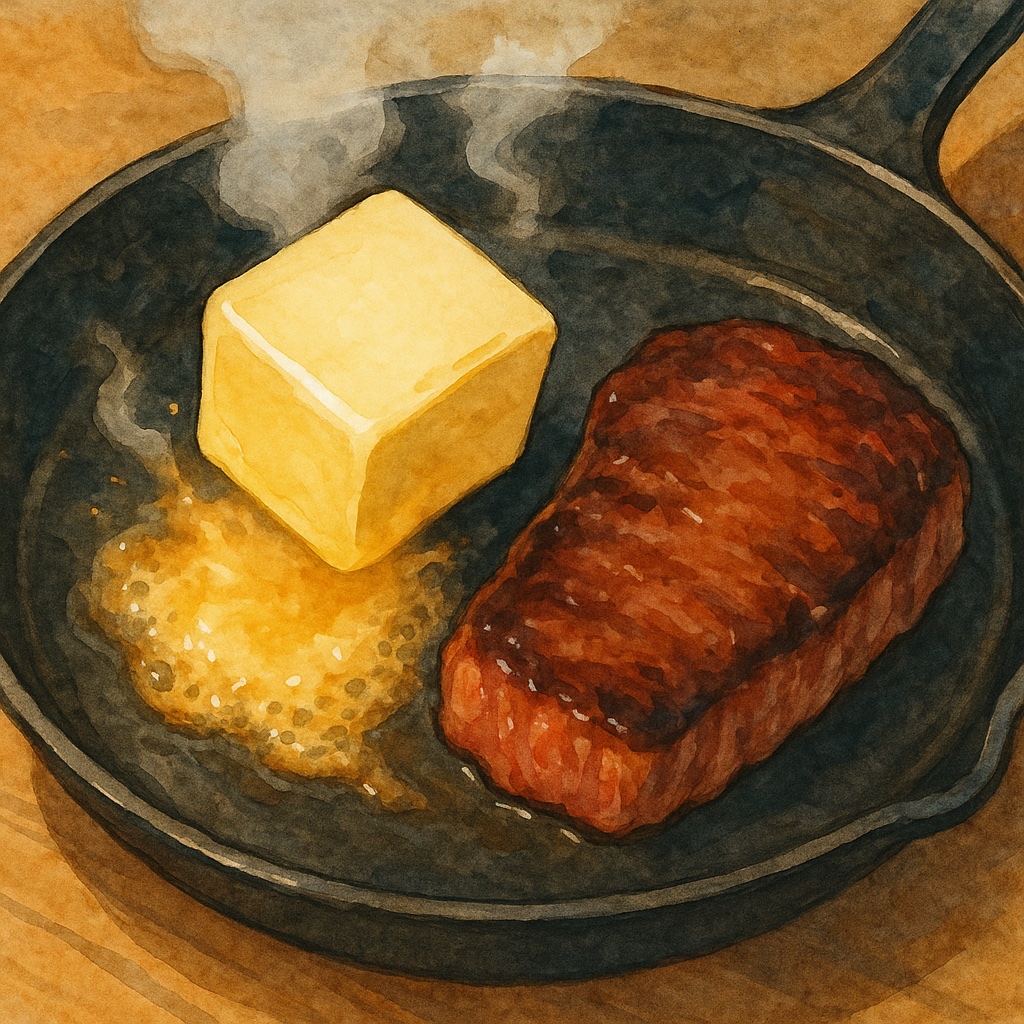
"Butter, garlic, thyme. The classic finishing trio. The pan is already past butter's smoke point — but the crust is built, so we can lower the heat and use it without burning it."
"Turn it down."
"Turn it down — to medium-low. Both pans."
He twisted his knob. She twisted hers. The roar in the room dropped to a contented sizzle. The pale gray-violet smoke thinned to a few lazy wisps.
"Butter."
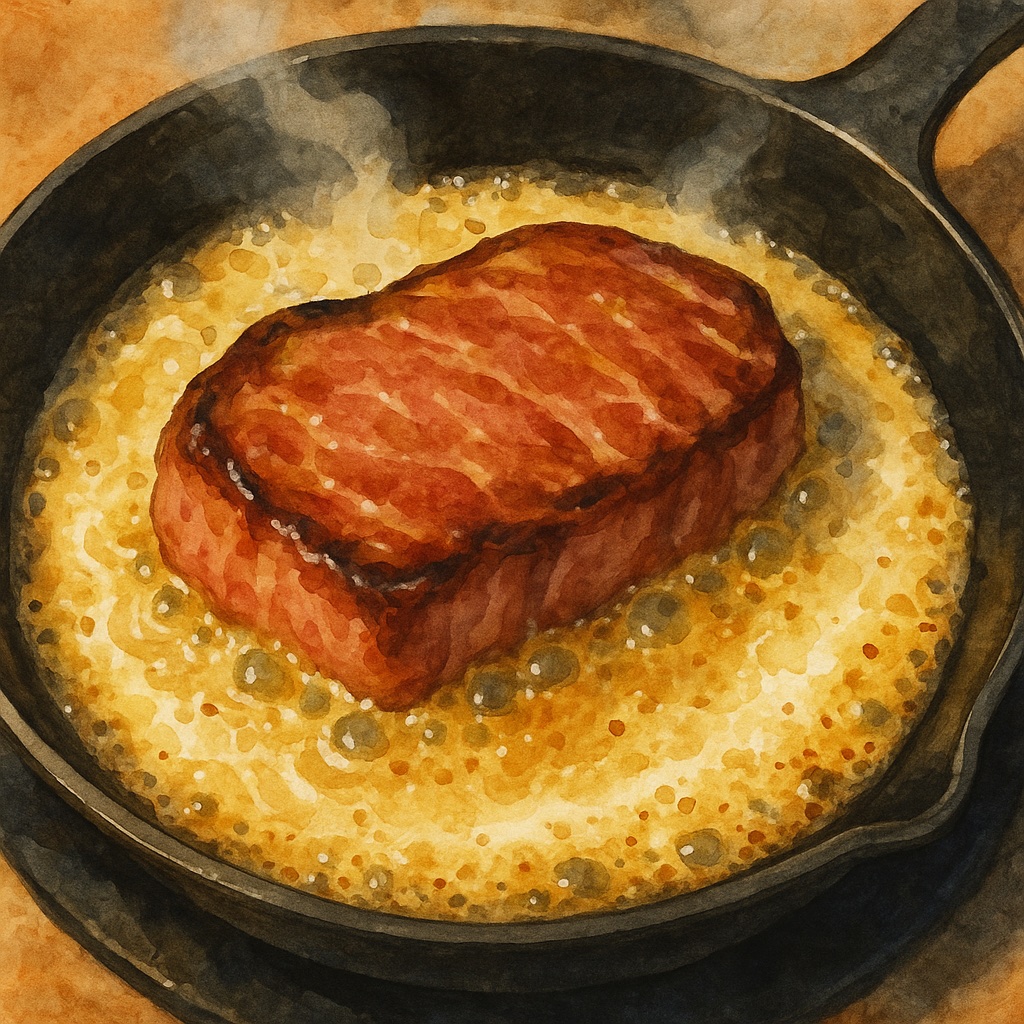
He cut a thick slab — a generous tablespoon, maybe a little more — off the stick and dropped it into his pan. It hit and foamed — a slow rolling foam, gold-bright, the milk solids whispering at the bottom of the pan. He dropped a second slab into Mara's pan. Two pans, two halos of foaming butter.
"Garlic."
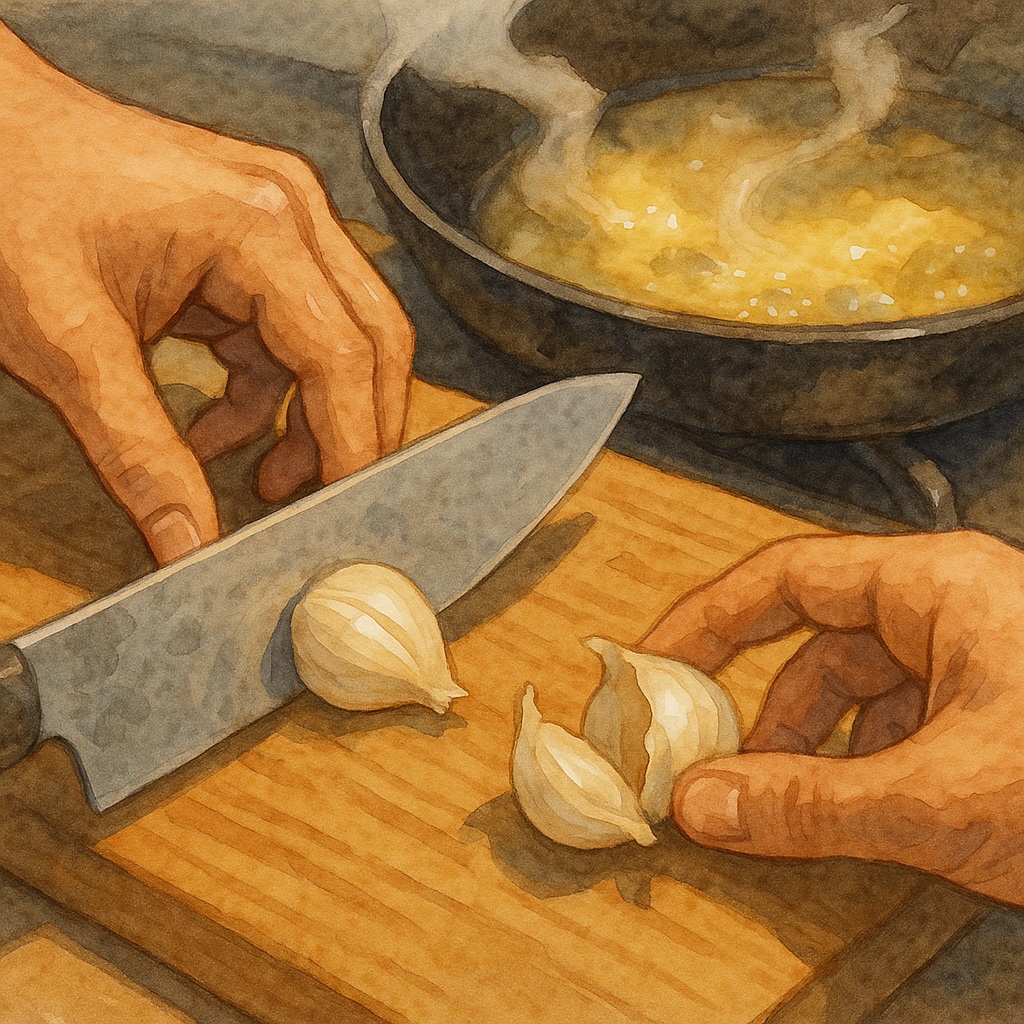
He smashed two cloves with the flat of a knife — skins still on, the way she'd taught him, so they wouldn't burn — and tossed one into each pan. The smell that came up was instantly, immediately, kitchen-changing. The whole room shifted register. From seared meat to seared meat plus the warm sweet animal smell of garlic in butter.
"Thyme."
She tucked a small bouquet of thyme sprigs into each pan with her tongs. The sprigs went bright green, then dark green, then started to perfume.
"Tilt."
She tilted her pan toward herself — careful, careful — the foaming butter pooling at the low edge near the handle. Theo did the same.
"And now we baste."
She showed him. A big spoon — a deep ladle-spoon, almost a small cup — scooped up the foamy aromatic butter from the low pool and poured it over the top of her steak. Then again. Then again. The butter cascaded over the crust and ran back down into the pool and got scooped up and poured over again. The crust glazed. The thyme oils streaked across the surface. The garlic toasted in the butter and went sweet.
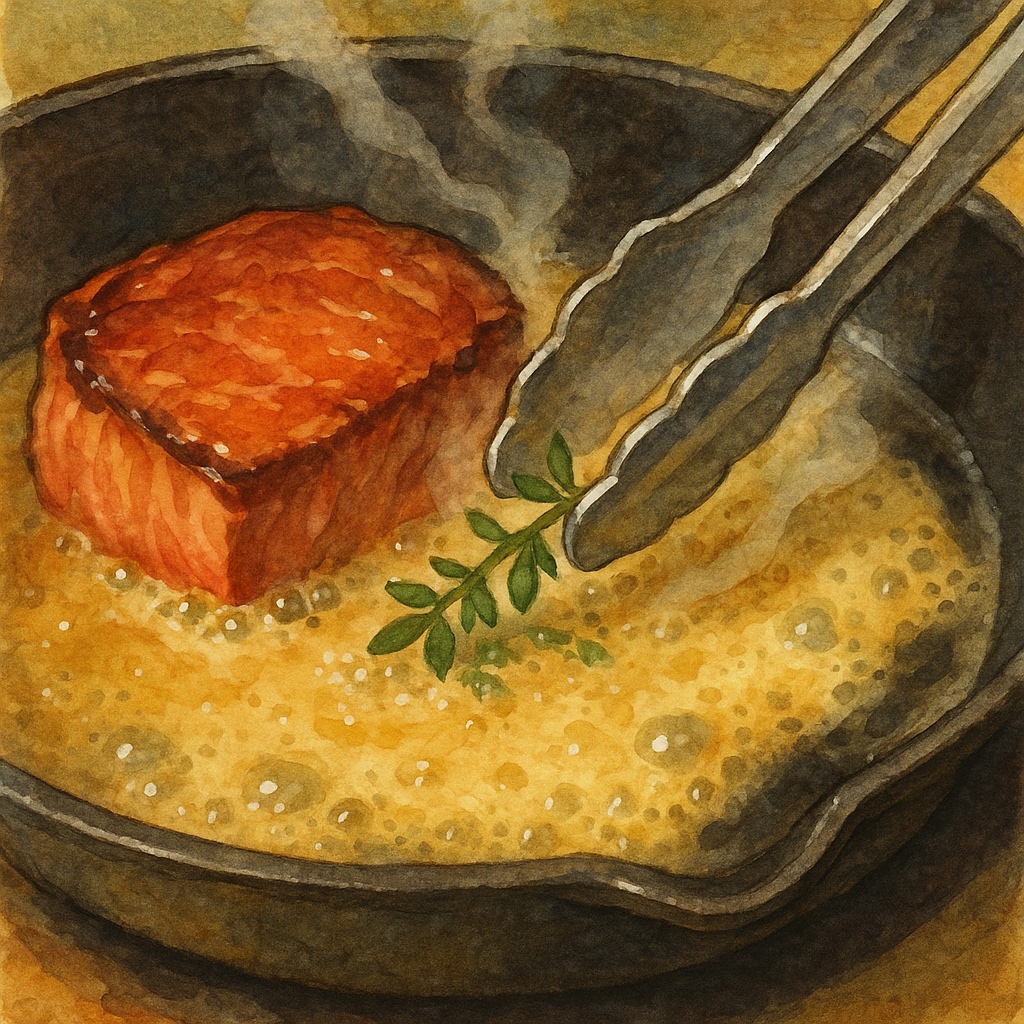
"Thirty seconds. Maybe a minute. Both sides if you want — flip once, baste again. The point is to coat the surface with aromatic browned butter, not to keep cooking the inside."
"Why couldn't we just do this from the start."
"Because butter at sear heat burns. We needed the high heat for the crust. Now the crust is built, the pan's coming down, the butter can be itself."
"The butter can be itself."
"The butter can be itself."
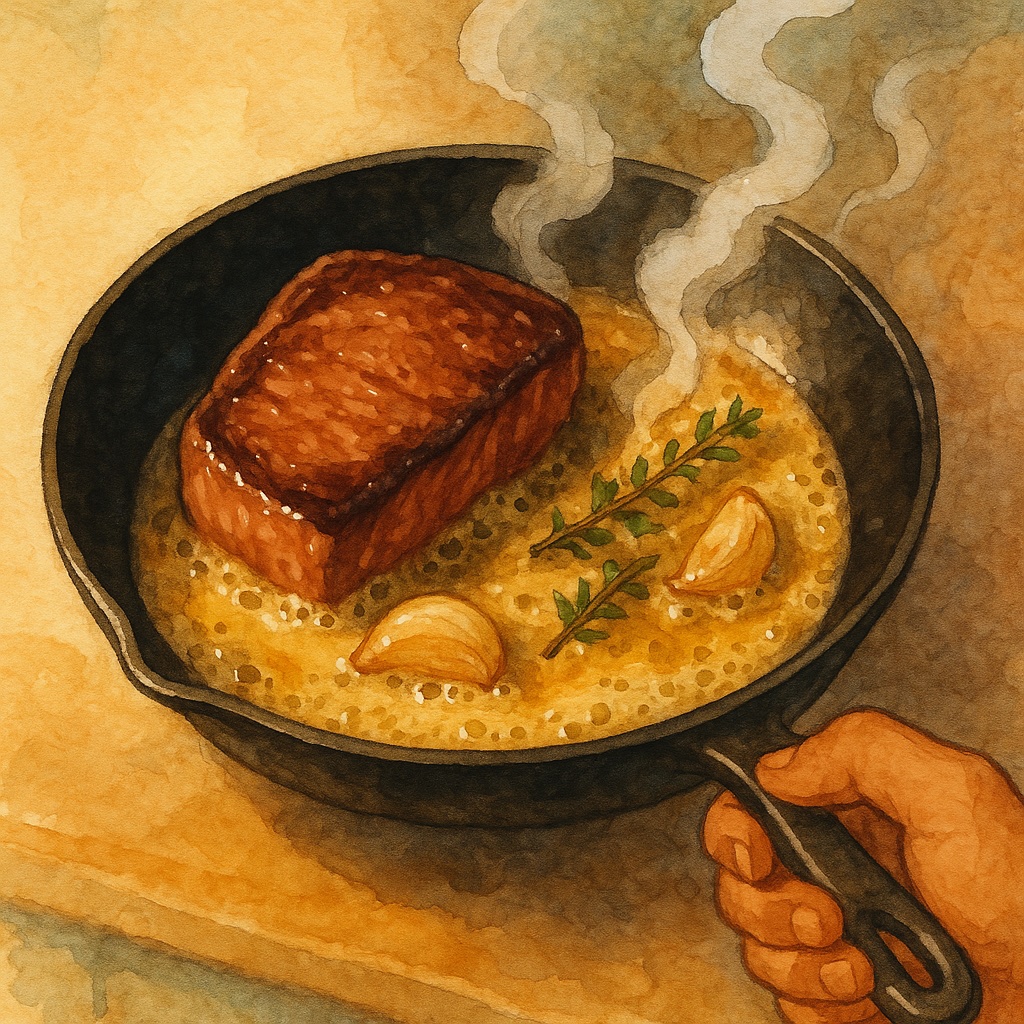
He bastes. His pan tilted, his spoon scooping, the butter going up and over the steak and back down. His face was doing the small oh face again. She was making the same face. Two people making the same face at two different pans is a kind of love.
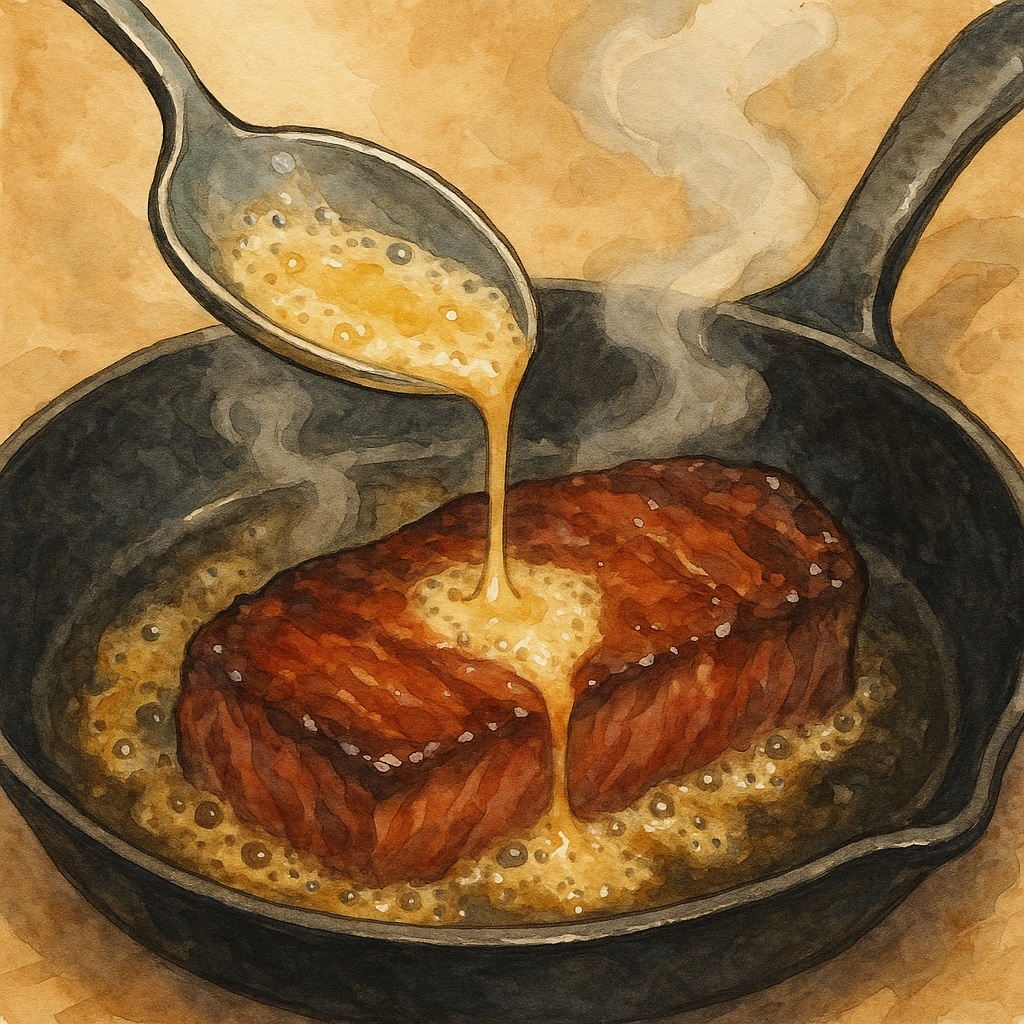
"Don't eat the garlic out of the pan."
"I'm not."
"You're hovering."
"I'm appreciating from a distance."
"You're appreciating from a spoon-length."
He pulled the spoon back. He bastes one more time. The clock said maybe forty seconds in. The thyme was perfuming hard enough that the cat had reappeared and was now staring at them with focused outrage. Brisket had a position on every chapter of every meal. This was the outrageous chapter.
"Off heat."
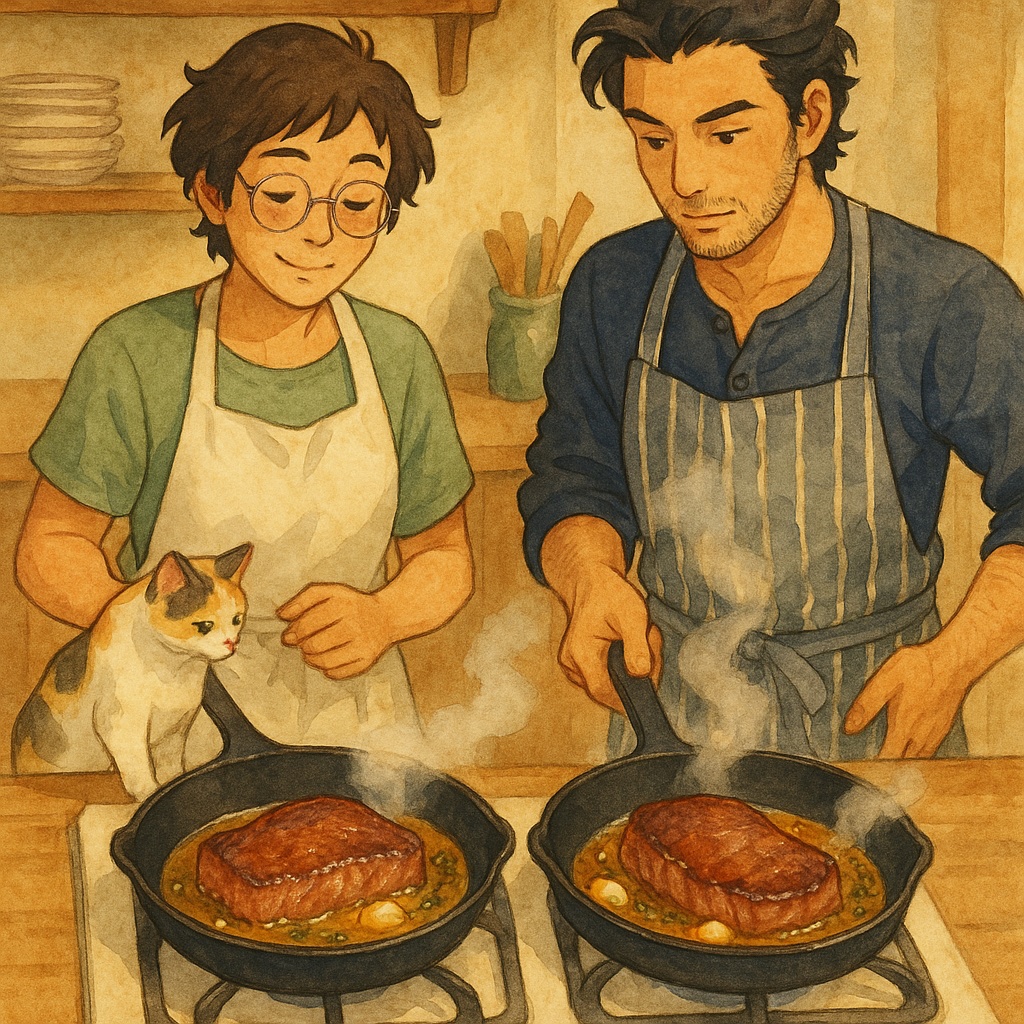
"Off heat."
Both burners clicked off. Both steaks came out of their pans and onto the wire rack on the wooden board. The butter had glazed both crusts to a deep glossy lacquer. The thyme had left small green confetti shreds in the foam.
"That," Mara said, "is what people mean when they say restaurant quality."
"It is what people mean when they say I want to lie down on the floor."
"It is also that."
The pans went into the sink with a careful hiss. The aromatic butter pooled in the bottom. Someone — both of them, eventually — would later sop it up with bread, ritually, like a closing prayer.
But not yet.
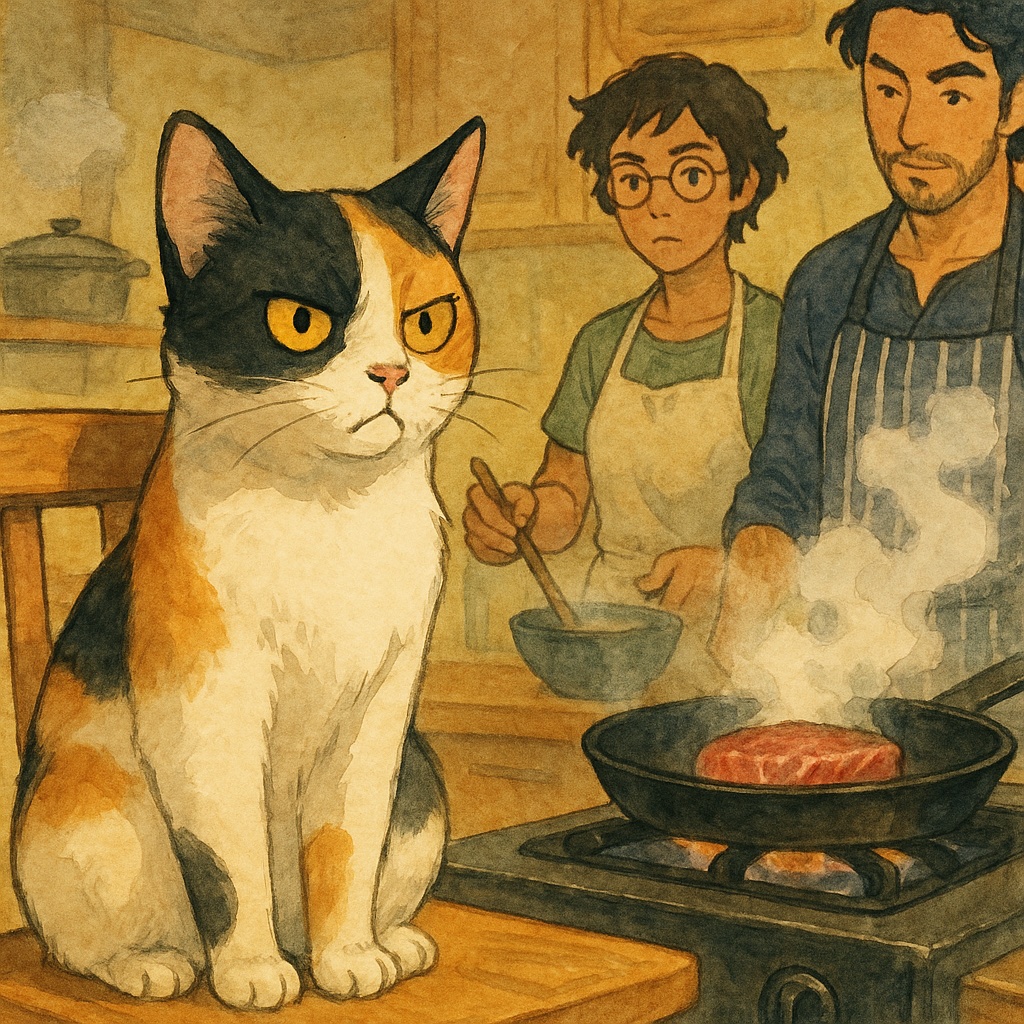
The steaks were on the wire rack now, doing nothing. Doing the most important thing.
Probe & Rest
"Numbers," Mara said.
"Numbers."
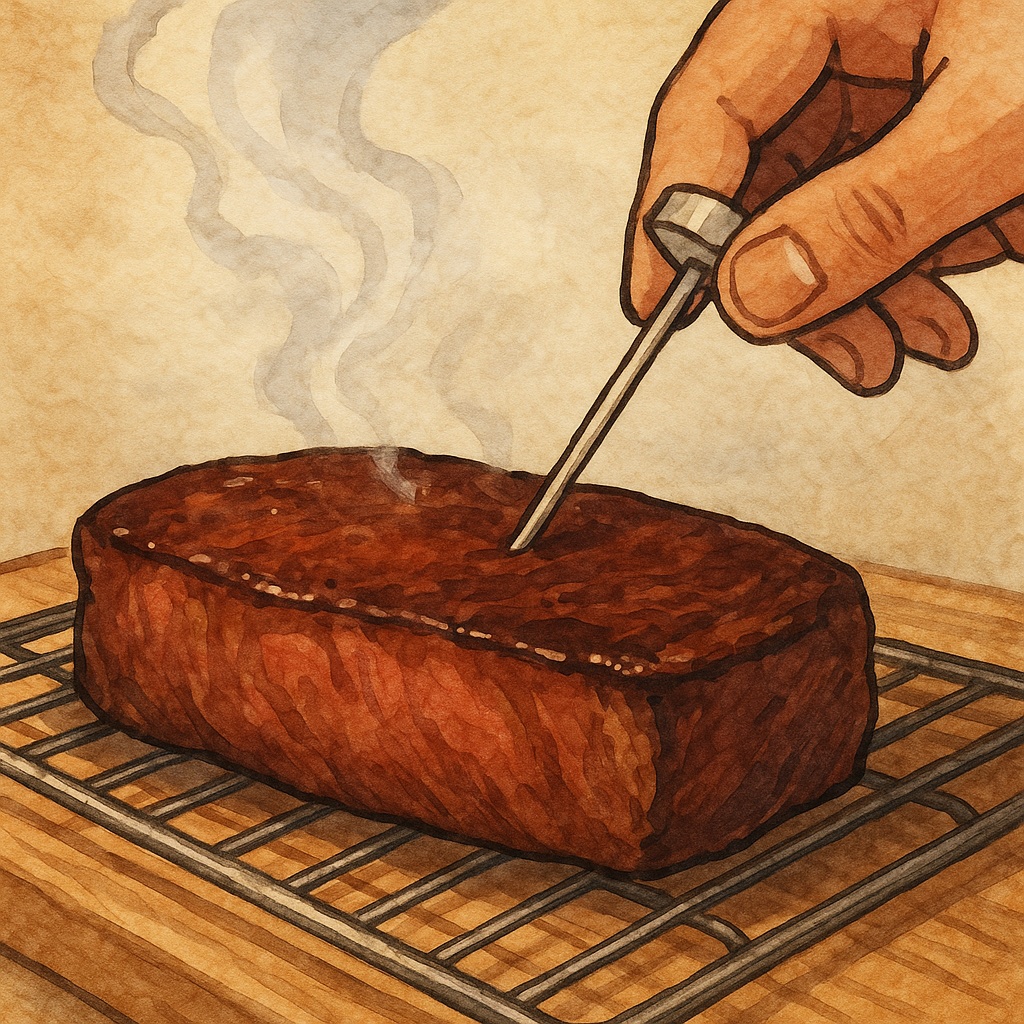
"Memorize three of them and you never have to overcook a steak again. Rare: fifty Celsius, one twenty-two Fahrenheit. Medium-rare: fifty-four Celsius, one twenty-nine Fahrenheit. Medium: sixty Celsius, one-forty Fahrenheit. Past medium and we are no longer friends."
"Past medium and we are no longer friends."
"Pull the steak about three degrees below your target. Carryover cooking finishes it. The center keeps climbing for several minutes after you take it off the heat — the outside is still hotter than the inside, the heat keeps marching inward, the temperature rises another two to four degrees while the steak rests."
"So for medium-rare —"
"Pull at fifty-one Celsius. One twenty-four Fahrenheit. By the time you cut, it's at fifty-four."
She stuck the probe in through the side of his steak. Through the side — never the top, never the fat, never near the bone if there is one. Into the dead centre. She watched the digital display climb and settle.
"Fifty-two and a half. Already heading up. Off the heat in time. Beautiful."
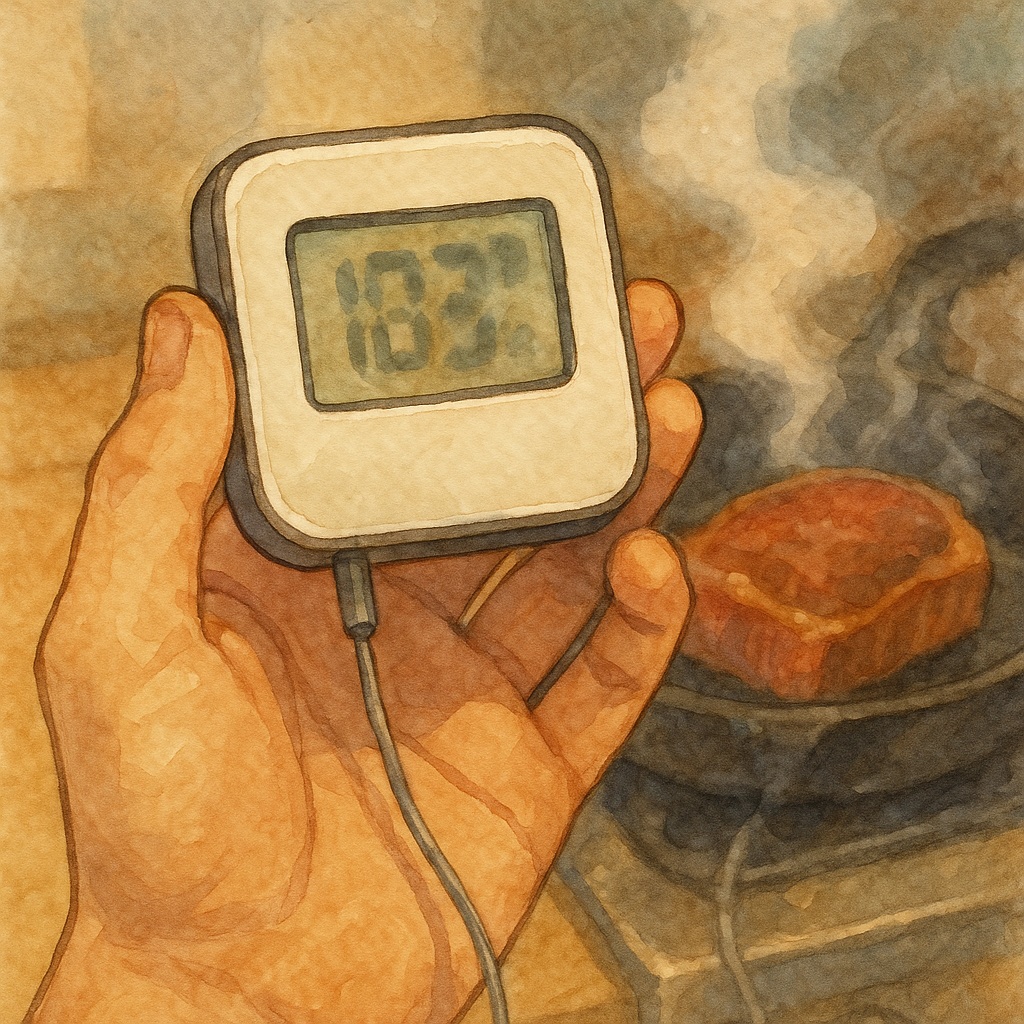
"Beautiful."
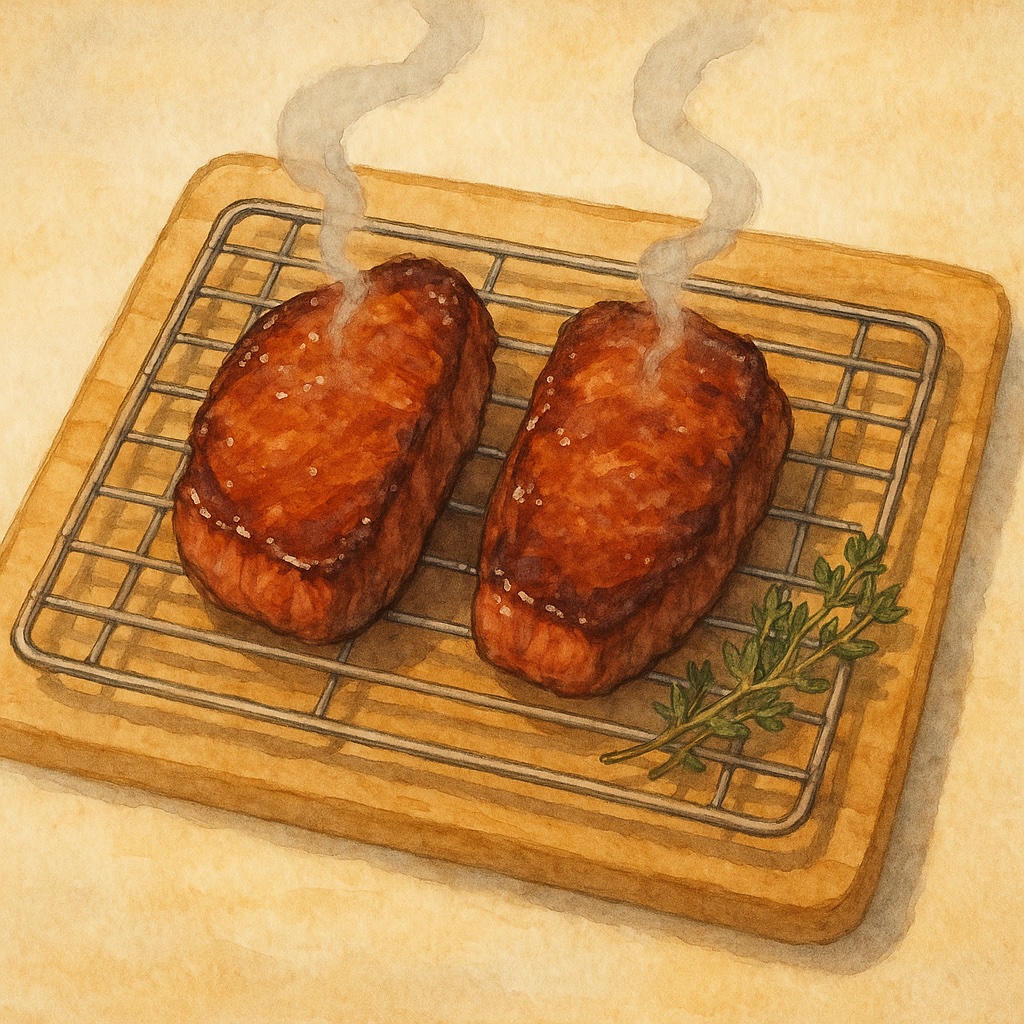
His steak: probed and settled. Hers: probed and settled. Both on the wire rack on the wooden board, parallel to each other, two thick rectangles of mahogany crust with faint steam rising off them and the smell of beef and butter and toasted garlic filling the whole kitchen.
"Now the hard part."
"Wait."
"Wait."
She tented a small piece of foil over both of them, very loosely — a low tent, not a wrap. Heat could still get out. Steam could still escape. The crust would not steam itself soft. The juices, inside the meat, would do their slow patient redistribution.
"Why we rest," she said. She picked up the pencil and pointed it at the steak. "When the meat is on the heat, the muscle fibers tighten and squeeze — they push the juices toward the center, away from the heat. The center is wet, the outer ring is drier. Cut a steak the second it comes off the pan and you get a flood — those juices pour out onto the board and you eat dry meat."
"That has happened to me."
"That has happened to everyone."
"How long."
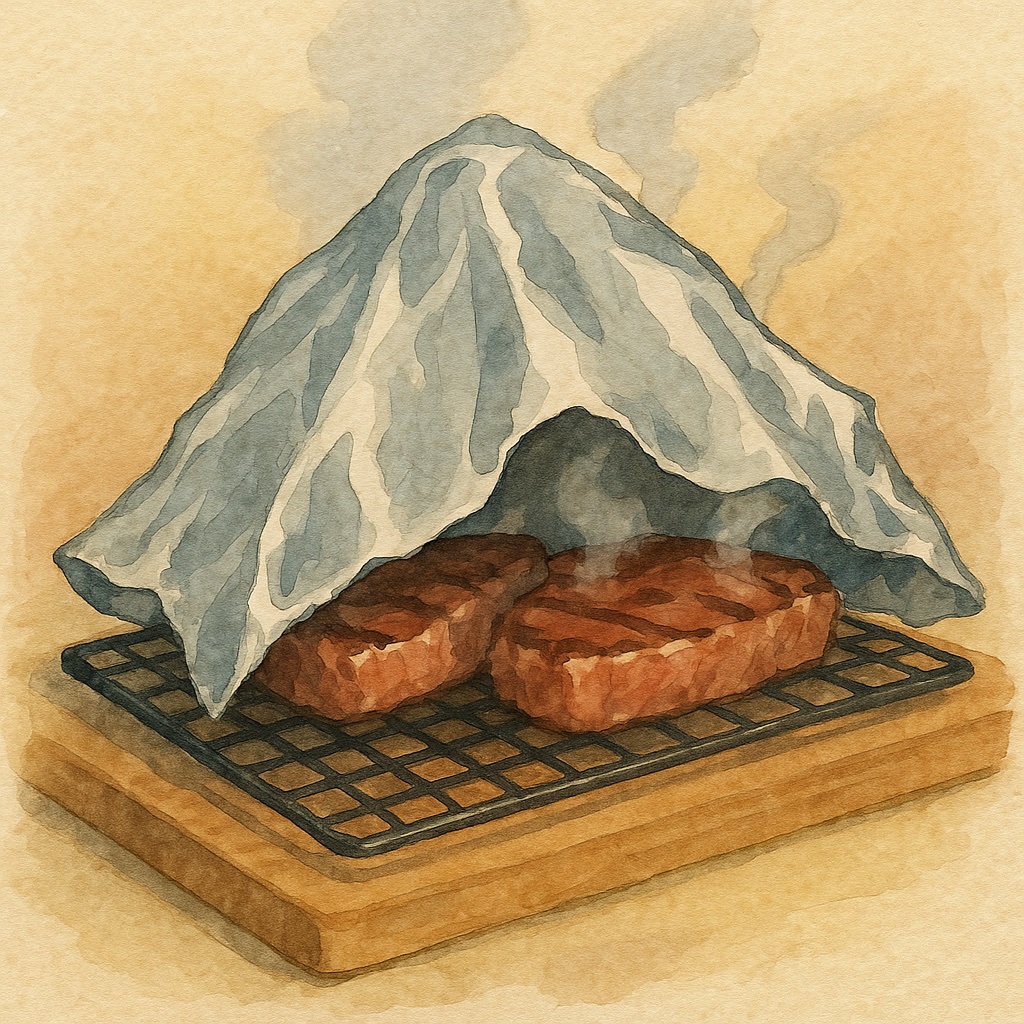
"Five minutes minimum. Eight to ten for a thick steak like this. The fibers relax, the juices redistribute back across the cross-section. The whole steak ends up evenly moist. The board stays clean."
"Eight minutes."
He looked at the steaks. He looked at the wine. He looked at the clock. He looked at the steaks again. He made a small wounded noise.
"This is the longest eight minutes of my life."
"This is the longest eight minutes of everyone's life."
She was already pouring two glasses of red wine. She nudged one into his hand. He took it without looking away from the resting steaks.
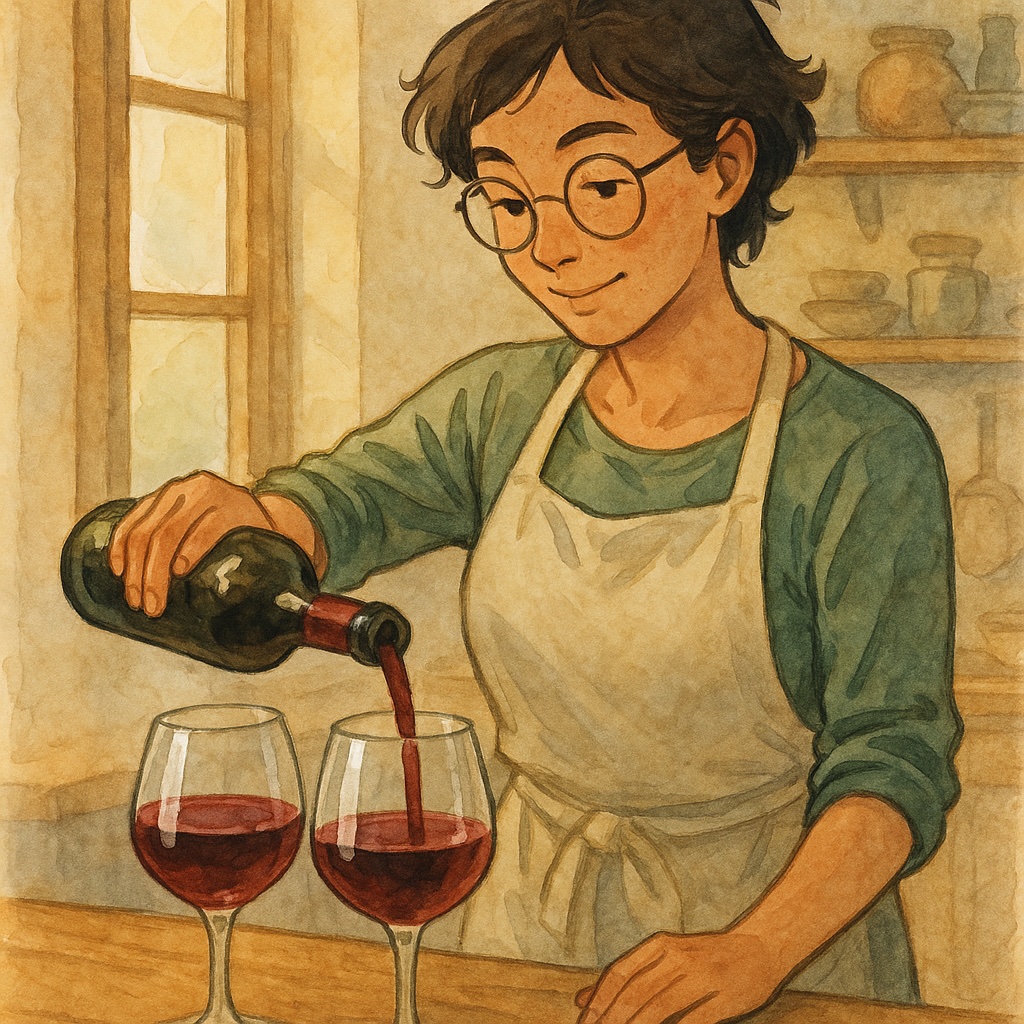
"Don't watch them."
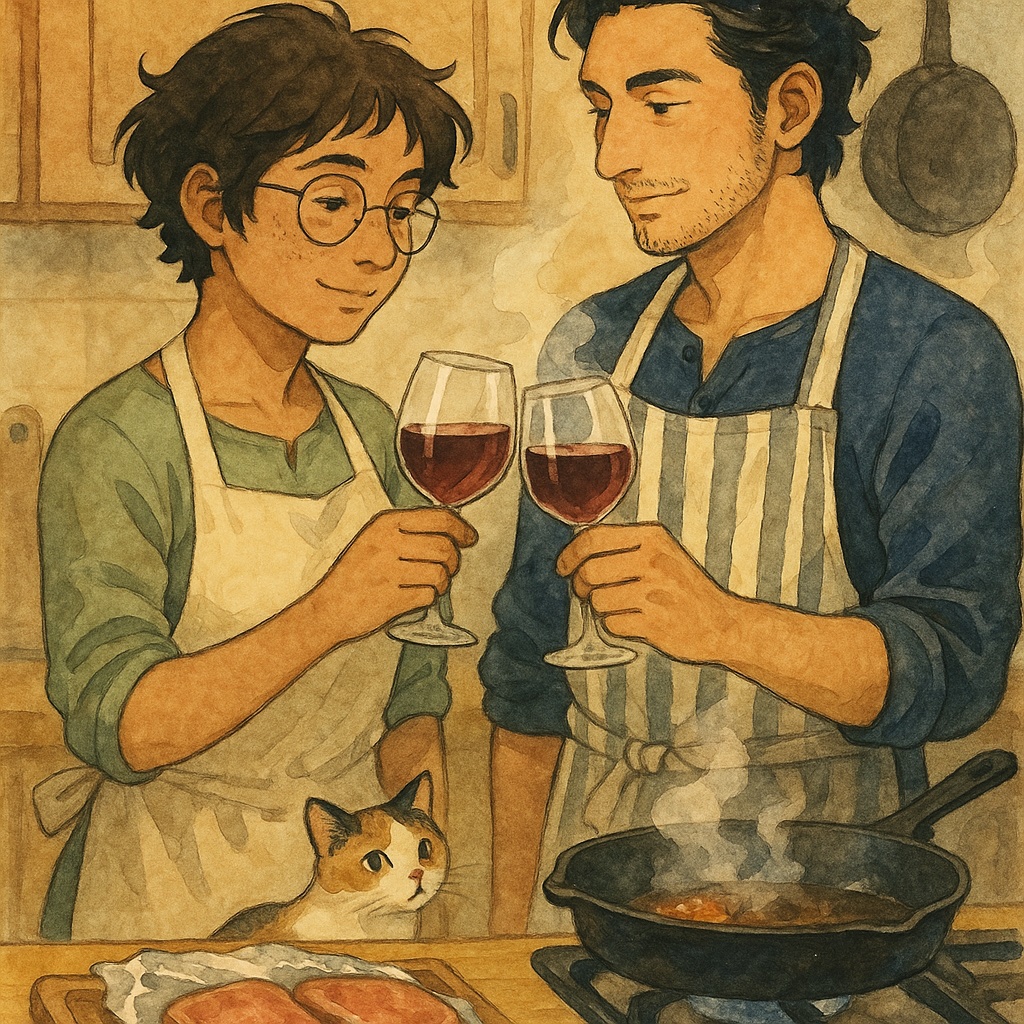
"I have to watch them. They might escape."
"They are not going to escape, Theo."
"You don't know what they're capable of."
She laughed and clinked her glass against his. The clink rang once in the quiet kitchen. Outside the window, the light had gone deep gold, almost amber. Brisket was sitting on the chair watching the steaks too, in a quiet protest of solidarity with Theo.
"While we wait," Mara said, "the other things to know. Don't cover them with a tight lid or wrap them in foil — that traps steam, and steam softens the crust. Loose tent. Or no tent at all if your kitchen is warm. Don't put them back on the pan to keep warm — they'll keep cooking. Don't slice them on a cold plate — the meat cools fast. Slice on the warm wooden board, plate immediately, eat immediately."
"Loose tent. No re-pan. Warm board."
"Loose tent. No re-pan. Warm board."
He took a sip of wine. He watched the steaks like a man on a porch watching for rain. They didn't move. They didn't need to. Inside each of them, on a scale he could not see, the juices were spreading themselves back out into the muscle fibers, settling into the meat, getting ready for the cut.
She put her hand on his wrist.
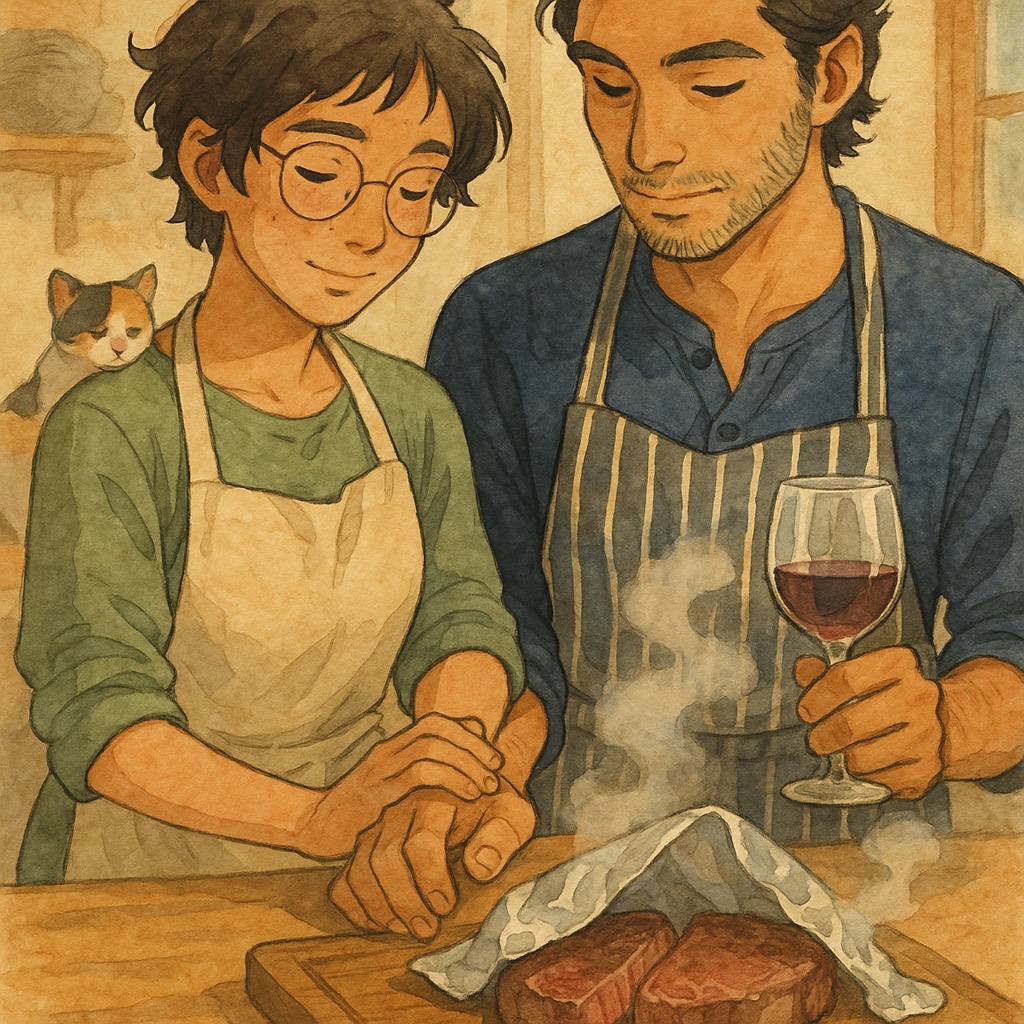
"Look at me."
He looked at her.
"Forty more seconds."
"Forty seconds."
She held his wrist gently. She did not let go. Forty seconds passed.
Then she did.
"Knife."
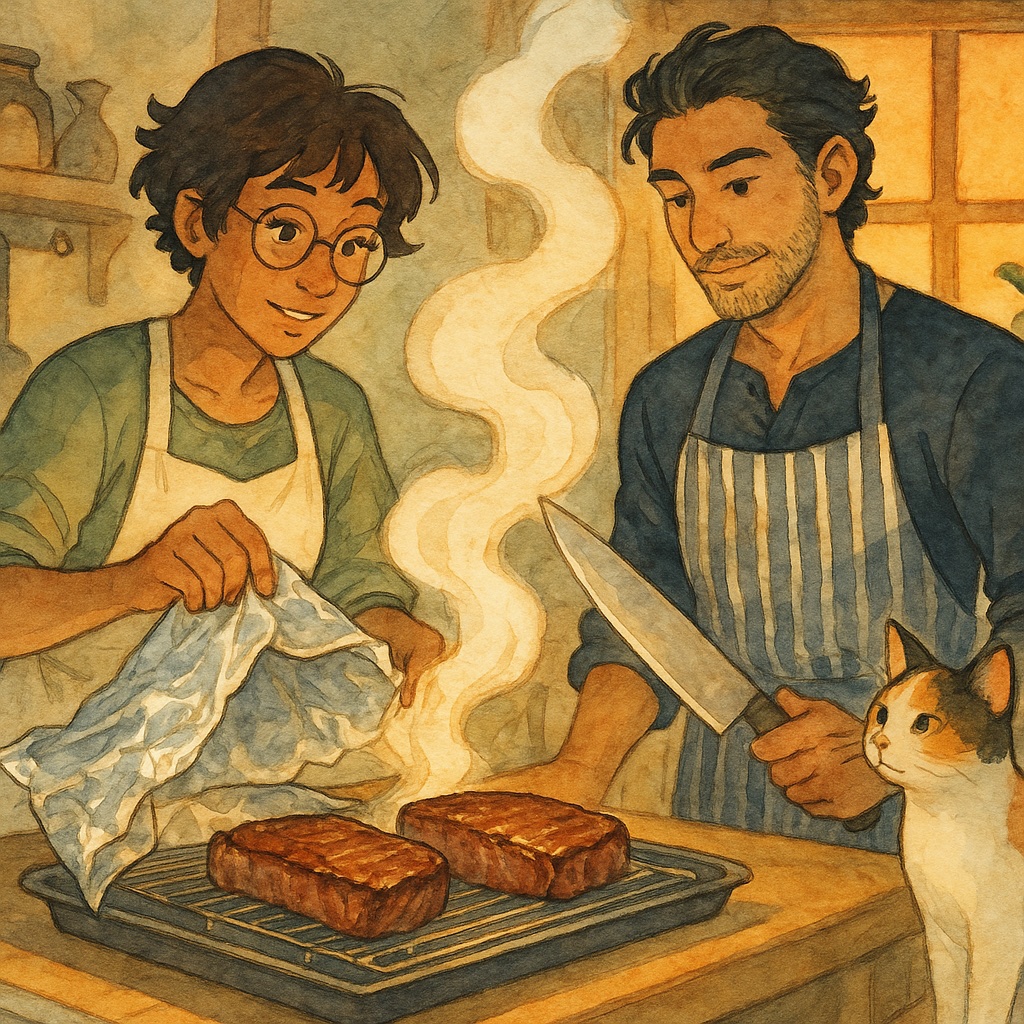
He picked up the knife.
The chapter ended on the snick of the wooden cutting board sliding into position under the steaks, and the soft sigh of the foil tent coming off, and one last full curl of fragrant steam rising into the amber light.
Slice & Settle
The knife was sharp.
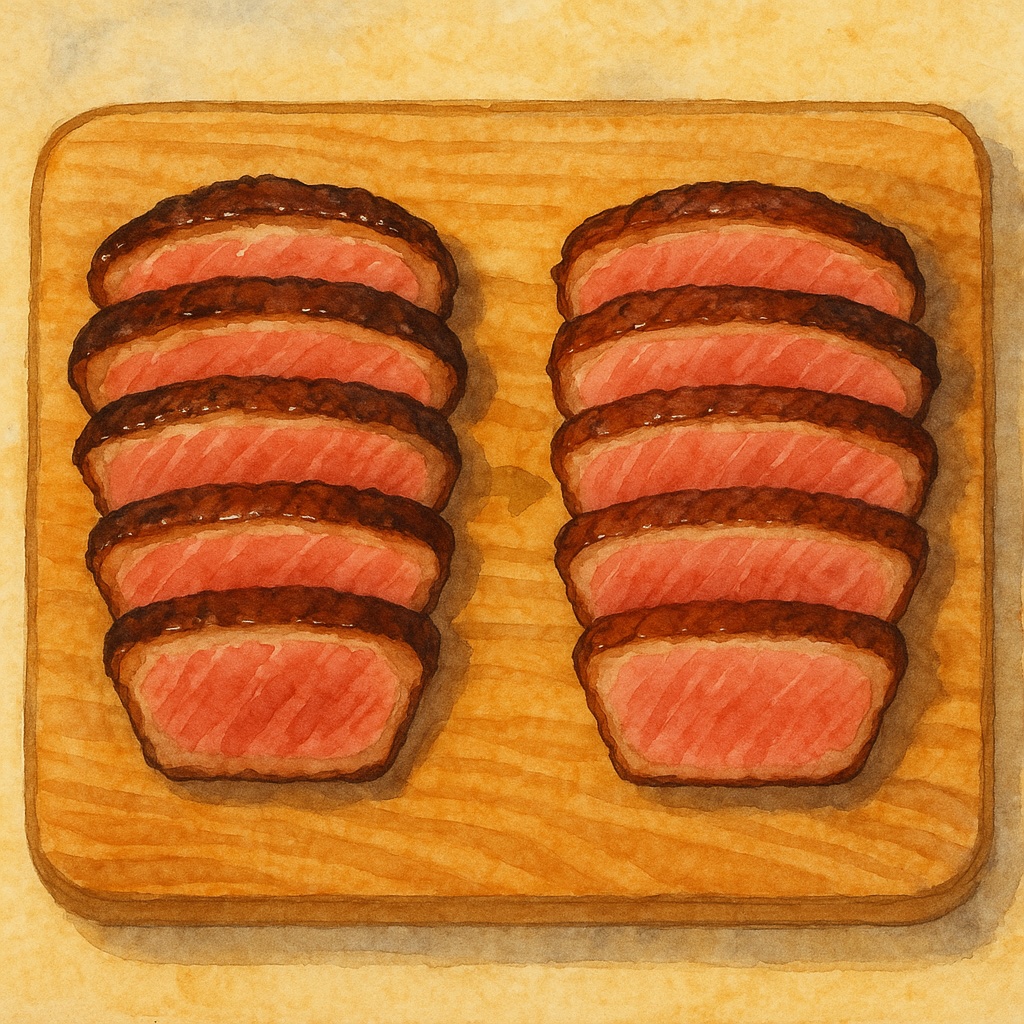
This is, somehow, the part most people skip. A blunt knife crushes the meat as it cuts; the juices pulse out the side; the slice looks ragged. A sharp knife glides — and the cross-section it leaves behind looks like a watercolor painting. Buy a sharp knife. Or sharpen the one you have.
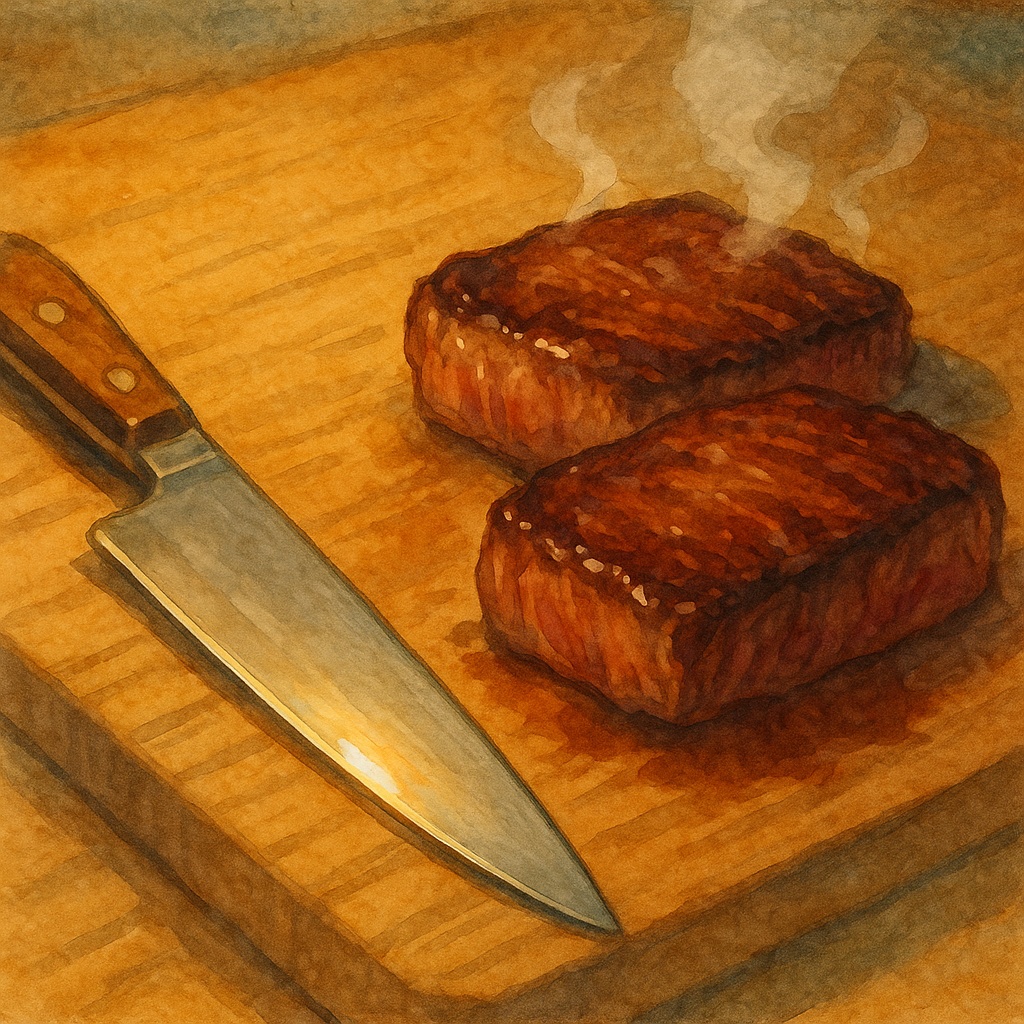
"Find the grain," Mara said.
"I see it."
The grain was the long lines of muscle fibers running across the steak — visible from above as faint parallel ridges. You could trace them with a finger. You could feel them.
"Cut perpendicular. Across them. Not with them. Every slice you make is severing the long fibers into short pieces — the bite-into-the-meat is the bite-across-the-fibers, not the bite-along-them. Cut with the grain and every bite is like chewing through floss."
"Across the grain. About a centimeter thick."
"About a centimeter thick. Maybe a hair more for a thicker steak."
He cut his first slice.
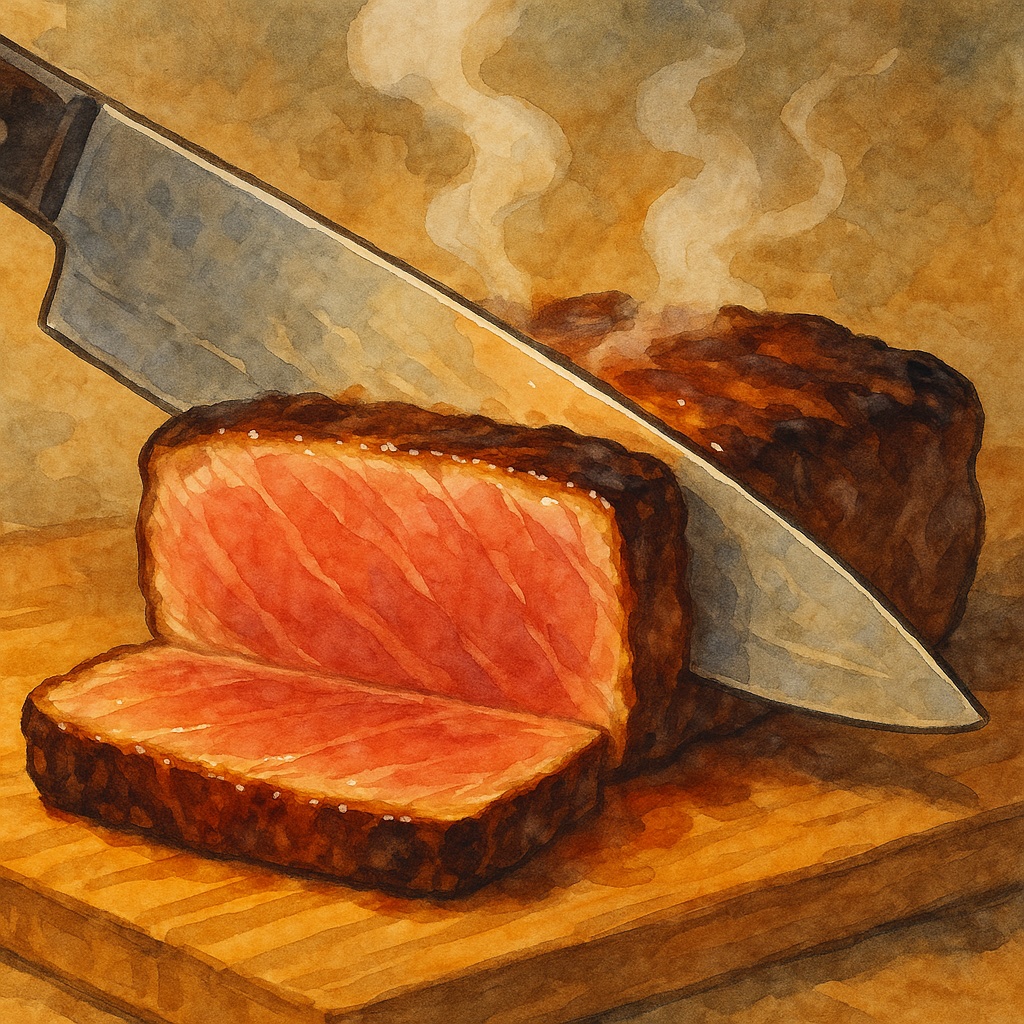
The steak opened like a small clean book.
The interior was — and they both made the same sound at the same time again — rosy. Edge to edge. The deep mahogany crust line ran along the very top and very bottom, a sharp narrow band of dark, and then below that, all the way through, the soft warm even pink of a perfect medium-rare. No grey ring. No raw stripe. Just pink, all the way across.
"Oh."
"Oh."
He cut another slice. Another. He fanned the slices out across the wooden board.
She picked up her own knife and cut into hers.
She tilted the slice toward the light.
Her interior was — they both squinted, looked at the two cross-sections side by side, looked at each other, looked back — the same. Edge to edge rosy. Mahogany crust on top and bottom. No grey ring on hers either, of course — the reverse sear had cooked it so slowly and evenly the inside was a single uninterrupted shade of warm pink. The forward sear had a very slightly deeper darkening just under the crust — a few millimeters of slightly-more-done meat — but at this thickness, at this care, it was almost invisible.
"Mine's prettier," he said.
"Mine's prettier," she said.
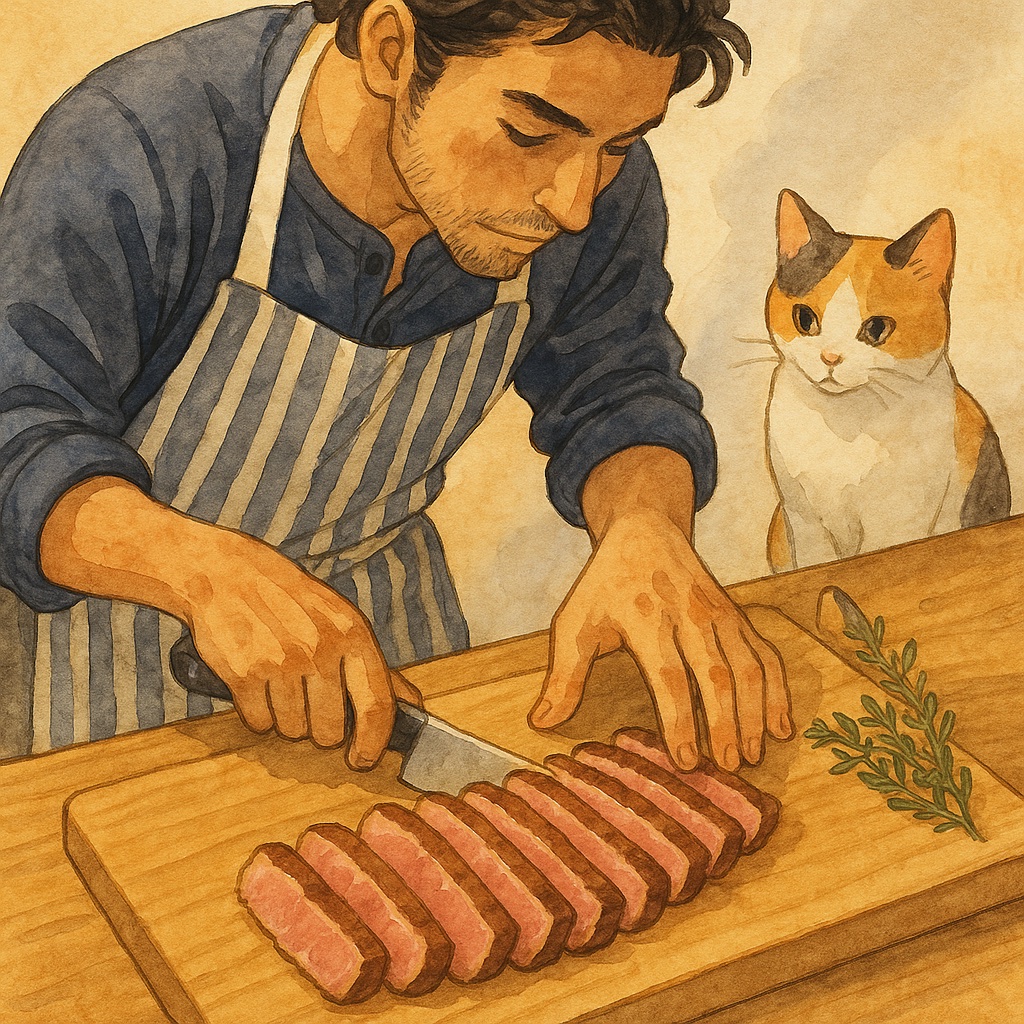
"Mine has, like, more confidence."
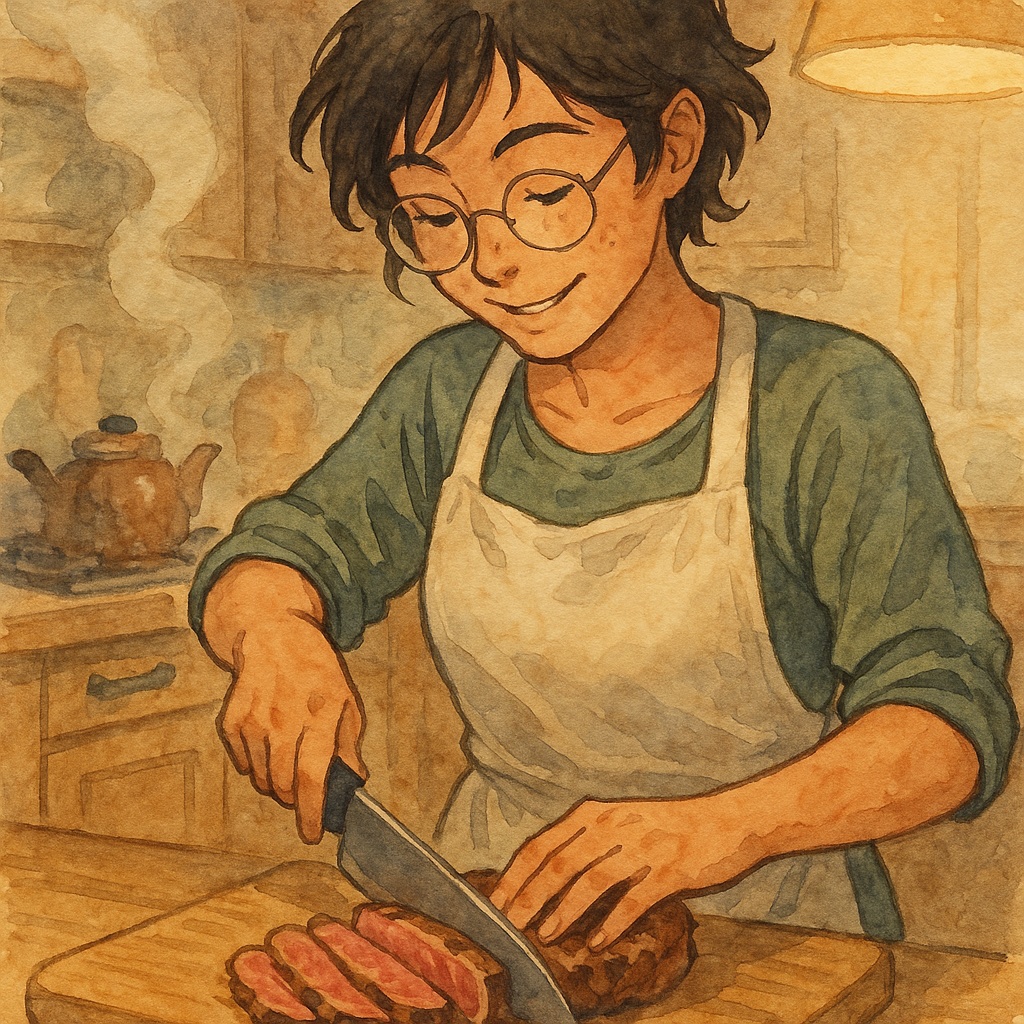
"Mine has the technique."
"Mara."
"Yes."
"We both won."
"We both won."
She did not even argue. She just took the small flake-salt bowl off the windowsill and dusted both fans of slices with a tiny shower of finishing flakes — Maldon-style, big flat-pyramid crystals — and ground fresh black pepper across them last, because peppercorns burn at sear heat but they sing on a finished steak.
"Salt builds. Pepper finishes."
"Salt builds. Pepper finishes."
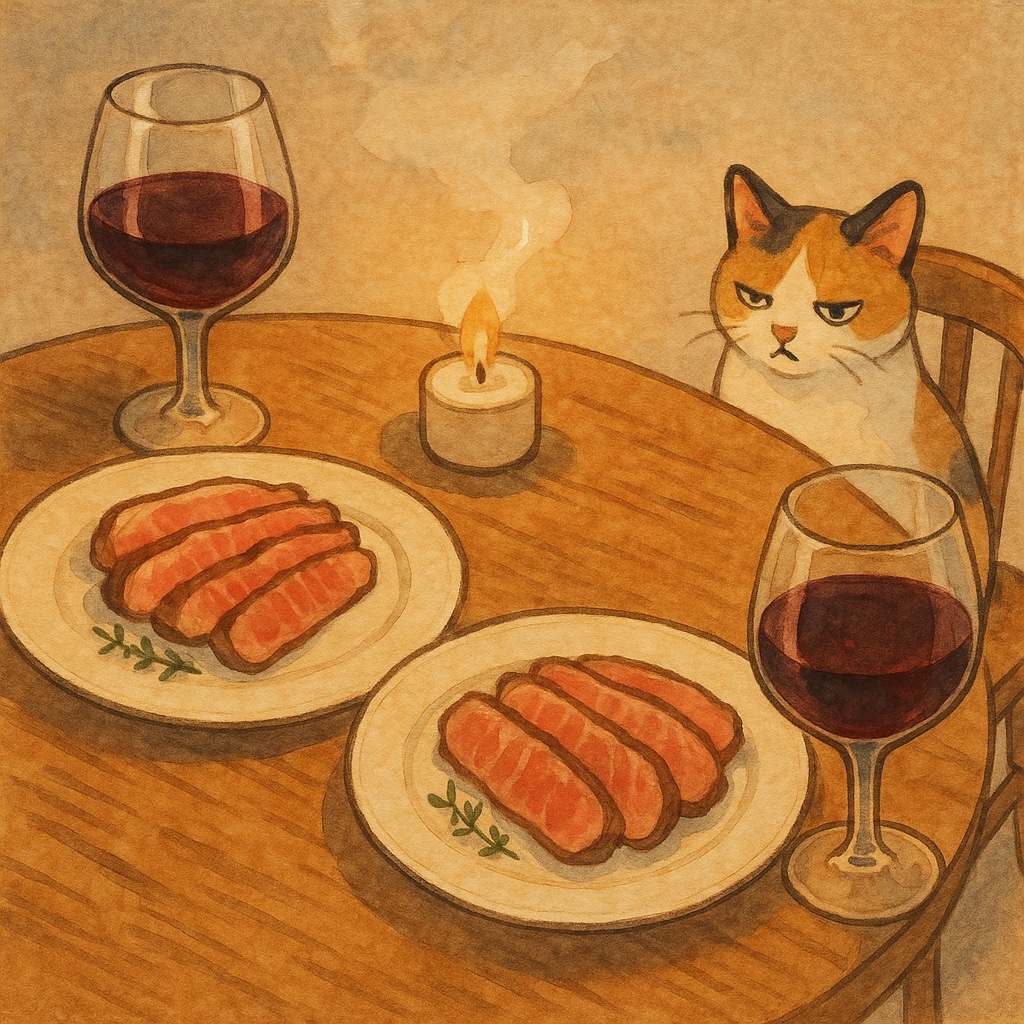
She lifted the slices — half of his, half of hers — and arranged them on his plate. Then half of hers and half of his on her plate. They were now eating each other's work; or they were eating their own work, depending on how you wanted to look at it. It was the same plate either way.
Two glasses of wine. Two plates. A small wooden table by the window. Brisket on the chair next to them with her tail neatly tucked and her eyes half-closed in disapproval that they would not be giving her any.
They sat down.
The first bite — both of them at the same time — was the kind of first bite that makes a kitchen quiet. The crust crackled. The interior gave way warm and soft. The salt sparked. The butter and thyme hummed underneath everything.
For a long minute neither of them said anything at all.
Then Theo, very gently:
"Loser does the dishes."
"Loser does the dishes."
They didn't look up. They were both chewing.
"There's no loser."
"There's no loser."
"So neither of us does the dishes."
"So both of us do the dishes."
"Deal."
The window had gone deep amber and then deep blue and then dark. The lamp over the table came on with a small soft tick. The wine glasses caught the light. Outside, the city did whatever the city does on a Sunday evening — which is the same thing it always does, but it had nothing to do with them.
The Maillard reaction had done its quiet impossible chemistry on the surface of two steaks. The salt had built. The pepper had finished. The pan had been patient. The rest had been honored. The knife had been sharp. The slicing had gone across the grain. The cross-sections had been rosy and the crusts had been deep mahogany and the only thing left to do was the only thing left to do.
They ate.
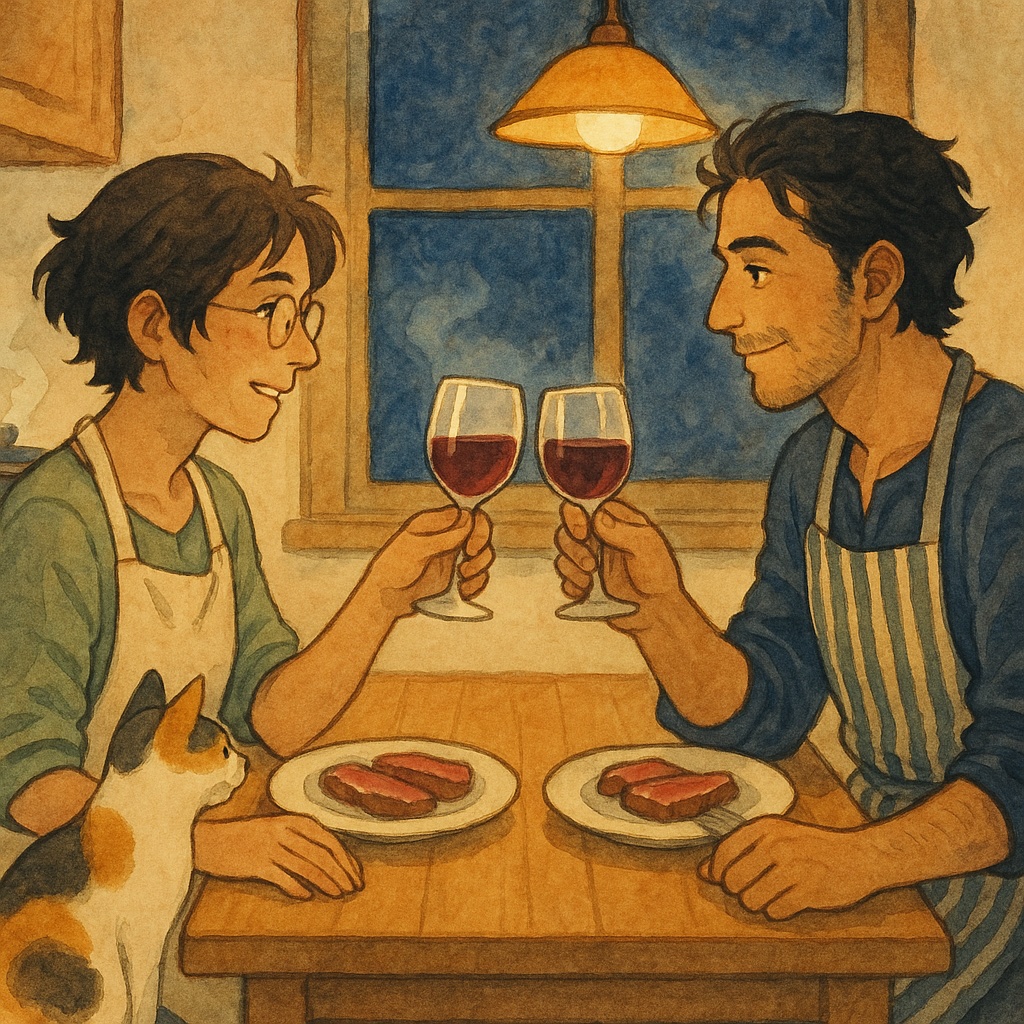
They ate together.
That was the whole tutorial. That was the whole point.
Cook with someone you like. Lay everything out. Let the pan get hot. Don't poke it. Let it rest. Eat together.